All species › Gannets and cormorants › Boobies and gannets › Blue-footed Booby
Position in the tree Birds Aves › Birds with a flexible palate Neognathae › All other modern birds Neoaves › Birds of the elements Elementaves › Tropicbirds and waterbirds Phaethoquornithes › Core waterbirds Aequornithes
Blue-footed Booby | Sula nebouxii
Blauwvoetgent | Bobo patas azules
The Blue-footed Booby is a booby of the eastern Pacific with bright blue feet, which the male displays emphatically during courtship. In the guide area it breeds mainly on islands in the Gulf of California and off the Pacific coast of Mexico, and often fishes close inshore, in groups that plunge into the water together. Further south it is a scarce visitor that reaches Panama in larger numbers in some years.

Voice
Silent at sea. At the colony the male gives a high, whistled schew, often during courtship, the female a low, hoarse honking honk or kwaak.
Recording: Barry Edmonston — CC BY-NC-SA 4.0 · converted to mono · xeno-canto
Identification
76–84 cm. Head and neck are pale brown, finely streaked white; the upperparts and upperwing are dark brown with pale feather edges. There is a white patch on the hindneck, upper back and rump; the underparts are white. The tail is dark with a paler centre. The feet are bright blue, the bill and bare facial skin blue-grey and the eye yellow. The female is larger than the male and has a dark ring around the pupil, making her pupil look larger. Juveniles have a darker brown head and neck, a browner breast and dull grey feet.
Confusion species
Peruvian Booby Sula variegata, a rare vagrant, has a pure white head and neck, a more strongly white-scaled back and blue-grey to dark feet. Cocos Booby Sula brewsteri has a uniformly brown breast sharply contrasting with the white belly, and yellow feet. Juvenile Masked Boobies Sula dactylatra and Nazca Boobies Sula granti have a brown head with a white collar and no blue feet.
Habitat
Warm coastal waters, bays and sea over the continental shelf, usually within a few tens of kilometres of the coast. It dives in groups, often from a great height, for sardines, anchovies and mackerel. It rests on rocks and cliffs. It breeds in colonies on bare ground on level parts of islands, without a real nest. During courtship the male alternately lifts his blue feet, spreads his wings and points his bill skywards.
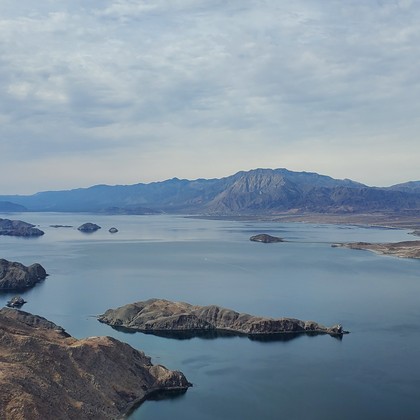
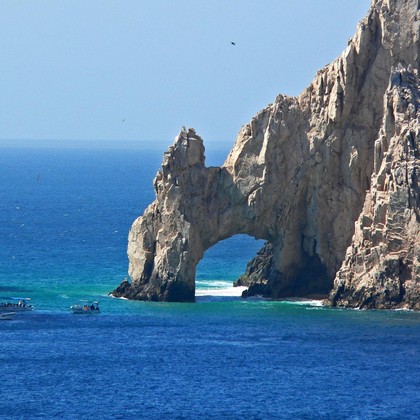
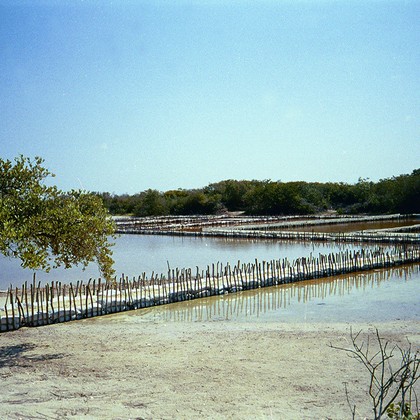
Where the bird is most at home, classified by the vegetation units of Mexico and Central America.

Range and movements
Breeds on islands in the Gulf of California, such as San Pedro Mártir, and on islands off the Pacific coast of Mexico, such as Isla Isabel and the Islas Marietas off Nayarit. Year-round along the coast from Baja California and Sonora to Jalisco; further south to Panama a scarce visitor, sometimes in larger numbers in El Niño years. Birds in the guide area belong to the nominate form S. n. nebouxii. Outside the guide area along the coasts of Colombia, Ecuador and northern Peru, and on the Galápagos Islands as the subspecies S. n. excisa.
- Resident
- dark = core range, pale = thinly spread
How and when to look
Boat trips to the Islas Marietas from Bahía de Banderas and to Isla Isabel offer good chances of seeing breeding birds at close range. In the Gulf of California hunting groups are often visible from the shore and from ferries. On the Pacific coast of Costa Rica and Panama it is mainly to be expected at headlands and from ferries.
Conservation status
Not threatened. The species depends heavily on sardines and anchovies; when food is scarce, as in El Niño years, breeding success is low. On the breeding islands disturbance by visitors and introduced predators are a threat.
Scientific name
Sula nebouxii | Milne-Edwards, 1882
Milne-Edwards described the species in 1882 and placed it straight away in the genus where it still stands. The genus Sula was introduced in 1760 by Brisson. Sula goes back to súla, the Old Norse and Icelandic word for the gannet; the name passed to the boobies. nebouxii honours the French naval surgeon and naturalist Adolphe-Simon Neboux (1806–1844). The specimen the first description was based on came from Pacific coast of America (assumed Chile).