All species › Gannets and cormorants › Boobies and gannets › Peruvian Booby
Position in the tree Birds Aves › Birds with a flexible palate Neognathae › All other modern birds Neoaves › Birds of the elements Elementaves › Tropicbirds and waterbirds Phaethoquornithes › Core waterbirds Aequornithes
Peruvian Booby | Sula variegata
Humboldtgent | Bobo peruano
The Peruvian Booby lives in the cold Humboldt Current off Peru and Chile and is a vagrant in the guide area, not a native species. When the sea there warms during El Niño and the anchovies move away, the birds disperse northwards. In such years they are seen on the Pacific coast of Panama and Costa Rica, sometimes in small groups.
Voice
Silent at sea. At the colony the male whistles and the female gives honking and quacking calls.
Recording: Cristian Pinto Fernandez — CC BY-NC-SA 4.0 · converted to mono · xeno-canto
Identification
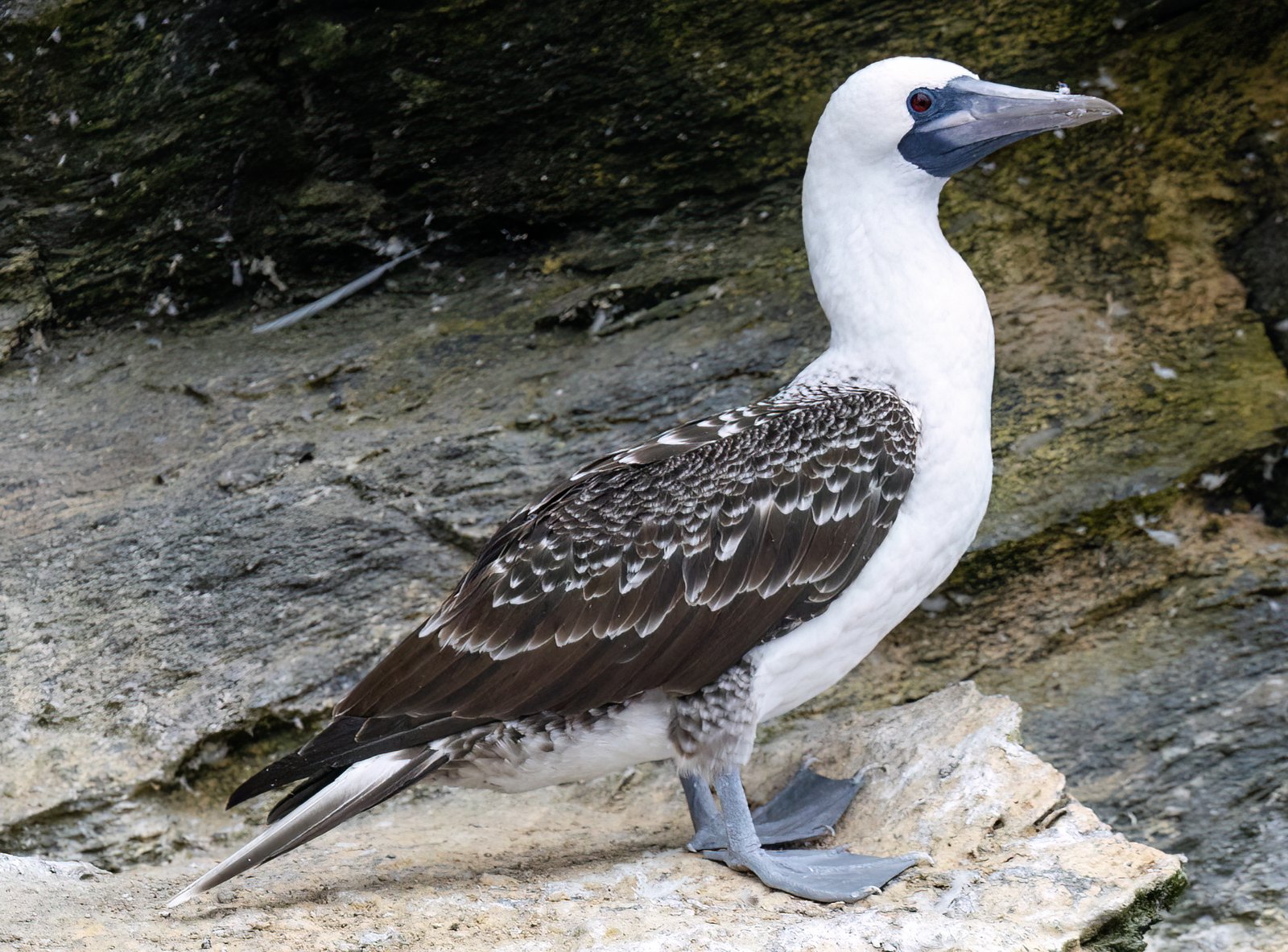
74–76 cm, a medium-sized booby. Head, neck and underparts are white; the upperparts and upperwing are dark brown with white feather edges, making the back and wing coverts look scaled or spotted white. The rump is white, the tail dark brown. The thighs and flanks are streaked dark. The bill is blue-grey, the bare facial skin dark, the legs blue-grey to dark grey. Females are larger than males. Juveniles have a browner, mottled head and neck and are less pure white below.
Confusion species
Blue-footed Booby Sula nebouxii is very similar but has bright blue feet, a pale brown, finely streaked head and neck rather than a white one, and a less white-scaled back; hybrids between the two species occur in northern Peru. Juvenile Masked Boobies Sula dactylatra and Nazca Boobies Sula granti have a brown head and neck with a white collar. Cocos Booby Sula brewsteri has a uniformly brown breast sharply contrasting with the white belly.
Habitat
Cold, productive coastal waters, where the birds dive in groups close inshore for anchovies and other schooling fish. They rest on rocks, cliffs, piers and boats. In the guide area mostly seen at headlands, harbours and in bays along the Pacific coast, sometimes together with Blue-footed and Cocos Boobies.
Where the bird is most at home, classified by the vegetation units of Mexico and Central America.


Range and movements
A small number of records in the guide area, almost all on the Pacific coast of Panama and Costa Rica, such as in the Gulf of Panama, in Chiriquí, in the Gulf of Nicoya and near the Osa Peninsula. Most records fall in El Niño years, when several birds are sometimes present at once. Outside the guide area the species breeds on islands and cliffs along the coast of Peru and Chile and wanders to Ecuador and Colombia.
How and when to look
During an El Niño it pays to check seabirds off the Pacific coast of Panama and Costa Rica, for example from the Amador Causeway in Panama City or from the ferry out of Puntarenas. The white head and dark feet are the best features against Blue-footed Booby.
Conservation status
Not threatened globally. The population is large but fluctuates strongly with the supply of anchovies and drops sharply in El Niño years. In the guide area a vagrant with no regular presence.
Scientific name
Sula variegata | (Tschudi, 1843)
Tschudi described the species in 1843 as Dysporus variegatus; because it was later moved to another genus, the author and year stand in brackets. The genus Sula was introduced in 1760 by Brisson. Sula goes back to súla, the Old Norse and Icelandic word for the gannet; the name passed to the boobies. variegata is Latin for 'variegated', after the mottled upperparts. The specimen the first description was based on came from islands off the coast of Peru.