All species › Parrots › African and New World parrots › Brown-throated Parakeet
Position in the tree Birds Aves › Birds with a flexible palate Neognathae › All other modern birds Neoaves › Landbirds Telluraves › Falcons, parrots and passerines Australaves › Falcons and passerines Eufalconimorphae › Parrots and passerines Psittacopasserae
Brown-throated Parakeet | Eupsittula pertinax
Maïsparkiet | Perico carisucio
The Brown-throated Parakeet is a small, long-tailed parakeet with a brown throat and breast. It lives mainly in northern South America and on the Leeward Antilles; in the guide area only in the dry lowlands on the Pacific side of Panama and in the extreme southwest of Costa Rica.

Voice
Shrill, grating calls, a rapidly repeated kree-kree-kree in flight and a soft twittering from perched groups.
Recording: JAYRSON ARAUJO DE OLIVEIRA — CC BY-NC-SA 4.0 · converted to mono · xeno-canto
Identification
25 cm, with a long, pointed tail. Upperparts green; face, throat and breast greyish-brown to olive-brown, belly yellowish-green. Birds in Panama (E. p. ocularis) have a small yellow-orange patch below and behind the eye and a narrow bare eye-ring. The primaries are blue, the bill is dark greyish. Male and female are alike.
Confusion species
The Orange-chinned Parakeet Brotogeris jugularis is smaller, with a short tail, a green throat with an orange chin spot and brown shoulders. Finsch's Parakeet Psittacara finschi is larger and all green, with a red forehead. The Orange-fronted Parakeet Eupsittula canicularis has an orange forehead and a blue crown and does not occur in Panama. The Subandean Parakeet Pyrrhura subandina of the Azuero Peninsula has a scaled breast and a reddish-brown tail.
Habitat
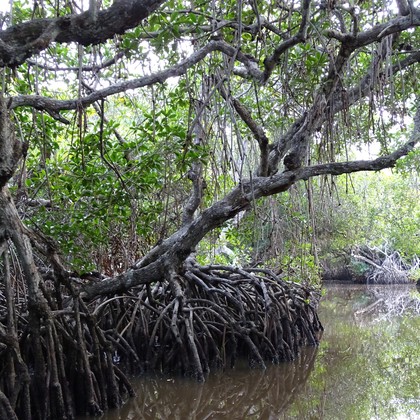
Dry, open country with scattered trees, savanna, pasture, scrub, forest edges and secondary forest, mangroves, gardens and villages; mainly in the lowlands. It eats seeds, fruit, flowers and nectar, also maize and other crops. It nests in a cavity it digs itself in a termite nest in a tree.
Where the bird is most at home, classified by the vegetation units of Mexico and Central America.





Range and movements
In the guide area in Panama on the Pacific side, from Chiriquí and Veraguas east through the Azuero Peninsula and Coclé to Panamá Oeste; from Chiriquí also in the extreme southwest of Costa Rica. Outside the guide area in northern South America, from Colombia to the Guianas and northern Brazil, and on Aruba, Curaçao and Bonaire.
- Resident
- dark = core range, pale = thinly spread
How and when to look
On the plains around David in Chiriquí and on the Azuero Peninsula small groups fly calling loudly between trees along roads and pastures. The brown throat is easy to see on perched birds; in flight the blue primaries show.
Conservation status
Not threatened. Widespread and common in many places, also in man-made landscapes; it benefits from the open country created by deforestation. It is trapped for the cage-bird trade.
Scientific name
Eupsittula pertinax | (Linnaeus, 1758) (GBIF: Aratinga pertinax)
Linnaeus described the species in 1758 as Psittacus pertinax; because it was later moved to another genus, the author and year stand in brackets. The genus Eupsittula was introduced in 1853 by Bonaparte. Eupsittula combines Greek eu 'good, true' with Modern Latin psittacula 'little parrot': 'true parakeet'. pertinax is Latin for 'tenacious, persistent'. The specimen the first description was based on came from Curaçao.