All species › Passerines › Wrens › Cactus Wren
Position in the tree Birds Aves › Birds with a flexible palate Neognathae › All other modern birds Neoaves › Landbirds Telluraves › Falcons, parrots and passerines Australaves › Falcons and passerines Eufalconimorphae › Parrots and passerines Psittacopasserae
Cactus Wren | Campylorhynchus brunneicapillus
Cactuswinterkoning | Matraca del desierto
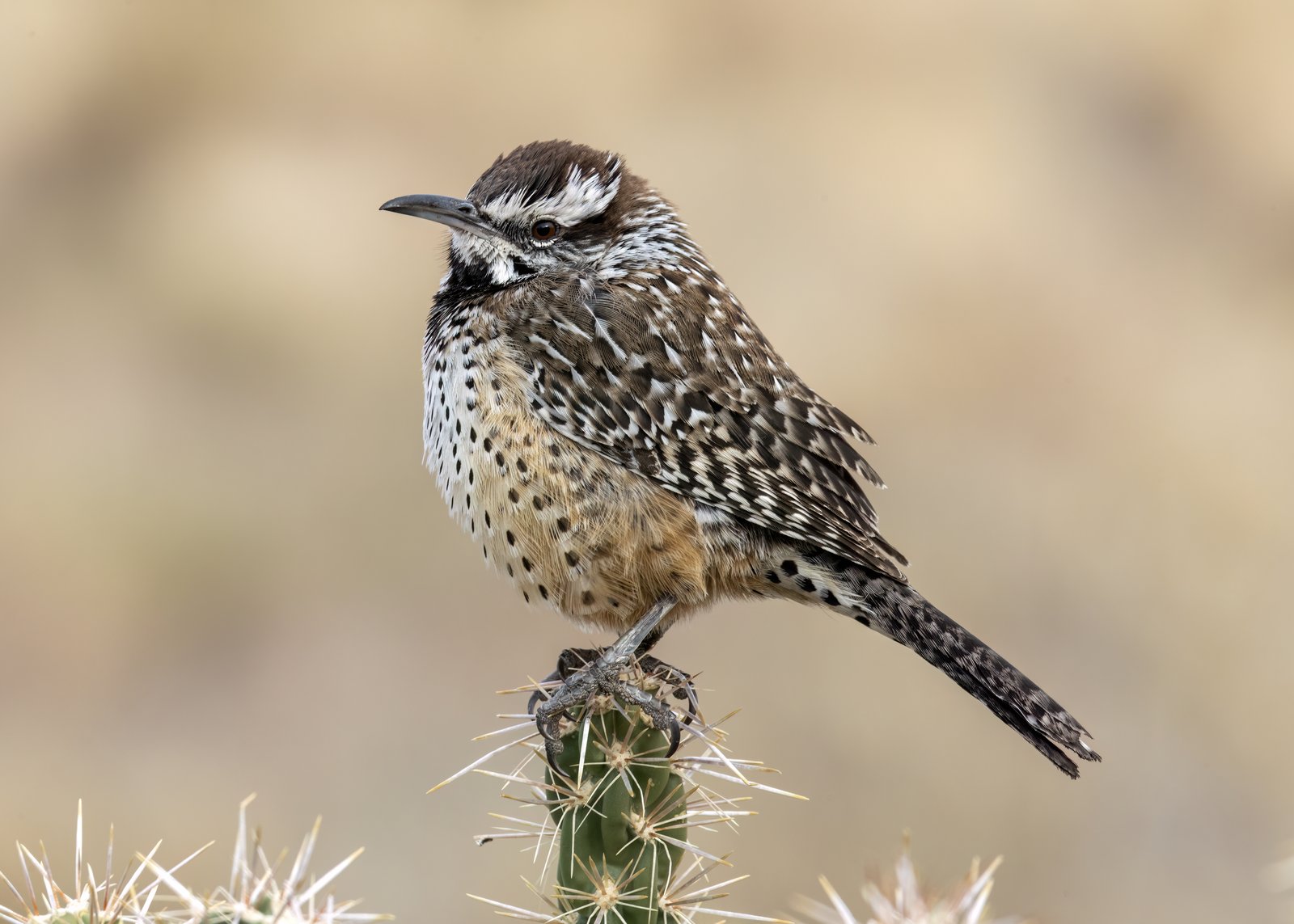
The Cactus Wren is the largest wren in North America and a characteristic bird of the deserts and dry plateaus of northern and central Mexico. It sings from the tops of cacti and shrubs and builds conspicuous ball-shaped nests among the spines of chollas and other cacti.
Voice
A low, harsh, accelerating char-char-char-char, recalling an engine that will not start. Also grating and clucking calls.
Recording: Pat Goltz — CC BY-NC-SA 4.0 · converted to mono · xeno-canto
Identification
18–19 cm. Crown dark rufous-brown, with a broad white supercilium. Back brown with white streaks. Throat and breast white to pale buff with dense black spots, forming a dark patch on the upper breast; belly and flanks warm buff with smaller spots. Wings and tail barred black and white; the outer tail feathers have white bars visible when the tail is spread. Bill fairly long and slightly curved. The sexes are alike; young birds have fewer and fainter spots below.
Confusion species
The curve-billed thrashers (Toxostoma) are larger and lack the white supercilium and black-and-white back streaks. Spotted Wren Campylorhynchus gularis and Boucard's Wren Campylorhynchus jocosus live in woodland and scrub further south and have fewer spots on the breast. Rock Wren Salpinctes obsoletus is smaller and greyer, without bold spots.
Habitat
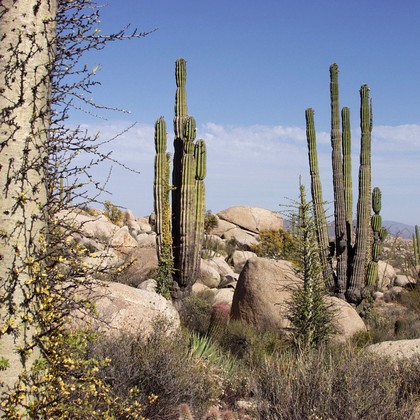
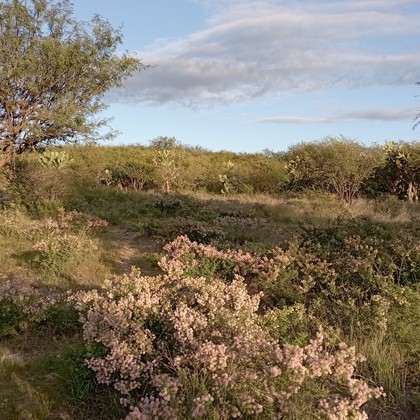
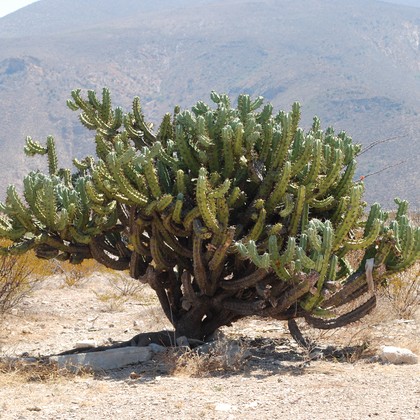
Desert and semi-desert with cacti, yuccas and thorny shrubs, dry scrub, chaparral at the desert edge and dry grassland with cacti; also villages, gardens and parks with cacti. From sea level to about 2000 m. It eats mainly insects and spiders, also seeds and cactus fruit. Its nests are also used for roosting.
Where the bird is most at home, classified by the vegetation units of Mexico and Central America.



Range and movements
Baja California, Sonora and northern and central Mexico, across the Chihuahuan Desert and the central plateau south to about Jalisco, Guanajuato, Querétaro and Hidalgo, and in the north-east into Tamaulipas. Outside the guide area in the south-western United States.
- Resident
- dark = core range, pale = thinly spread
How and when to look
In the Sonoran Desert and in Baja California regularly seen around settlements, often singing from the top of a cactus or post. The ball-shaped nests in chollas reveal its presence even when the bird itself stays hidden.
Conservation status
Not threatened. Common in most of its range. It has declined in coastal southern California because of development and fires.
Scientific name
Campylorhynchus brunneicapillus | (de Lafresnaye, 1835)
De Lafresnaye described the species in 1835 as Picolaptes brunneicapillus; because it was later moved to another genus, the author and year stand in brackets. The genus Campylorhynchus was introduced in 1824 by Spix. Campylorhynchus is Greek, from kampulos 'curved' and rhunkhos 'bill', after the slightly decurved bill. brunneicapillus is Latin, from brunneus 'brown' and capillus 'hair of the head', after the brown crown. The specimen the first description was based on came from coast of southern Sonora, Mexico.