All species › Waders, gulls and terns › Auks, puffins and murres › Cassin's Auklet
Position in the tree Birds Aves › Birds with a flexible palate Neognathae › All other modern birds Neoaves › Birds of the elements Elementaves › Cranes and waders Gruimorphae
Cassin's Auklet | Ptychoramphus aleuticus
Cassins alk | Alcuela oscura
Cassin's Auklet is a small, plain grey auk of the cold waters off the west coast of North America. In the guide area it breeds on the islands off the Pacific coast of Baja California, where it spends the day at sea and visits its burrow only at night. In flight it looks like a small grey ball on fast-whirring wings.
Voice
Silent at sea. At the colony at night a hoarse, grating series of krr-eek calls from the burrows, audible across the whole island.
Recording: Matthew L. Brady — CC BY-NC-SA 4.0 · shortened to the first 60 s, mono · xeno-canto
Identification
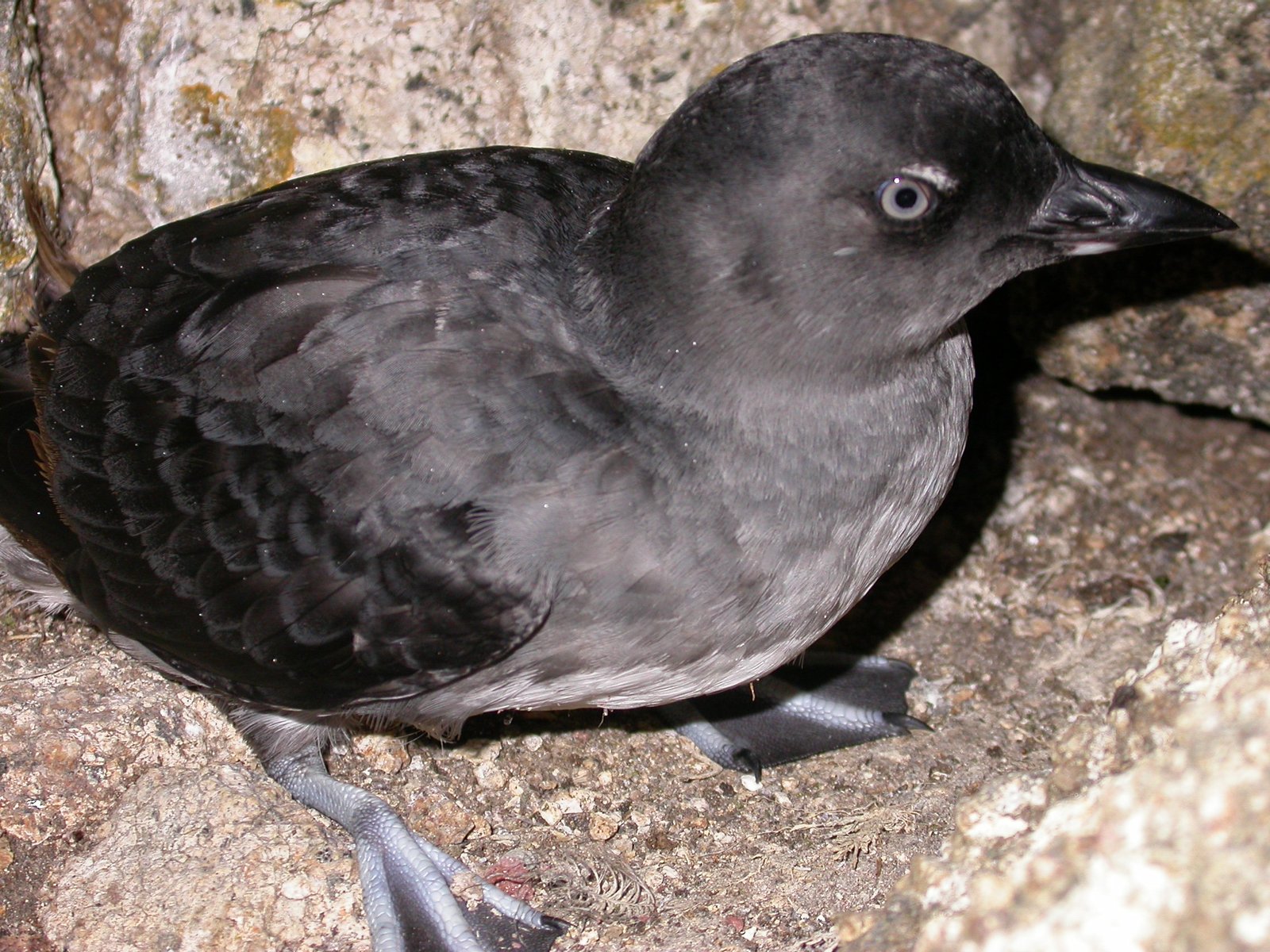
20–23 cm, small and round, with a domed head, a very short neck, short, blunt wings and a short tail. Dark grey-brown above, slightly paler grey on the throat, breast and flanks, with a white belly and undertail coverts. Adults have a pale yellow to white eye with a small white crescent above it; the short, conical bill is dark with a pale spot at the base of the lower mandible. A narrow pale stripe on the underwing. The plumage hardly changes through the year. Juveniles have a dark eye and a paler throat.
Confusion species
Rhinoceros Auklet Cerorhinca monocerata is much larger, with a heavy, orange-yellow bill. Craveri's Murrelet Synthliboramphus craveri, Guadalupe Murrelet Synthliboramphus hypoleucus and Scripps's Murrelet Synthliboramphus scrippsi are sharply patterned in black and white, with a thin, pointed bill and a dark eye. At a distance flight helps: Cassin's Auklet flies low, straight and whirring, and often dives rather than takes off.
Habitat
Breeds on islands free of introduced predators, in self-dug burrows or in crevices between rocks. It forages at sea over the edge of the continental shelf and in cool upwelling zones, diving for krill and other small crustaceans.
Where the bird is most at home, classified by the vegetation units of Mexico and Central America.



Range and movements
In the guide area it breeds on islands off the Pacific coast of Baja California, including the Coronado Islands, Todos Santos, San Martín, San Jerónimo, the San Benito Islands and Isla Guadalupe, and is present at sea there year-round; in winter also further south off the coast of Baja California Sur. Outside the guide area the species breeds along the west coast of North America, from the Aleutians and southern Alaska through British Columbia to California.
- Resident
- dark = core range, pale = thinly spread
How and when to look
Pelagic trips to the Coronado Islands or Todos Santos give the best chance: small grey birds that take off just ahead of the boat and whirr away low over the water.
Conservation status
Near Threatened. The species has declined in many places. Periods of warm sea water, when krill becomes scarce, cause mass mortality; introduced rats and cats on breeding islands, oil and drowning in nets are further threats. Introduced predators have been removed from several Mexican islands.
Scientific name
Ptychoramphus aleuticus | (Pallas, 1811)
Pallas described the species in 1811 as Uria Aleutica; because it was later moved to another genus, the author and year stand in brackets. The genus Ptychoramphus was introduced in 1837 by Brandt. Ptychoramphus is Greek, from ptux, ptukhos 'fold' and rhamphos 'bill', after the folded, ridged bill. aleuticus refers to the Aleutian Islands, the island arc between Alaska and Kamchatka. The specimen the first description was based on came from the North Pacific (not further specified).