All species › Waders, gulls and terns › Auks, puffins and murres › Craveri's Murrelet
Position in the tree Birds Aves › Birds with a flexible palate Neognathae › All other modern birds Neoaves › Birds of the elements Elementaves › Cranes and waders Gruimorphae
Craveri's Murrelet | Synthliboramphus craveri
Craveri's alk | Mérgulo de Craveri
Craveri's Murrelet is a small black-and-white auk that breeds almost exclusively in Mexican waters, largely on islands in the Gulf of California. Pairs swim and fly close together and are seen almost only from boats. On the breeding islands the birds come ashore only in darkness.
Voice
Mostly silent at sea. At the colony at night a dry, cricket-like rattle and high trills; partners keep in contact on the water with a short, high tsip.
Recording: Paul Marvin — CC BY-NC-SA 4.0 · converted to mono · xeno-canto
Identification
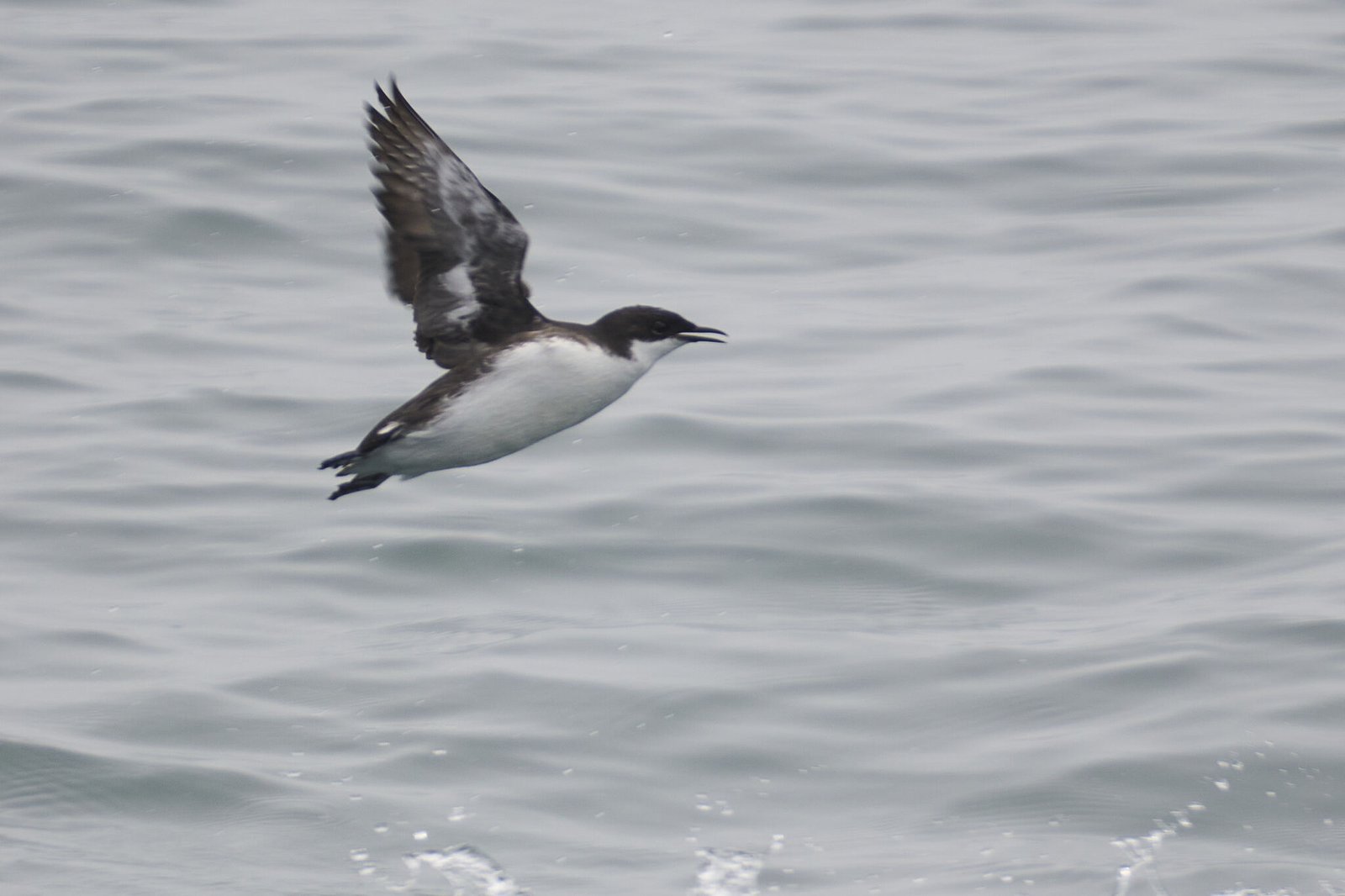
23–25 cm, small and slim, with a thin, pointed black bill that is slightly longer than in related species. Black to blackish-brown above, bright white below. The black of the head extends below the eye and onto the chin, so that the eye lies within the dark cap; a thin white crescent above and below the eye. On the breast sides a dark half-collar extends into the white, and the flanks are dark. The underwing is dusky to dirty grey, with at most a paler central band. Male and female are alike and there is little seasonal change.
Confusion species
Scripps's Murrelet Synthliboramphus scrippsi has a bright white underwing, a slightly shorter bill and black that extends less far below the eye. Guadalupe Murrelet Synthliboramphus hypoleucus also has a white underwing and in addition white in front of and above the eye. Cassin's Auklet Ptychoramphus aleuticus is plain grey, with a pale eye and a short, thick bill. The most reliable feature is the colour of the underwing, visible only as the bird takes off.
Habitat
Breeds on arid rocky islands, in crevices, under boulders and under low shrubs. Outside the breeding season at sea, over deep water and along fronts, often far offshore. It dives for small fish and the larvae of fish and crustaceans.
Where the bird is most at home, classified by the vegetation units of Mexico and Central America.



Range and movements
Breeds on islands in the Gulf of California, including Isla Rasa, Partida, San Pedro Mártir and islands near Tiburón, and in smaller numbers on islands off the Pacific coast of Baja California, such as the San Benito Islands. After breeding birds disperse over the Gulf of California and along the Pacific coast of Mexico, south to off Sinaloa, Nayarit and Jalisco. Outside the guide area only as a vagrant or post-breeding visitor in the waters off California, in larger numbers in warm years.
- Resident
- Summer visitor (c. Apr–Sep)
- Winter visitor (c. Oct–Mar)
- Passage (Mar–Apr, Oct–Nov)
- dark = core range, pale = thinly spread
How and when to look
Boat trips in the Gulf of California, for example between Bahía de los Ángeles and the Midriff Islands, give the best chance in spring; a pair of black-and-white murrelets flying off low will briefly show the dusky underwing.
Conservation status
Vulnerable. The population is small, confined to a handful of islands and declining. Introduced rats and cats on breeding islands are the main threat; oil, drowning in nets and disturbance by artificial light from boats also play a role. Introduced predators have been removed from several islands.
Scientific name
Synthliboramphus craveri | (Salvadori, 1866)
Salvadori described the species in 1866 as Uria Craveri; because it was later moved to another genus, the author and year stand in brackets. The genus Synthliboramphus was introduced in 1837 by Brandt. Synthliboramphus is Greek, from sunthlibō 'to compress' and rhamphos 'bill', after the short, laterally compressed bill. craveri honours the Italian brothers Federico (1815–1890) and Ettore Craveri (1816–1884), naturalists and collectors in Mexico and California. The specimen the first description was based on came from Isla Raza, Gulf of California, Mexico.