All species › Waders, gulls and terns › Auks, puffins and murres › Guadalupe Murrelet
Position in the tree Birds Aves › Birds with a flexible palate Neognathae › All other modern birds Neoaves › Birds of the elements Elementaves › Cranes and waders Gruimorphae
Guadalupe Murrelet | Synthliboramphus hypoleucus
Xantus' alk | Mérgulo de Guadalupe
The Guadalupe Murrelet is a small black-and-white auk that breeds only on Isla Guadalupe and the San Benito Islands off Baja California. It lives farther offshore than the other auks of the region and is seen almost only from boats, usually in pairs. Until 2012 it was treated together with Scripps's Murrelet as a single species.

Voice
Mostly silent at sea, apart from a short, high contact call between partners. At the colony at night high whistles and rapid squeaky series.
No recording with a suitable Creative Commons licence is available for this species yet.
Identification
23–25 cm, small, with a small head, a thin, pointed black bill and bluish-grey legs. Black above, with a bluish-grey sheen in fresh plumage, and bright white from chin to undertail. The white of the face extends in front of and above the eye, so that the dark eye stands in a white field rather than in the black cap. The underwing is bright white. Male and female are alike and there is little seasonal change.
Confusion species
Scripps's Murrelet Synthliboramphus scrippsi is very similar, but the black cap reaches down to eye level, so that the eye lies within the black, with only a thin white crescent above and below it. Craveri's Murrelet Synthliboramphus craveri has a dusky underwing, a dark half-collar on the breast sides and black that extends below the eye. At sea the distinction can often only be made on good photographs.
Habitat
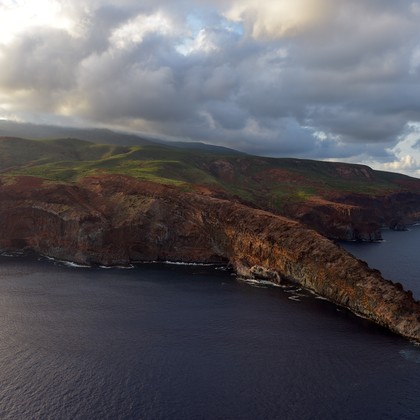
Breeds on steep, rocky islands, in crevices, cavities under boulders and under dense shrubs. Outside the breeding season on the open ocean, often beyond the edge of the continental shelf and far offshore. It dives for small schooling fish and fish larvae.
Where the bird is most at home, classified by the vegetation units of Mexico and Central America.


Range and movements
In the guide area it breeds only on Isla Guadalupe, more than two hundred kilometres off the coast of Baja California, and on the San Benito Islands; possibly also in small numbers on a few other islands off Baja California. Outside the breeding season birds disperse over the open ocean off Baja California and north to off California, outside the guide area.
- Summer visitor (c. Apr–Sep)
- Winter visitor (c. Oct–Mar)
- Passage (Mar–Apr, Oct–Nov)
- dark = core range, pale = thinly spread
How and when to look
Multi-day pelagic trips to Isla Guadalupe or the San Benito Islands in spring give the best chance; photographs of the head make it easier to separate from Scripps's Murrelet afterwards.
Conservation status
Endangered. The world population numbers a few thousand birds and is almost confined to two island groups. Introduced cats and rats destroyed colonies on Guadalupe; oil from shipping and disturbance by artificial light are other threats. Introduced predators have been removed from the San Benito Islands and restoration work is under way on Guadalupe.
Scientific name
Synthliboramphus hypoleucus | (Xántus, 1860)
Xántus described the species in 1860 as Brachyrhamphus hypoleucus; because it was later moved to another genus, the author and year stand in brackets. The genus Synthliboramphus was introduced in 1837 by Brandt. Synthliboramphus is Greek, from sunthlibō 'to compress' and rhamphos 'bill', after the short, laterally compressed bill. hypoleucus is Greek, from hupo 'beneath' and leukos 'white', after the white underparts. The specimen the first description was based on came from Cabo San Lucas, Baja California Sur, Mexico.