All species › Swifts › Hummingbirds › Charming Hummingbird
Position in the tree Birds Aves › Birds with a flexible palate Neognathae › All other modern birds Neoaves › Birds of the elements Elementaves › Nightjars and swifts Strisores
Charming Hummingbird | Polyerata decora
Pacifische blauwborstamazilia | Amazilia encantadora
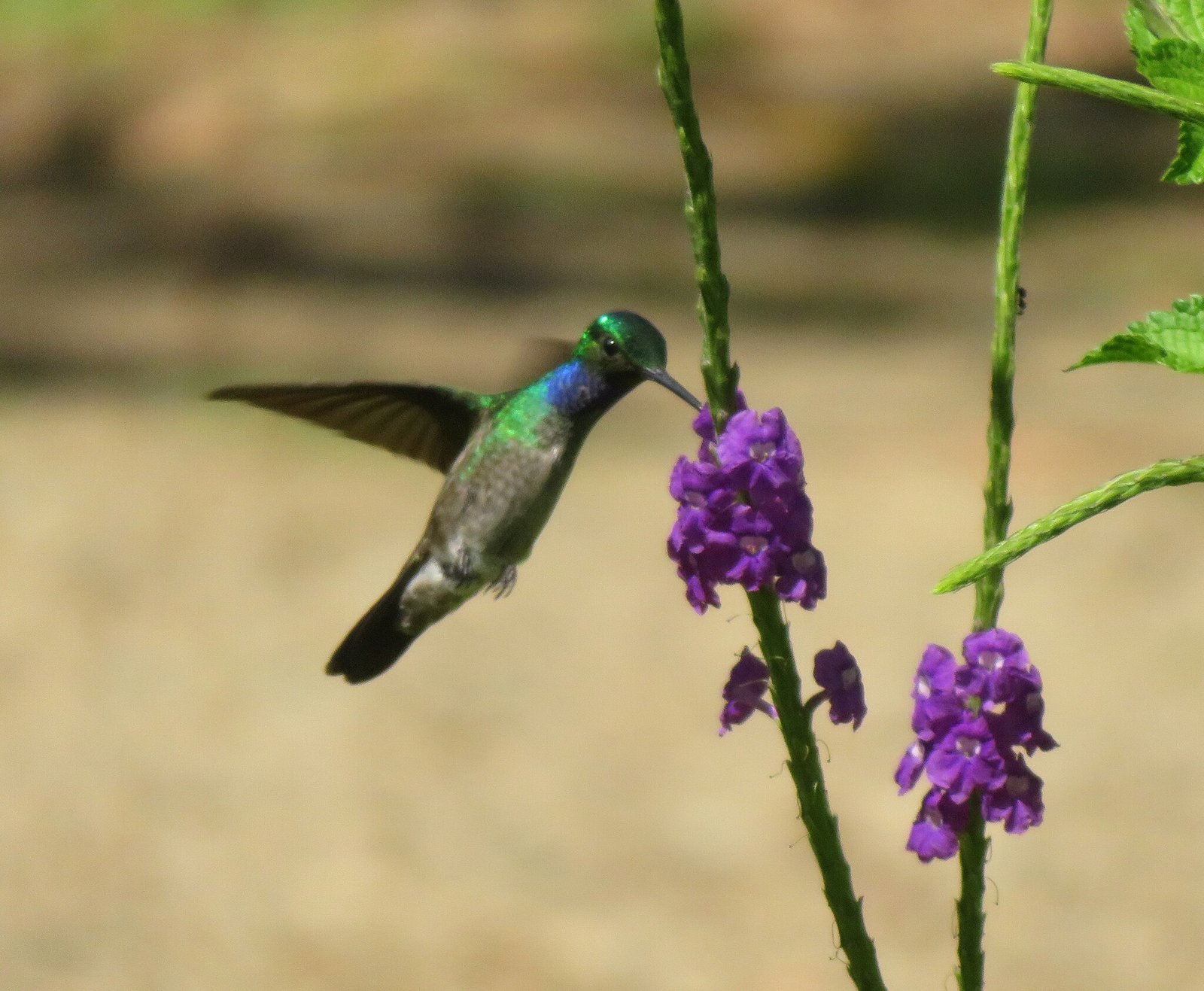
The Charming Hummingbird is the Pacific counterpart of the Blue-chested Hummingbird and occurs only in south-western Costa Rica and western Panama. For a long time it was treated as a subspecies of the Blue-chested Hummingbird. The male has a glittering blue-violet breast and throat.
Voice
A dry chip and a song of high, squeaky notes, often sustained for long periods from a fixed perch.
Recording: Steve Hampton — CC BY-NC-SA 4.0 · converted to mono · xeno-canto
Identification
9–10 cm, with a straight bill that is black above and has a pink to red lower mandible with a dark tip. The male is green above, with a green to blue-glossed crown, a glittering blue-violet throat and breast, a grey belly and a dark bronze-green tail. The female is pale grey below with green spots on the throat and breast and a blue wash on the breast; the tail has grey tips.
Confusion species
Blue-chested Hummingbird Polyerata amabilis lives on the Caribbean side and in central and eastern Panama; the male has a smaller, more violet breast patch and a green throat. Rufous-tailed Hummingbird Amazilia tzacatl is larger, with a red bill and a rufous tail. Blue-throated Sapphire Chlorestes eliciae has a red bill and a golden-coppery tail.
Habitat
Edges of humid lowland and foothill forest, secondary forest, plantations, shade coffee and gardens, from sea level to about 1200 m. It feeds at flowering shrubs and herbs along forest edges and in clearings.
Where the bird is most at home, classified by the vegetation units of Mexico and Central America.





Range and movements
Only in the guide area: the Pacific slope of Costa Rica from about the Carara area southwards, including the Osa Peninsula and the area around the Golfo Dulce, to western Panama in Chiriquí and western Veraguas.
- Resident
- dark = core range, pale = thinly spread
How and when to look
On the Osa Peninsula and around the Golfo Dulce in Costa Rica, and in Carara National Park, at flowering shrubs along forest edges and in lodge gardens.
Conservation status
Not threatened. Fairly common within its small range. The species tolerates secondary forest and plantations, but the lowland forest of the Pacific coast is heavily fragmented.
Scientific name
Polyerata decora | Salvin, 1891
Salvin described the species in 1891 and placed it straight away in the genus where it still stands. The genus Polyerata was introduced in 1863 by Heine. Polyerata is Greek, from polus 'much' and eratos 'lovely, beloved': 'very lovely'. decora is Latin, from decorus 'elegant, handsome'. The specimen the first description was based on came from Volcán de Chiriquí (Volcán Barú), Panama.