All species › Swifts › Hummingbirds › White-bellied Emerald
Position in the tree Birds Aves › Birds with a flexible palate Neognathae › All other modern birds Neoaves › Birds of the elements Elementaves › Nightjars and swifts Strisores
White-bellied Emerald | Chlorestes candida
Witbuikamazilia | Colibrí cándido
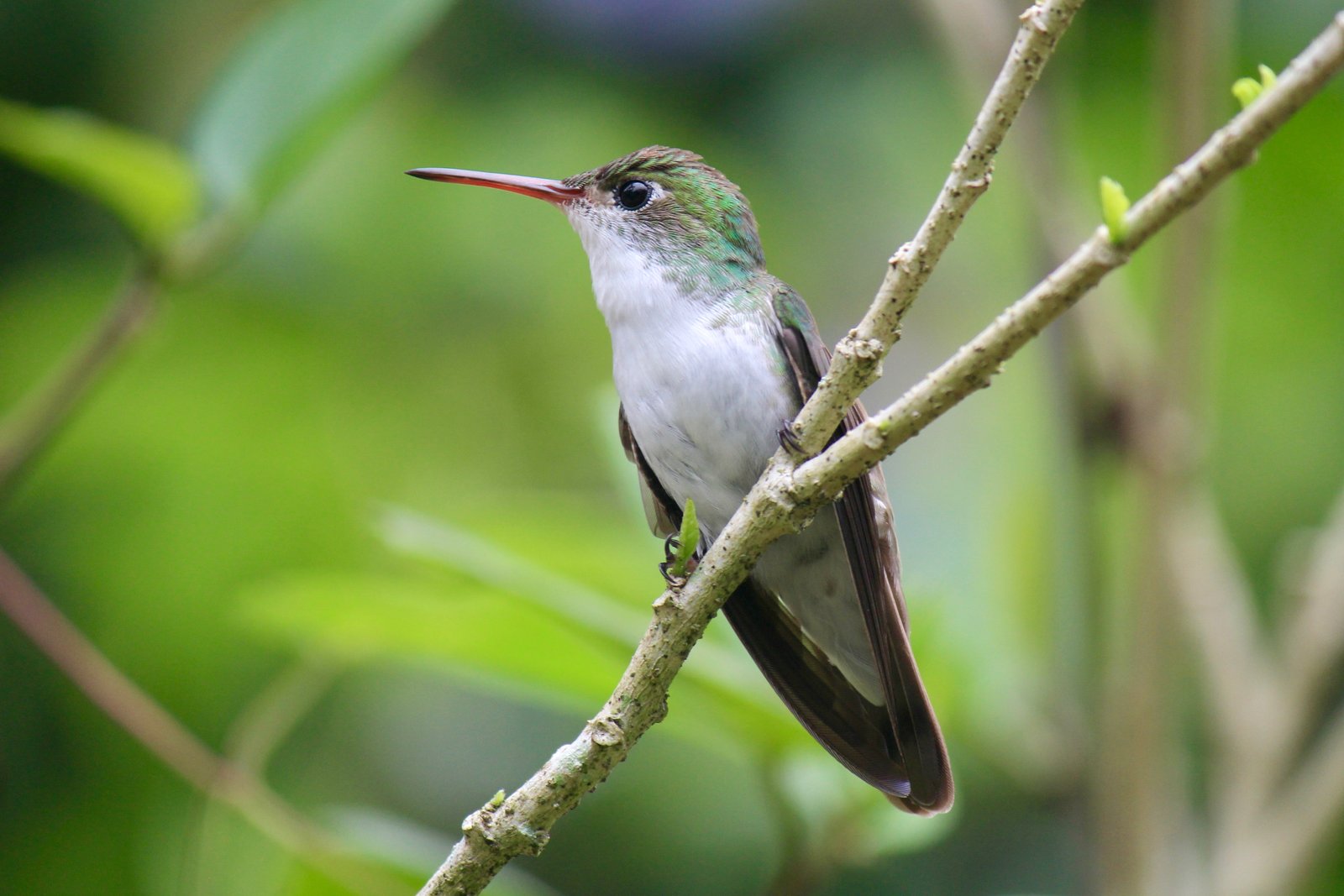
The White-bellied Emerald is a small hummingbird with green upperparts and clean white underparts. It occurs in the lowlands and foothills from south-eastern Mexico to Nicaragua, and in much of the Yucatán Peninsula and Belize is one of the commonest hummingbirds. Male and female are very similar.
Voice
A dry, sharp tsik or tchit; the song is a series of high, squeaky and scratchy notes.
Recording: GABRIEL LEITE — CC BY-NC-SA 4.0 · converted to mono · xeno-canto
Identification
8–9 cm, with a straight bill that is dark above and has a pink lower mandible with a dark tip. The upperparts, crown and flanks are green, with small green spots on the sides of the throat and breast. The rest of the underparts are white. The tail is grey-green to bronze-green, with a dark band and grey tips to the outer feathers. The female is slightly duller, with more grey in the tail.
Confusion species
Azure-crowned Hummingbird Saucerottia cyanocephala is larger, with a blue crown, a longer bill and a plain bronze-green tail. Female White-necked Jacobins Florisuga mellivora are much larger, with a scaly throat and breast. Rufous-tailed Hummingbird Amazilia tzacatl has a green throat and breast, a red bill and a rufous tail.
Habitat
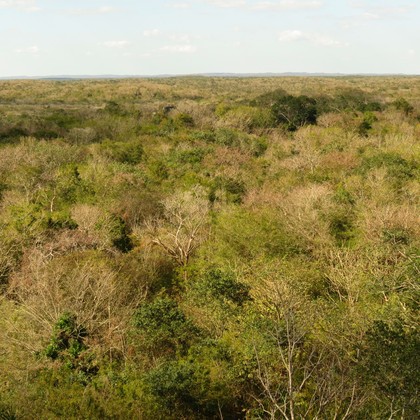
Edges of humid and semi-humid forest, seasonal forest, secondary forest, clearings with shrubs, plantations, shade coffee and gardens, from sea level to about 1500 m. It feeds at all levels, including in flowering trees, and catches many small insects.
Where the bird is most at home, classified by the vegetation units of Mexico and Central America.





Range and movements
On the Atlantic slope of Mexico from southern San Luis Potosí and Puebla through Veracruz, Oaxaca, Tabasco and Chiapas to the whole Yucatán Peninsula, and further in Belize, Guatemala, Honduras and Nicaragua, mainly on the Caribbean side. Rare and local in northern Costa Rica.
- Resident
- dark = core range, pale = thinly spread
How and when to look
Along forest edges and in gardens on the Yucatán Peninsula and in Belize, for example around the archaeological sites in the forest, at flowering shrubs and trees.
Conservation status
Not threatened. Common in most of its range. The species tolerates secondary forest, plantations and gardens well.
Scientific name
Chlorestes candida | (Bourcier & Mulsant, 1846)
Bourcier & Mulsant described the species in 1846 as Trochilus candidus; because it was later moved to another genus, the author and year stand in brackets. The genus Chlorestes was introduced in 1854 by Reichenbach. Chlorestes is Greek, from khlōros 'green' and esthēs 'clothing': 'clad in green'. candida is Latin, from candidus 'shining white', after the white underparts. The specimen the first description was based on came from Cobán, Guatemala.