All species › Nightjars › Nightjars and nighthawks › Chuck-will's-widow
Position in the tree Birds Aves › Birds with a flexible palate Neognathae › All other modern birds Neoaves › Birds of the elements Elementaves › Nightjars and swifts Strisores
Chuck-will's-widow | Antrostomus carolinensis
Carolinanachtzwaluw | Tapacaminos de Carolina
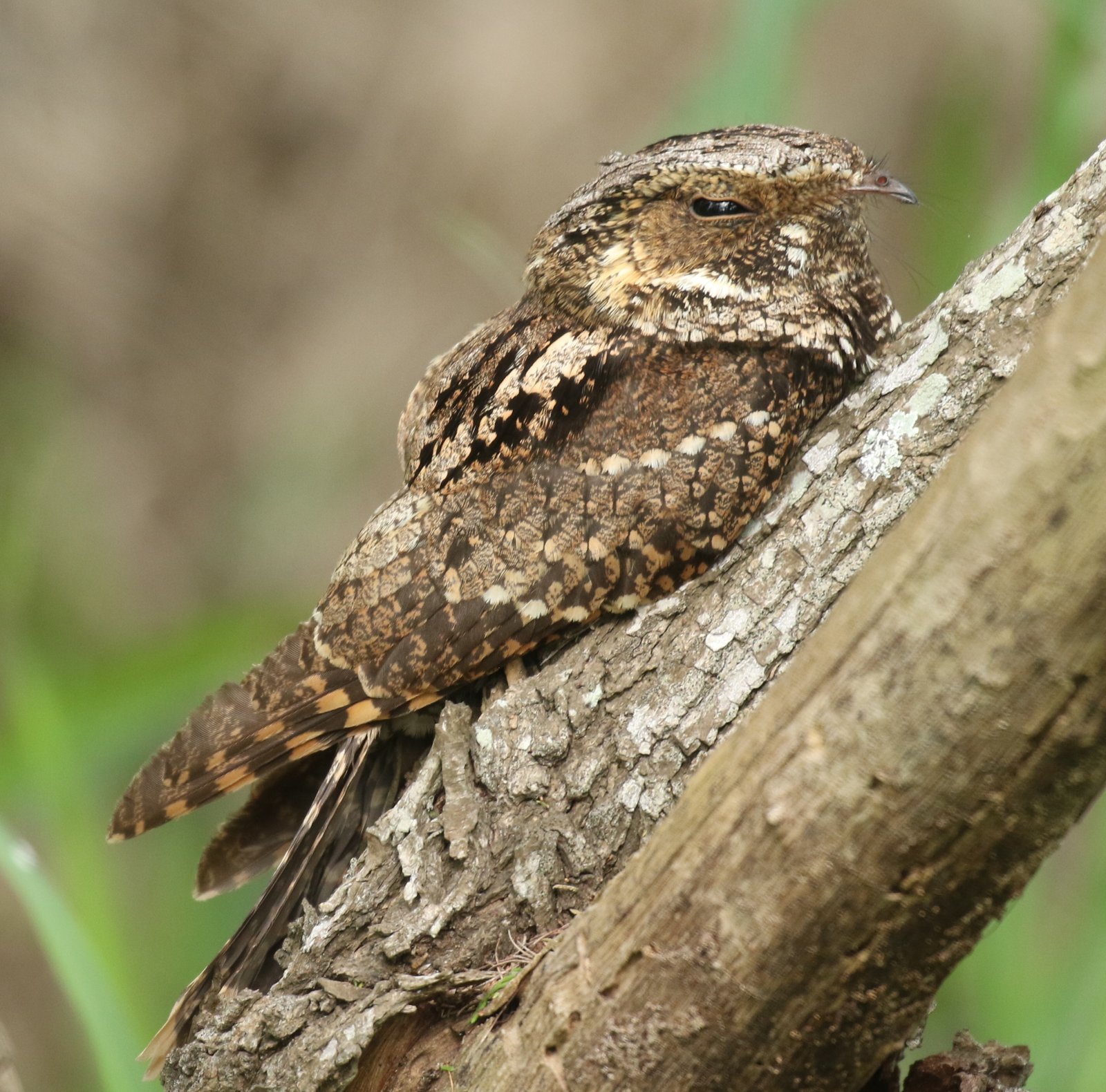
Chuck-will's-widow is the largest nightjar of North America, a heavy, warm rufous-brown bird with a large, flat head. It breeds in the south-eastern United States and winters largely in the guide area, from eastern Mexico to Panama. In winter it is almost silent and is usually found by chance, flushed from forest by day or on a road at night.
Voice
The song, a rhythmic chuck-will-WID-ow with a soft first note, is heard mainly on the breeding grounds; in the guide area the species sings at most briefly in spring before departure. In winter usually only a low quck or nothing is heard.
Recording: steve — CC BY-SA 4.0 · converted to mono · xeno-canto
Identification
28–33 cm. A large, heavy nightjar with a large, flat head, a wide gape with long bristles, long wings and a long, rounded tail. The plumage is warm rufous-brown to buff, finely marbled and spotted with black. The throat is rufous-brown with a narrow pale band below; the breast is dark spotted. The male has white inner webs to the three outer tail feathers, visible mainly when it flies off; in the female these areas are buff. The wings lack a white bar.
Confusion species
The Rufous Nightjar Antrostomus rufus in Costa Rica and Panama is very similar but smaller, with a more distinct pale throat band and smaller white tail patches in the male; away from the song they are hard to separate. The Eastern Whip-poor-will Antrostomus vociferus and Mexican Whip-poor-will Antrostomus arizonae are smaller and greyer, with a blacker throat and more white in the male's tail. The Tawny-collared Nightjar Antrostomus salvini and Yucatan Nightjar Antrostomus badius are smaller and darker, with a rufous hindneck collar. The Pauraque Nyctidromus albicollis has a longer tail and, in the male, a white wing band.
Habitat
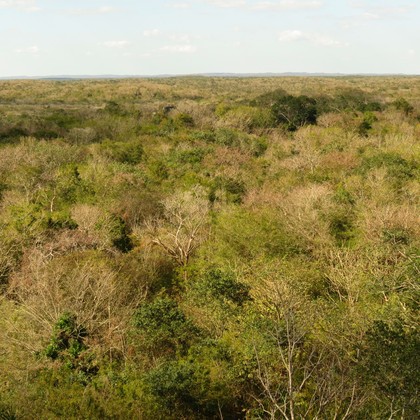
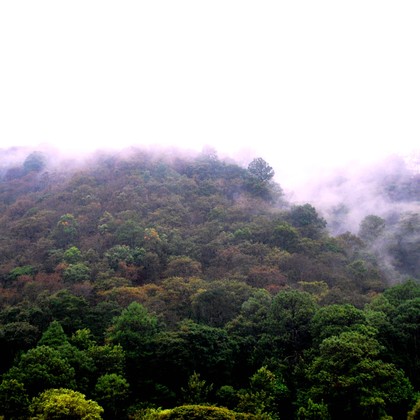
In winter semi-evergreen and dry forest, forest edges, secondary forest, coastal forest, mangrove edges, scrub and plantations with trees, mainly in the lowlands but locally up into pine-oak forest in the mountains. By day it rests on the ground among leaves or lengthwise on a branch. It hunts large insects at dusk and at night and sometimes catches small birds or bats.
Where the bird is most at home, classified by the vegetation units of Mexico and Central America.




Range and movements
Winter visitor in Mexico on the Gulf and Caribbean side, from Tamaulipas and Veracruz through Tabasco, Oaxaca and Chiapas to the Yucatán Peninsula, and throughout Central America from Belize and Guatemala to Panama, most often reported in Costa Rica. Migrants follow mainly the Gulf coast. Outside the guide area it breeds in the south-eastern and central United States; it also winters in Florida, the Greater Antilles and north-western South America.
- Winter visitor (c. Oct–Mar)
- dark = core range, pale = thinly spread
How and when to look
Birds are usually found by chance: flushed from the ground in forest or scrub, or caught in torchlight on a road at night. At some sites, such as parks and lodges in Costa Rica and Belize, the same birds return daily to a fixed roost and can be seen there by day.
Conservation status
Near Threatened. The breeding population in the United States has declined steeply in recent decades, partly through loss of forest and a decline in large night-flying insects. In the guide area the species depends in winter on lowland forest and scrub, which are shrinking through clearance.
Scientific name
Antrostomus carolinensis | (Gmelin, 1789)
Gmelin described the species in 1789 as Caprimulgus carolinensis; because it was later moved to another genus, the author and year stand in brackets. The genus Antrostomus was introduced in 1838 by Bonaparte. Antrostomus is Greek, from antron 'cave' and stoma 'mouth': 'cave-mouth', after the enormous gape. carolinensis means 'from Carolina', after the American colony where Catesby described the bird. The specimen the first description was based on came from South Carolina.