All species › Loons › Loons › Common Loon
Position in the tree Birds Aves › Birds with a flexible palate Neognathae › All other modern birds Neoaves › Birds of the elements Elementaves › Tropicbirds and waterbirds Phaethoquornithes › Core waterbirds Aequornithes
Common Loon | Gavia immer
IJsduiker | Colimbo grande
The Common Loon is a large, heavy loon with a dagger-shaped bill, known for its yodelling call on the lakes of Canada and the northern United States. In the guide area it is a regular winter visitor along the coasts of north-western Mexico, especially in the Gulf of California. Some immature birds remain through the summer.
Voice
Usually silent in winter, but sometimes heard in spring. On the breeding grounds a long, mournful wail, a yodelling call and a quavering, laughing tremolo.
Recording: Jorge Valella Robledo — CC BY-NC-SA 4.0 · converted to mono · xeno-canto
Identification
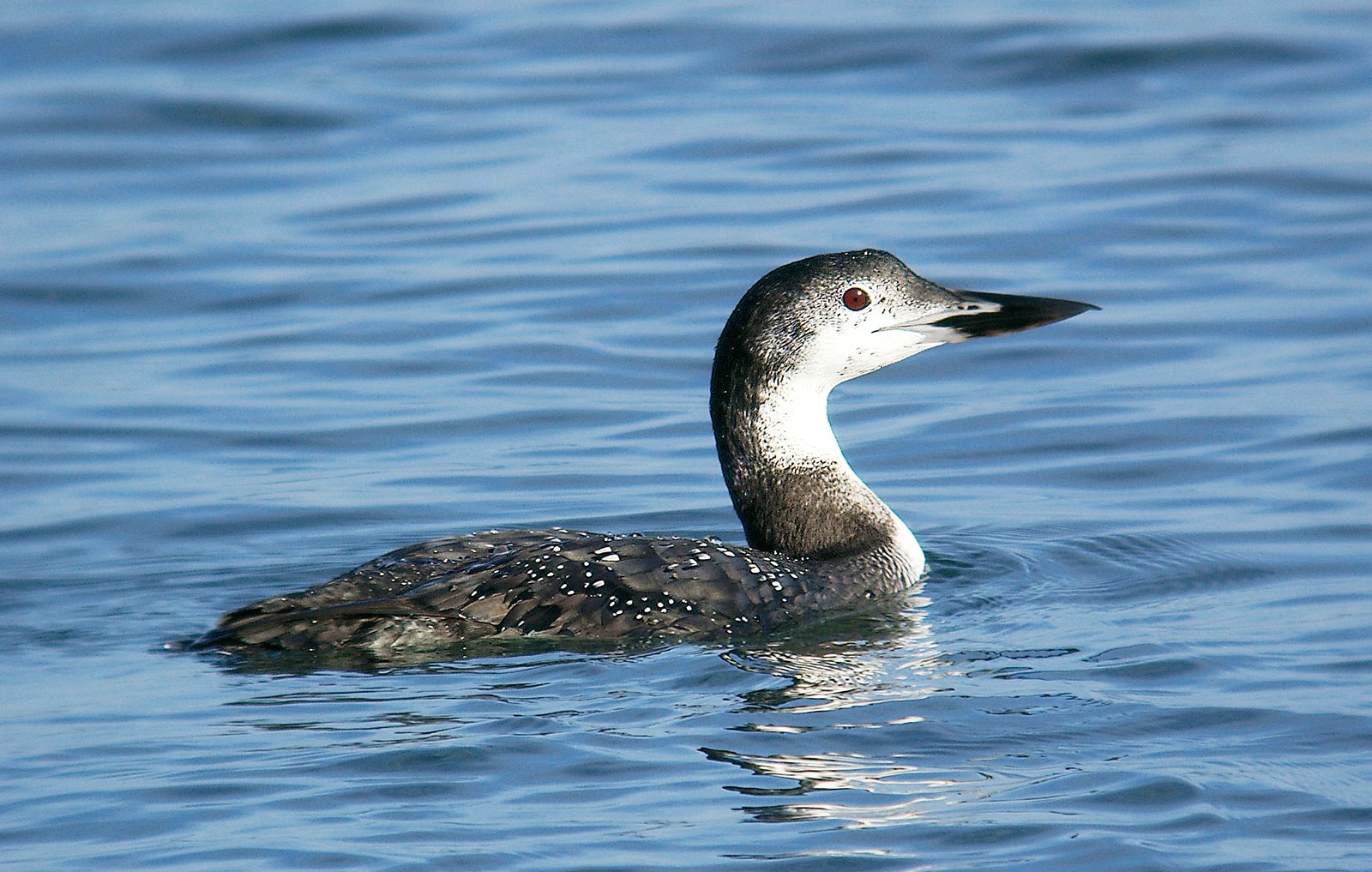
66–91 cm. Large and heavy, with an angular head, often with a bump on the forehead and a steep rear crown, a thick neck and a heavy, straight, dagger-shaped bill. In winter plumage the upperside and hindneck are dark grey-brown, the throat and underparts white; the white reaches around the eye and forms a white notch in the side of the neck, and the bill is pale grey with a dark culmen and tip. Breeding plumage, also seen in spring in the guide area, has a black head glossed green, a black-and-white striped neck ring and a black back full of white spots in a chequered pattern; the bill is then black. Juveniles have a scaly back. In flight the large feet project well beyond the tail.
Confusion species
The Pacific Loon Gavia pacifica is smaller, with a rounded head, a thinner bill, a sharp, straight border between the dark hindneck and the white foreneck and no white around the eye. The Red-throated Loon Gavia stellata is smaller and slimmer, with a thin, upward-held bill and a spotted back. The Yellow-billed Loon Gavia adamsii, a vagrant, has a pale, slightly upturned bill without a dark culmen. Cormorants such as the Double-crested Cormorant Nannopterum auritum have a hooked bill and a longer tail.
Habitat
Sheltered coastal waters, bays, lagoons and harbours, also deeper water further offshore; a few birds on large lakes and reservoirs inland. Dives for fish, crabs and other invertebrates and can stay underwater for a long time.
Where the bird is most at home, classified by the vegetation units of Mexico and Central America.


Range and movements
Along the Pacific coast of Baja California and especially in the Gulf of California, along Baja California, Baja California Sur and Sonora, less numerous south to Sinaloa, Nayarit and Jalisco. Further south along the Pacific coast rare, to Colima, Guerrero and Oaxaca. On the Gulf of Mexico side rare, from Tamaulipas to Veracruz, and seldom on lakes inland in northern and central Mexico. Outside the guide area it breeds in Alaska, Canada, the northern United States, Greenland and Iceland, and winters along the coasts of North America and north-western Europe.
- Winter visitor (c. Oct–Mar)
- dark = core range, pale = thinly spread
How and when to look
Along the coasts of the Gulf of California, for example at Puerto Peñasco and San Felipe, the species is easiest to find in winter. At long range the heavy bill, the angular head and the low, heavy way it sits in the water help.
Conservation status
Least Concern. The species is sensitive to lead poisoning from swallowed fishing weights, mercury pollution, lake acidification, disturbance on breeding lakes and oil pollution in the wintering areas. In the guide area a regular winter visitor.
Scientific name
Gavia immer | (Brünnich, 1764)
Brünnich described the species in 1764 as Colymbus Immer; because it was later moved to another genus, the author and year stand in brackets. The genus Gavia was introduced in 1788 by Forster. Gavia is the Latin word for an unidentified seabird. immer goes back to a Norwegian name for the bird, akin to Icelandic himbrimi. It has also been linked to Swedish immer 'blackened ashes', for the dark plumage, and to Latin immergo 'to plunge in'. The specimen the first description was based on came from the Faroe Islands.