All species › Loons › Loons › Red-throated Loon
Position in the tree Birds Aves › Birds with a flexible palate Neognathae › All other modern birds Neoaves › Birds of the elements Elementaves › Tropicbirds and waterbirds Phaethoquornithes › Core waterbirds Aequornithes
Red-throated Loon | Gavia stellata
Roodkeelduiker | Colimbo chico
The Red-throated Loon is the smallest and slenderest loon. It breeds on small lakes in the Arctic and boreal zone and winters at sea, often close inshore. The guide area lies at the southern edge of its winter range: the species is a scarce winter visitor in north-western Mexico, and most birds here are in the grey-and-white winter plumage.

Voice
Almost silent in winter. On the breeding grounds a cackling, goose-like kak-kak-kak in flight and plaintive, wailing calls.
Recording: Stanislas Wroza — CC BY-NC-SA 4.0 · shortened to the first 60 s, mono · xeno-canto
Identification
53–69 cm. A slender loon with a thin, slightly upturned bill that is often held tilted upwards, a small, rounded head and a thin neck. In winter plumage the upperside is grey-brown with fine white spots, and the face, foreneck and underparts are clean white; the white surrounds the eye and extends high up the side of the neck. In breeding plumage the head and sides of the neck are grey, the hindneck is finely striped black and white and the throat is dark red-brown, while the back is unspotted grey-brown. Juveniles are dingier grey on the head and neck. Flies with fast, deep wingbeats, the head held slightly lower than the body.
Confusion species
The Pacific Loon Gavia pacifica has a straight bill held horizontally, a darker, sharply defined hindneck, a dark eye set in the black and, in winter plumage, a dark, unspotted back and often a thin chinstrap. The Common Loon Gavia immer is much larger, with a heavy bill and an angular head. Grebes such as Western Grebe Aechmophorus occidentalis have a longer, thinner neck, and the Horned Grebe Podiceps auritus is much smaller, with a short bill.
Habitat
Shallow coastal waters, bays, lagoons and estuaries, often just beyond the surf; rarely on inland waters. Dives for small fish. In winter usually alone or in small, loose groups.
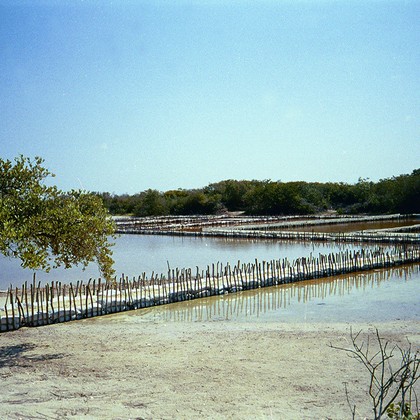
Where the bird is most at home, classified by the vegetation units of Mexico and Central America.

Range and movements
Mainly along the Pacific coast of northern Baja California and in the northern Gulf of California, along the coasts of Baja California and Sonora. Further south along Baja California Sur rare, with scattered records to Nayarit and a single one inland. Outside the guide area it breeds around the North Pole, in Alaska, Canada, Greenland, northern Europe and Siberia, and winters along the coasts of the northern Pacific and Atlantic Oceans.
- Winter visitor (c. Oct–Mar)
- dark = core range, pale = thinly spread
How and when to look
Seawatching from the coast of northern Baja California in winter gives the best chance, especially in bays and lagoons. The thin, upward-held bill and the white face with the spotted back are good features even at a distance.
Conservation status
Least Concern. Numbers have declined in parts of the range; threats include bycatch in gillnets, oil pollution and disturbance of shallow coastal waters, among others by offshore wind farms. In the guide area a scarce winter visitor.
Scientific name
Gavia stellata | (Pontoppidan, 1763)
Pontoppidan described the species in 1763 as Colymbus Stellatus; because it was later moved to another genus, the author and year stand in brackets. The genus Gavia was introduced in 1788 by Forster. Gavia is the Latin word for an unidentified seabird. stellata is Latin for 'starred' or 'set with stars', after the fine white speckling on the back in non-breeding plumage. The specimen the first description was based on came from the River Tame in England.