All species › Sunbittern and Kagu › Sunbittern › Sunbittern
Position in the tree Birds Aves › Birds with a flexible palate Neognathae › All other modern birds Neoaves › Birds of the elements Elementaves › Tropicbirds and waterbirds Phaethoquornithes › Tropicbirds and sunbittern Phaethontimorphae
Sunbittern | Eurypyga helias
Zonneral | Garza del sol
The Sunbittern is a slender, long-necked bird of forest streams and the only member of its family. Its closest relative is the Kagu of New Caledonia. At rest it is camouflaged in grey and brown, but when threatened or displaying it spreads its wings and tail to reveal a large pattern of orange, yellow and black that resembles a pair of eyes. In the guide area the subspecies E. h. major occurs, from the Caribbean slope of Guatemala to Panama.

Voice
A high, long-drawn, thin whistle, wiiiiiii, sometimes slightly rising or falling, often given from a branch over the water. When disturbed and near the nest also a hissing sound and a dry rattle.
Recording: JAYRSON ARAUJO DE OLIVEIRA — CC BY-NC-SA 4.0 · shortened to the first 60 s, mono · xeno-canto
Identification
43–48 cm. A slender bird held horizontally, with a small head, a thin long neck, a long, straight, dagger-shaped bill, a long, broad tail and rather short orange legs. The head is black with a white stripe above and a white stripe below the eye; the throat is white. Neck, breast and upperparts are finely barred and spotted in grey, brown, olive and black; the belly is pale buff. The upper mandible is black, the lower mandible orange. The tail is grey with fine wavy lines and two broad black and chestnut bands. When the wings are spread, each shows a large patch of chestnut, orange-yellow and black, framed by grey and white bands. Male and female are alike. Walks slowly and cautiously, with the neck drawn in and the head thrust forward.
Confusion species
The Sungrebe Heliornis fulica lives on the same streams, but mostly swims, is smaller and has a short bill and a black-and-white striped head and neck. Bare-throated Tiger Heron Tigrisoma mexicanum and Fasciated Tiger Heron Tigrisoma fasciatum are much larger and heavier, with a bare yellow or greenish throat and no colourful wing pattern. Sandpipers and the Green Heron lack the long, broad tail and the black-and-white head.
Habitat
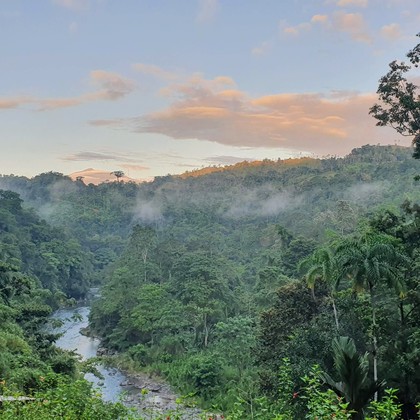
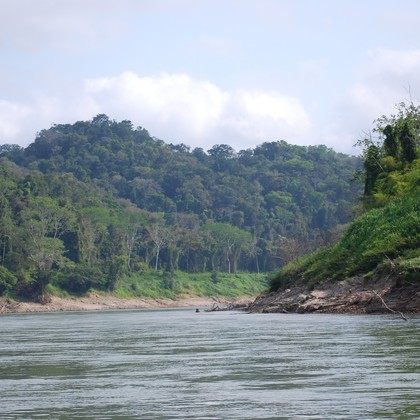
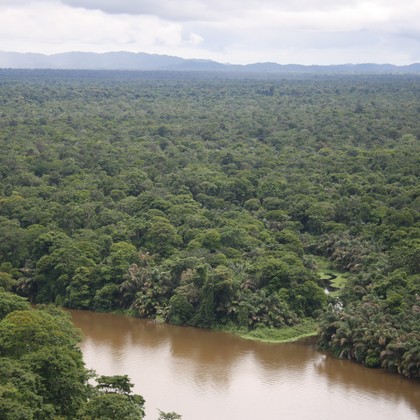
Shady streams and small rivers with stones, gravel and sandbars in humid forest, also edges of pools and swamp forest; mainly in hills and foothills up to about 1,200 m, locally in the lowlands. Forages by walking slowly along the bank and in shallow water for insects, crustaceans, frogs and small fish, which it catches with a quick thrust of the bill. The nest is a globular cup of mud and plant material on a branch over or near water.
Where the bird is most at home, classified by the vegetation units of Mexico and Central America.


Range and movements
From the Caribbean slope of Guatemala (Izabal) through the Caribbean slope of Honduras and Nicaragua to Costa Rica and Panama, where it occurs on both slopes. Only old records are known from southern Mexico (Chiapas), where it may have disappeared. Outside the guide area in northern South America and the Amazon basin, south to Bolivia and central Brazil.
- Resident
- dark = core range, pale = thinly spread
How and when to look
Walking slowly or waiting along clear forest streams in the foothills, such as on the Caribbean slope of Costa Rica and in western Panama, gives the best chance. The high, drawn-out whistle often gives the bird away before it is seen. When it flies off, the orange wing patches become visible.
Conservation status
Least Concern. The species is scarce in much of its range and sensitive to clearing of forest along streams and to pollution and disturbance of the water. Rare and local in the north of the guide area; most widespread in Costa Rica and Panama.
Scientific name
Eurypyga helias | (Pallas, 1781)
Pallas described the species in 1781 as Ardea helias; because it was later moved to another genus, the author and year stand in brackets. The genus Eurypyga was introduced in 1811 by Illiger. Eurypyga is Greek, from eurus 'broad' and pugē 'rump, tail', after the broad, fanned tail. helias is Greek hēlias 'of the sun', after the sunburst-like eyespots on the spread wings. The specimen the first description was based on came from Suriname.