All species › Tropicbirds › Tropicbirds › Red-billed Tropicbird
Position in the tree Birds Aves › Birds with a flexible palate Neognathae › All other modern birds Neoaves › Birds of the elements Elementaves › Tropicbirds and waterbirds Phaethoquornithes › Tropicbirds and sunbittern Phaethontimorphae
Red-billed Tropicbird | Phaethon aethereus
Roodsnavelkeerkringvogel | Rabijunco etéreo
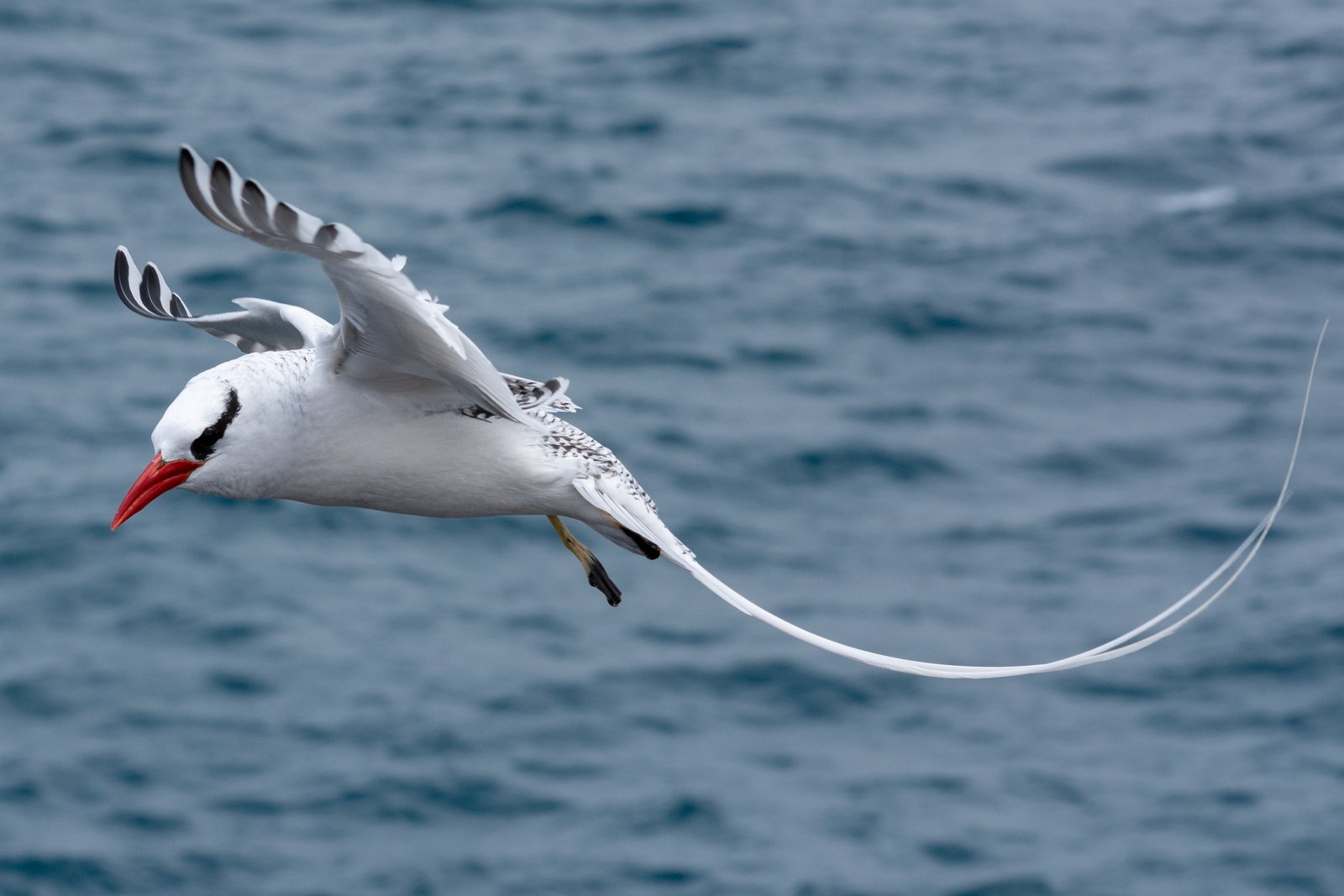
The Red-billed Tropicbird is a white seabird with a red bill and two long white tail streamers. It flies with fast, stiff wingbeats high above the sea and dives from a great height on flying fish and squid. In the guide area it breeds mainly on islands in the Gulf of California and off the Pacific coast of Mexico, and also in a small colony on the Caribbean side of Panama. Birds in the guide area belong to the subspecies P. a. mesonauta.
Voice
At the colony and in display flight, loud, rasping screams, often in a series, such as kreee-kreee-kri-kri-kri. Usually silent at sea.
Recording: Jesse Fagan — CC BY-NC-SA 4.0 · converted to mono · xeno-canto
Identification
45–50 cm without the streamers; in adults the two central tail feathers project another 45 to 55 cm beyond the tail. Adults are white with fine black barring on the back, scapulars and inner wing, making the upperside look greyish at close range. A black eye-stripe extends to the nape. The outer primaries and their coverts form a black wedge at the wingtip. The bill is red. Juveniles lack the streamers and have a yellow bill, coarser barring, black tail tips and a black nuchal collar joining the eye-stripes behind the head.
Confusion species
The White-tailed Tropicbird Phaethon lepturus, a vagrant on the Caribbean side, is smaller, with an unbarred white back, a yellow to orange bill and a black diagonal bar across the inner wing. The Red-tailed Tropicbird Phaethon rubricauda, rare far off the Pacific coast, has a white back, little black in the wingtip and red tail streamers. Terns such as the Royal Tern Thalasseus maximus have a forked tail without streamers and a black cap.
Habitat
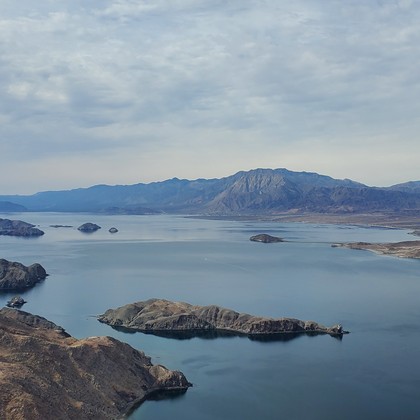
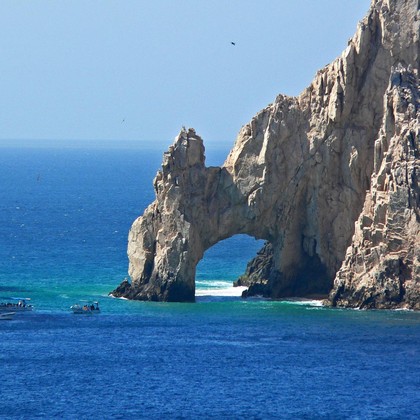
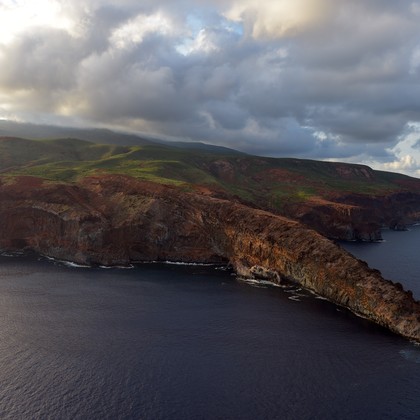
Breeds in crevices, holes and under overhanging rocks on steep cliffs and rocky islands, laying its single egg on bare ground. Forages over the open sea and the continental shelf, sometimes far offshore, plunge-diving for flying fish and squid. Small groups perform noisy display flights over the breeding cliffs.
Where the bird is most at home, classified by the vegetation units of Mexico and Central America.


Range and movements
Breeds on islands in the Gulf of California, such as San Pedro Mártir, on Isla Isabel off Nayarit and in the Revillagigedo Islands. At sea along the whole Pacific coast from Mexico to Costa Rica and Panama, most numerous off Mexico. On the Caribbean side a small colony on an islet off Bocas del Toro in Panama, otherwise rare. Outside the guide area in tropical parts of the Atlantic Ocean, the eastern Pacific, the Red Sea, the Persian Gulf and the north-western Indian Ocean.
- Resident
- Summer visitor (c. Apr–Sep)
- Winter visitor (c. Oct–Mar)
- Passage (Mar–Apr, Oct–Nov)
- dark = core range, pale = thinly spread
How and when to look
Boat trips to breeding islands such as Isla Isabel or in the Gulf of California, and pelagic trips off the Pacific coast of Mexico, give the best chance. At Bocas del Toro the birds can be seen from a boat near the breeding islet. In juveniles, bill colour and the nuchal collar are the key features.
Conservation status
Least Concern, but probably declining globally. On breeding islands introduced rats and cats threaten eggs and chicks; these predators have been removed from several Mexican islands. Disturbance and egg collecting play a role locally.
Scientific name
Phaethon aethereus | Linnaeus, 1758
Linnaeus described the species in 1758 and placed it straight away in the genus where it still stands. He introduced the genus Phaethon in that same work. Phaethon goes back to the Greek phaethon 'sun, the shining one'. aethereus is Latin for 'heavenly', from aether 'the high, clear air'. The specimen the first description was based on came from Ascension Island.