All species › Swifts › Hummingbirds › Dusky Hummingbird
Position in the tree Birds Aves › Birds with a flexible palate Neognathae › All other modern birds Neoaves › Birds of the elements Elementaves › Nightjars and swifts Strisores
Dusky Hummingbird | Phaeoptila sordida
Bruinkopkolibrie | Colibrí prieto
The Dusky Hummingbird is a dull, greyish-green hummingbird of the dry interior of south-western Mexico. It occurs nowhere else. Male and female look alike, and neither has a glittering throat.

Voice
A dry, hard chit or chek, and a rattling twitter in chases.
Recording: Isain Contreras Rodríguez — CC BY-NC-SA 4.0 · converted to mono · xeno-canto
Identification
9–10 cm, with a straight bill whose lower mandible is red with a dark tip. The upperparts are dull bronze-green and the head darker greyish-brown, with a narrow whitish stripe behind the eye above a dark ear patch. The underparts are plain grey. The tail is dull bronze-green to dark, with grey tips to the outer feathers. Male and female are almost identical.
Confusion species
Female Broad-billed Hummingbird Cynanthus latirostris has a more distinct white eyestripe, brighter green upperparts and a blue-black tail with white tips. Female Golden-crowned Emerald Cynanthus auriceps is smaller and has a deeply forked tail. Female White-eared Hummingbird Basilinna leucotis has a broad white eyestripe on a black mask and spotted underparts.
Habitat
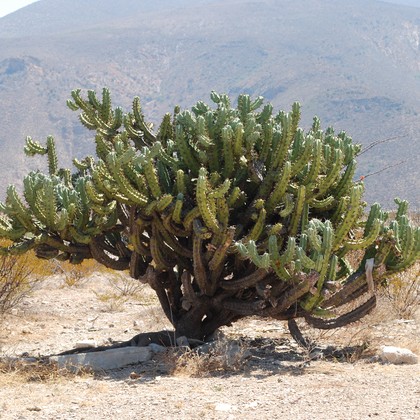
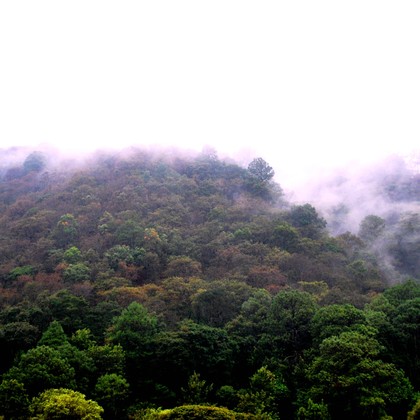
Dry scrub, thorn scrub, dry deciduous forest, open oak woodland, riparian growth and gardens in the dry interior, at about 900 to 2200 m. It feeds at flowers of shrubs, agaves and trees, and catches small insects.
Where the bird is most at home, classified by the vegetation units of Mexico and Central America.



Range and movements
Endemic to the guide area, and restricted to south-western Mexico: the Balsas basin and the dry interior valleys of Michoacán, Guerrero, Morelos, the south of the State of México, Puebla and Oaxaca.
- Resident
- dark = core range, pale = thinly spread
How and when to look
Common in the Valley of Oaxaca, for example at the archaeological site of Monte Albán and around Teotitlán del Valle, and in the dry valleys of Morelos. Often at flowering shrubs in gardens and along field edges.
Conservation status
Not threatened. Fairly common in suitable dry terrain, and it also does well in man-made landscapes.
Scientific name
Phaeoptila sordida | (Gould, 1859)
Gould described the species in 1859 as Cyanomyia (?) sordida; because it was later moved to another genus, the author and year stand in brackets. The genus Phaeoptila was introduced in 1861 by Gould. Phaeoptila is Greek, from phaios 'dusky' and ptilon 'feather', after the drab plumage. sordida is Latin for 'dirty, shabby' (from sordes 'dirt'), after the dull grey-brown plumage. The specimen the first description was based on came from Oaxaca, Mexico.