All species › Nightjars › Nightjars and nighthawks › Dusky Nightjar
Position in the tree Birds Aves › Birds with a flexible palate Neognathae › All other modern birds Neoaves › Birds of the elements Elementaves › Nightjars and swifts Strisores
Dusky Nightjar | Antrostomus saturatus
Zwarte nachtzwaluw | Chotacabras sombrío
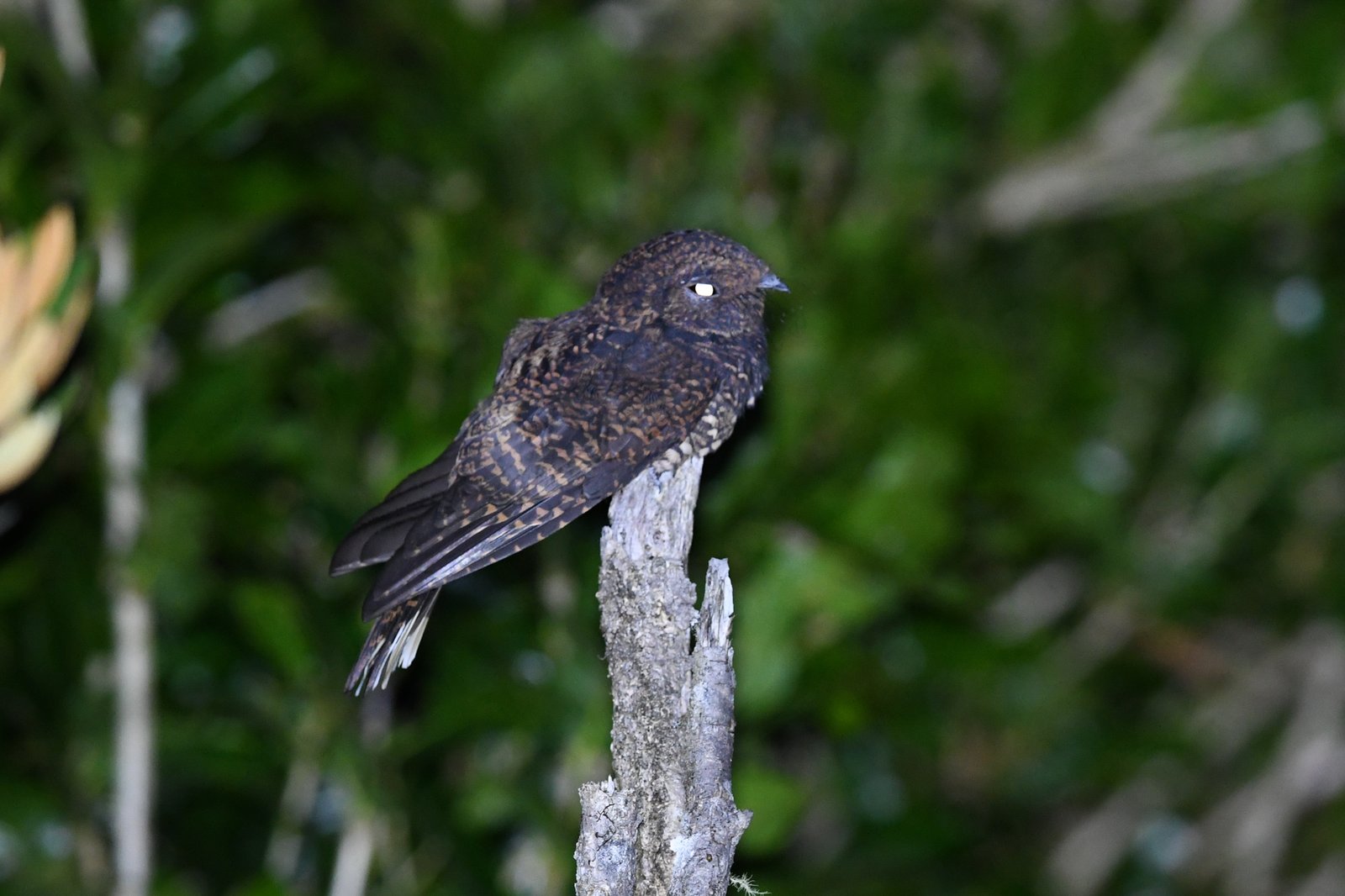
The Dusky Nightjar is the darkest nightjar of the guide area and occurs only in the high mountains of Costa Rica and western Panama. It lives above about 1800 m at forest edges, in clearings and in pastures with scattered trees, up to the treeline. By day it rests on the ground in dense cover; at dusk it hunts and sings along forest edges and roads.
Voice
The song is a clear, whistled phrase of three or four notes, stressed in the middle, repeated at short intervals. It sings mainly at dusk and before dawn, most often in the dry season and early rainy season. Also short, soft calls.
Recording: Bill Pyle — CC BY-NC-SA 4.0 · shortened to the first 60 s, mono · xeno-canto
Identification
21–24 cm. A medium-sized, stocky nightjar with a large head and rounded wings without a white wing band. The plumage is very dark blackish-brown, densely marked with small cinnamon and buff spots, without a distinct nape collar and with at most a faint pale throat band. The male has small white tips to the outer tail feathers, visible in flight; in the female they are buff and less obvious. Perched, the bird looks almost uniformly dark.
Confusion species
No other nightjar in the mountains of Costa Rica and Panama is as dark. The Rufous Nightjar Antrostomus rufus is warmer rufous-brown and lives lower, in dry and semi-open lowlands. The Eastern Whip-poor-will Antrostomus vociferus is a rare winter visitor, much greyer, with a distinct throat band. The Pauraque Nyctidromus albicollis has a white wing band and lives lower. The Short-tailed Nighthawk Lurocalis semitorquatus has long, pointed wings and a short tail and hunts high above the forest.
Habitat
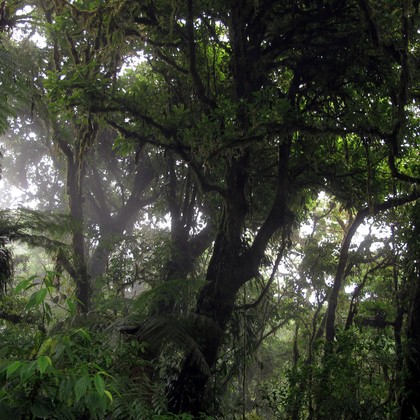
Edges of montane oak forest and montane rainforest, clearings and felled areas, scrub and páramo above the treeline, and pastures with scattered trees; from about 1800 m to above 3000 m. It hunts flying insects from the ground, a low branch or a post, often over roads and clearings. The egg is laid without a nest on the ground, among leaf litter or in low scrub.
Where the bird is most at home, classified by the vegetation units of Mexico and Central America.



Range and movements
Only in the mountains of Costa Rica, in the Cordillera Central and the Cordillera de Talamanca, and in the adjoining highlands of western Panama, mainly in Chiriquí and the neighbouring part of Bocas del Toro. Does not occur outside the guide area.
- Resident
- dark = core range, pale = thinly spread
How and when to look
Good places are the montane pastures and forest edges around Cerro de la Muerte in Costa Rica, the slopes of the Irazú and Poás volcanoes, and in Panama the area around Volcán Barú and Cerro Punta. At dusk the birds often sit on or beside roads, where they show red eyeshine in torchlight.
Conservation status
Not threatened. The range is small, but much of it lies in protected montane forest. The species tolerates clearings and pastures within the forest, and so appears to be holding its own locally.
Scientific name
Antrostomus saturatus | Salvin, 1870
Salvin described the species in 1870 and placed it straight away in the genus where it still stands. The genus Antrostomus was introduced in 1838 by Bonaparte. Antrostomus is Greek, from antron 'cave' and stoma 'mouth': 'cave-mouth', after the enormous gape. saturatus is Latin for 'saturated, dark', after the very dark plumage. The specimen the first description was based on came from Volcán de Chiriquí (Barú), Panama.