All species › Nightjars › Nightjars and nighthawks › Eastern Whip-poor-will
Position in the tree Birds Aves › Birds with a flexible palate Neognathae › All other modern birds Neoaves › Birds of the elements Elementaves › Nightjars and swifts Strisores
Eastern Whip-poor-will | Antrostomus vociferus
Whippoorwill | Tapacaminos cuerporruín norteño
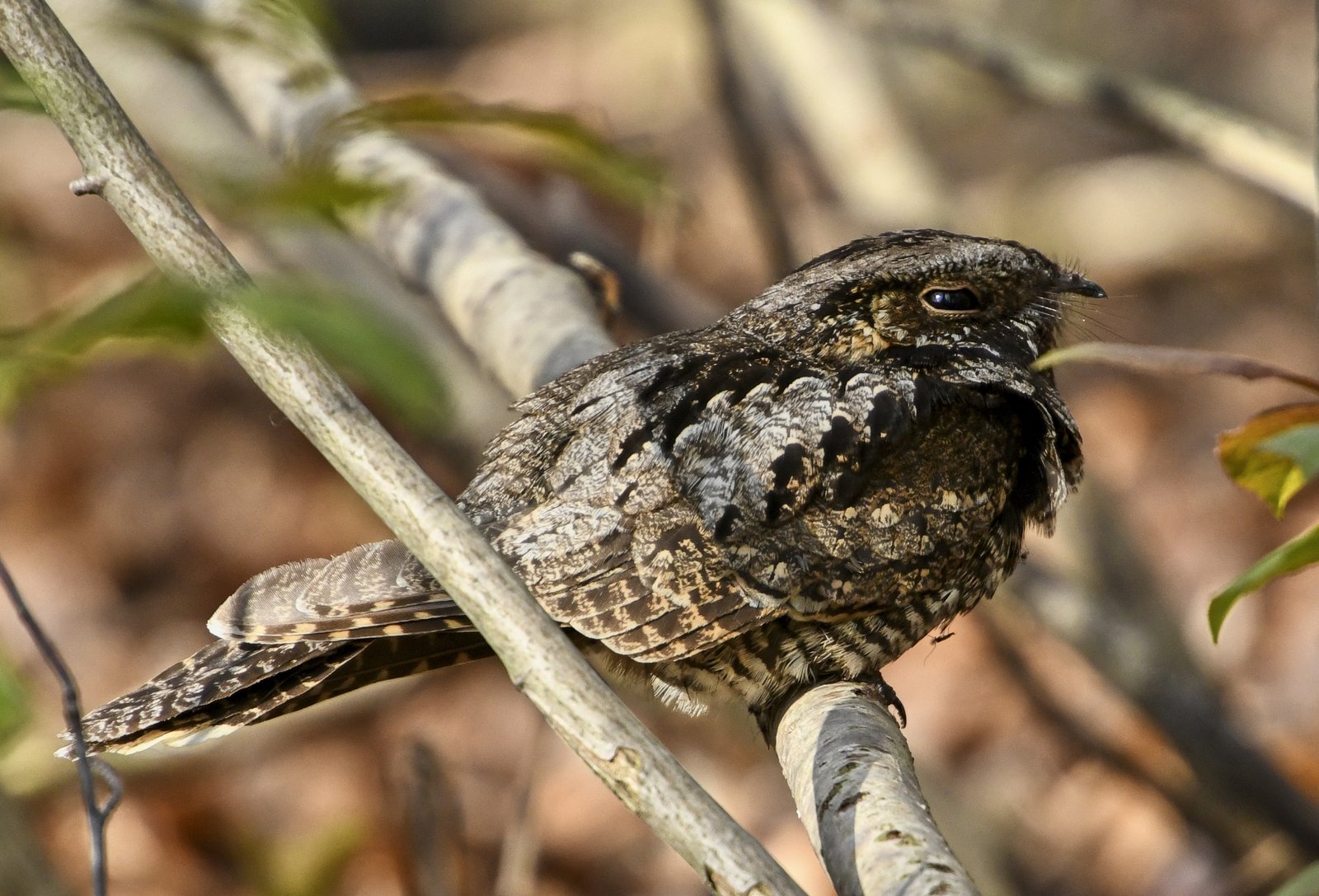
The Eastern Whip-poor-will breeds in eastern North America and is a winter visitor to the guide area. It is named after its song, a rapidly repeated whip-poor-WILL, but it sings little in its winter quarters. Until 2010 it was treated as one species with the Mexican Whip-poor-will; the two are best separated in the field by song. By day it rests on the forest floor or lengthwise on a branch, where its camouflage makes it almost invisible.
Voice
The song is a clear, fast and rhythmically repeated whip-poor-WILL, stressed on the last syllable. In the guide area birds sing mainly in spring, shortly before and during the northward migration; in winter they are usually silent. Also a soft quit call.
Recording: Jacob Saucier — CC BY-NC-SA 4.0 · shortened to the first 60 s, mono · xeno-canto
Identification
22–26 cm. A stocky nightjar with a large, flat head, a short bill with long bristles and rounded wings without a white wing band. The plumage is grey-brown, finely spotted and streaked with black, grey and rufous, with a dark throat and below it a narrow white (buff in the female) throat band. In the male the outer three tail feathers are largely white, visible when it flushes; in the female they have narrow buff tips. On a perched bird the wings do not reach the tail tip.
Confusion species
The Mexican Whip-poor-will Antrostomus arizonae is very similar; on average it is greyer, with less white in the male's tail, and its song is lower and burry. In winter the two overlap in part of Mexico, and silent birds cannot then be separated with certainty. The Chuck-will's-widow Antrostomus carolinensis, also a winter visitor, is clearly larger and warmer brown, with a pale brown throat. The Buff-collared Nightjar Antrostomus ridgwayi has a buff nape collar and lives in dry scrub. The Pauraque Nyctidromus albicollis has a white wing band and a longer tail.
Habitat
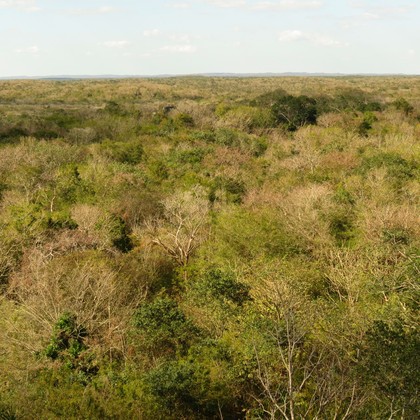
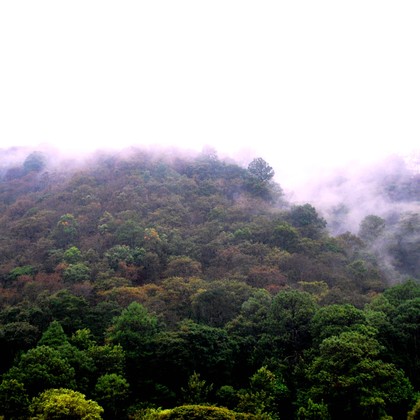
In winter in humid and semi-humid lowland and foothill forest, secondary forest, forest edges, gallery forest and seasonal forest, locally also in pine-oak forest at middle elevations; mainly up to about 1500 m, rarely higher. It hunts moths and other flying insects at dusk and by moonlight from the ground or a low branch.
Where the bird is most at home, classified by the vegetation units of Mexico and Central America.




Range and movements
Winters mainly on the Gulf and Caribbean side, from southern Tamaulipas and San Luis Potosí through Veracruz, Puebla and Oaxaca to Tabasco, Chiapas and the Yucatán Peninsula, and further in Guatemala, Belize, El Salvador and Honduras. Scarce in Nicaragua and Costa Rica, a vagrant to Panama. On migration also elsewhere in eastern Mexico. Does not breed in the guide area; the breeding range lies in the eastern United States and southern Canada.
- Winter visitor (c. Oct–Mar)
- dark = core range, pale = thinly spread
How and when to look
In winter the species is hard to find; birds are most often noticed when they flush along a forest track at dusk or sit on the ground in torchlight with red eyeshine. In March and April some birds already start singing, for example in forested areas in Veracruz, Chiapas and on the Yucatán Peninsula.
Conservation status
Near Threatened. The North American breeding population has declined steeply in recent decades, probably owing to fewer large moths and other insects and to loss and change of forest. Forest loss in the winter quarters may also play a part.
Scientific name
Antrostomus vociferus | (Wilson, 1812)
Wilson described the species in 1812 as Caprimulgus vociferus; because it was later moved to another genus, the author and year stand in brackets. The genus Antrostomus was introduced in 1838 by Bonaparte. Antrostomus is Greek, from antron 'cave' and stoma 'mouth': 'cave-mouth', after the enormous gape. vociferus is Latin for 'loud-voiced', after the endlessly repeated call. The specimen the first description was based on came from Pennsylvania, USA.