All species › Woodpeckers and allies › Toucans › Fiery-billed Aracari
Position in the tree Birds Aves › Birds with a flexible palate Neognathae › All other modern birds Neoaves › Landbirds Telluraves › Raptors, owls, kingfishers and woodpeckers Afroaves › Mousebirds, rollers and woodpeckers Coraciimorphae › Trogons and cavity nesters Cavitaves › Hornbills, kingfishers and woodpeckers Picocoraciae › Kingfishers, bee-eaters and woodpeckers Picodynastornithes
Fiery-billed Aracari | Pteroglossus frantzii
Vuursnavelarassari | Arasarí piquinaranja
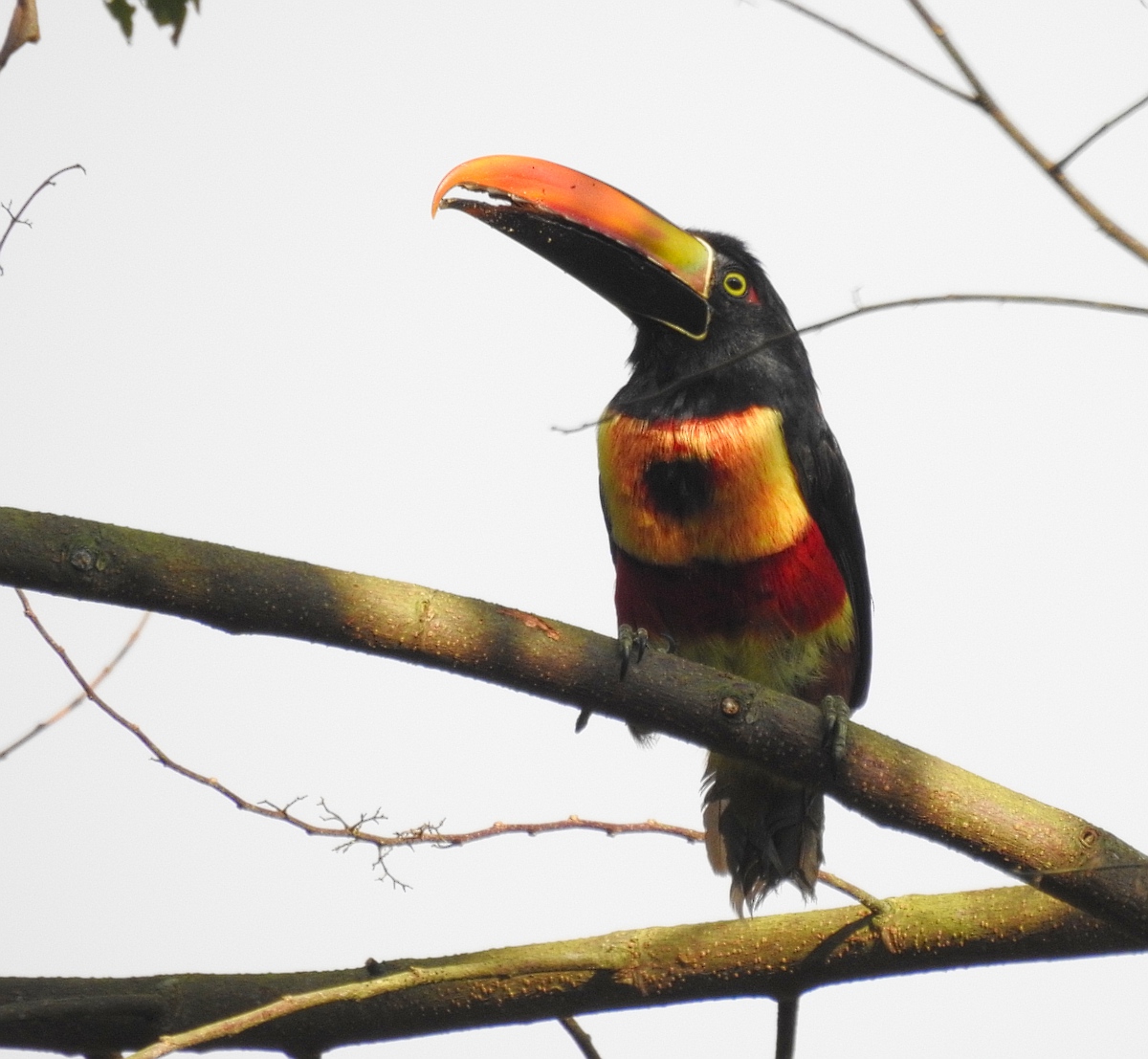
The Fiery-billed Aracari is an aracari found only in the guide area, on the Pacific side of southern Costa Rica and western Panama. It replaces the Collared Aracari there and can be recognised by its orange-red upper mandible. Its scientific name honours the German physician and naturalist Alexander von Frantzius.
Voice
A high, sharp pseek or keeek and a two-note pi-tseek, almost identical to the call of Collared Aracari.
Recording: Stephan Risch — CC BY-NC-SA 4.0 · converted to mono · xeno-canto
Identification
41–46 cm. Head, throat and neck black, back and wings dark green, rump red, tail long and dark. The underparts are yellow with a red wash, with a black spot in the centre of the breast and a broad band of red and black across the belly. Iris yellow, bare skin around the eye red. The upper mandible is orange-red with a yellow-green base and blackish marks along the cutting edge, the lower mandible black. The sexes are alike.
Confusion species
Collared Aracari Pteroglossus torquatus has an ivory to dull yellow upper mandible and a narrower, blacker belly band; in Costa Rica it lives on the Caribbean slope and in the north-west. Keel-billed Toucan Ramphastos sulfuratus and Yellow-throated Toucan Ramphastos ambiguus are much larger, with a black belly and a yellow throat and breast.
Habitat
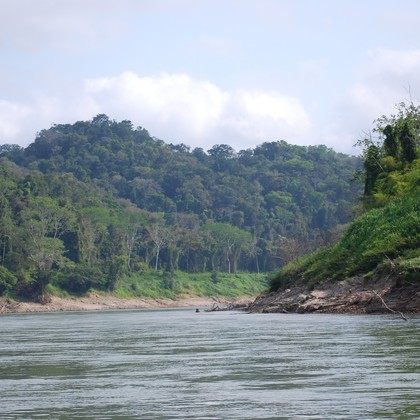
Humid lowland and foothill forest on the Pacific side, tall secondary forest, forest edges, gallery forest and gardens and plantations with fruit trees near forest; mostly below 1200 m, locally up to about 1500 m. It lives in groups of six to ten birds in the middle and upper tree layers and eats mainly fruit, also insects, eggs and nestlings. It nests and roosts in a tree cavity.
Where the bird is most at home, classified by the vegetation units of Mexico and Central America.



Range and movements
Endemic to the guide area. Pacific side of Costa Rica, from the area around the Gulf of Nicoya and Carara south through the valley of the General river and the Osa Peninsula, to western Panama in Chiriquí and western Veraguas.
- Resident
- dark = core range, pale = thinly spread
How and when to look
Easy to see at Carara, near Uvita and on the Osa Peninsula, including around Corcovado, in Costa Rica. Groups visit fruiting trees at lodges and along forest edges.
Conservation status
Least Concern. Its range is small and much of the lowland forest there has been cleared, but the species also occurs in secondary forest and is common in protected areas such as Corcovado.
Scientific name
Pteroglossus frantzii | Cabanis, 1861
Cabanis described the species in 1861 and placed it straight away in the genus where it still stands. The genus Pteroglossus was introduced in 1811 by Illiger. Pteroglossus is Greek, from pteron 'feather' and glōssa 'tongue', after the frayed, feather-like tongue. frantzii honours the German physician and naturalist Alexander von Frantzius (1821–1877), who worked and collected in Costa Rica for many years. The specimen the first description was based on came from Aguacate, Costa Rica.