All species › Woodpeckers and allies › Toucans › Northern Emerald Toucanet
Position in the tree Birds Aves › Birds with a flexible palate Neognathae › All other modern birds Neoaves › Landbirds Telluraves › Raptors, owls, kingfishers and woodpeckers Afroaves › Mousebirds, rollers and woodpeckers Coraciimorphae › Trogons and cavity nesters Cavitaves › Hornbills, kingfishers and woodpeckers Picocoraciae › Kingfishers, bee-eaters and woodpeckers Picodynastornithes
Northern Emerald Toucanet | Aulacorhynchus prasinus
Smaragdarassari | Tucaneta verde
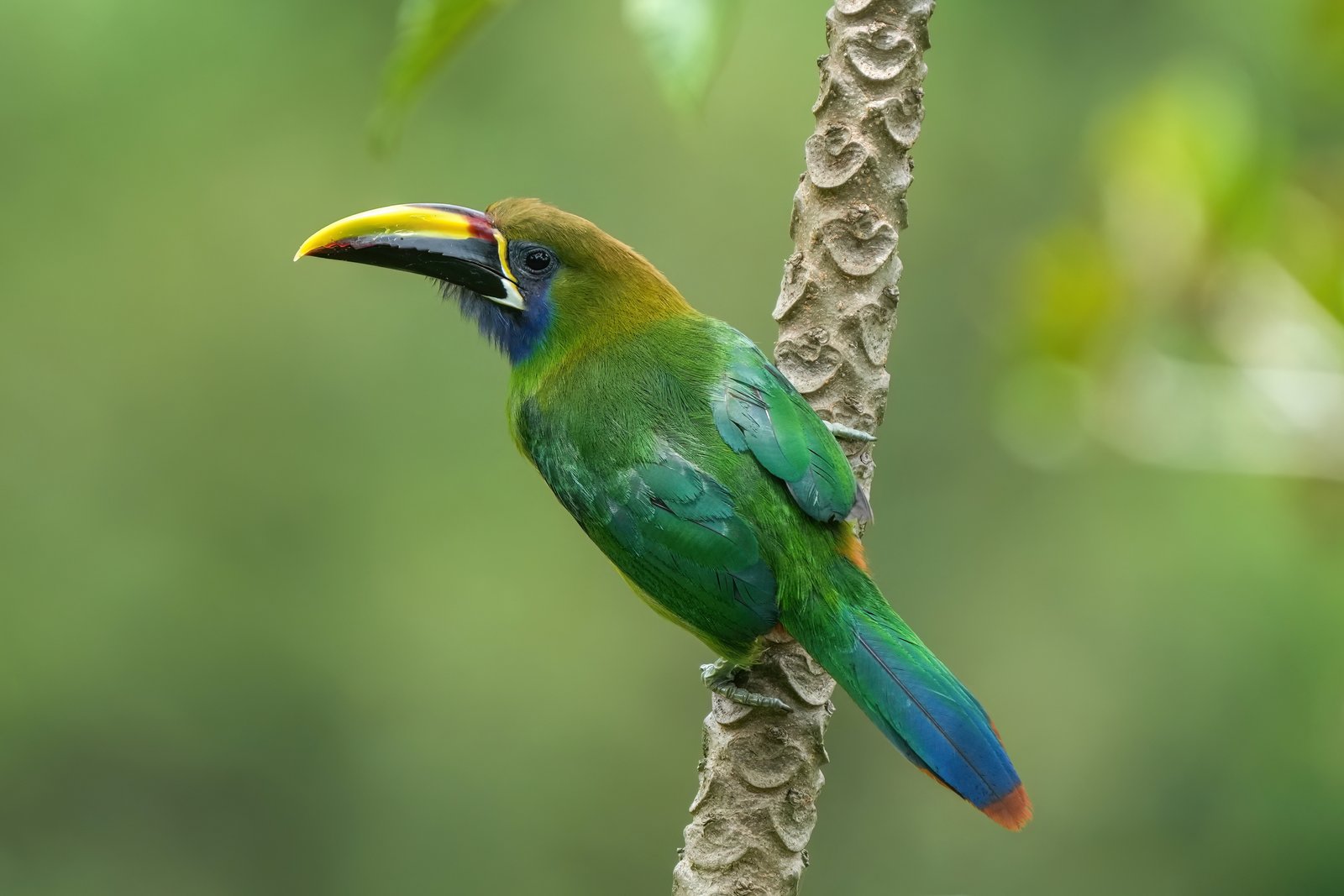
The Northern Emerald Toucanet is a small, grass-green toucan of montane forest from Mexico to Panama and the only mainly green toucan in the guide area. In the classification followed here the species includes all forms from Mexico to Panama, including the blue-throated forms of Costa Rica and Panama and the form of the Pacific mountains of Guerrero and Oaxaca (A. p. wagleri), which are treated elsewhere as separate species; the South American forms make up a separate species.
Voice
A long series of dry, barking or rasping krrek or kwak notes, recalling sawing or a croaking frog; members of a group often call together.
Recording: Orlando Jarquín G. — CC BY-NC-SA 4.0 · converted to mono · xeno-canto
Identification
29–37 cm; the birds of Mexico are the largest. The plumage is bright green, slightly yellower below, with chestnut undertail coverts and chestnut tips to the tail feathers. The throat is white in Mexico and northern Central America and blue in Costa Rica and Panama. The bill has a black lower mandible and a yellow or yellow-and-black upper mandible, with a narrow white band at the base. The eye is dark. The sexes are alike; the female has a slightly shorter bill.
Confusion species
No other toucan in the guide area is mainly green. The aracaris, such as Collared Aracari Pteroglossus torquatus, have yellow underparts with red and black, and Yellow-eared Toucanet Selenidera spectabilis has a black head and (in the male) black underparts with a yellow ear patch.
Habitat
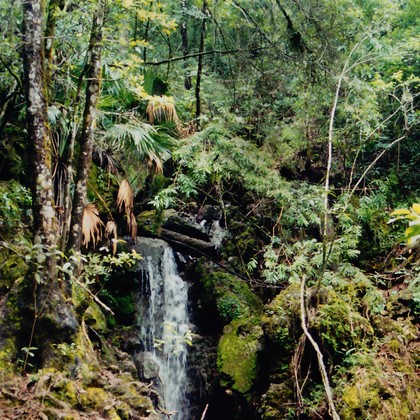
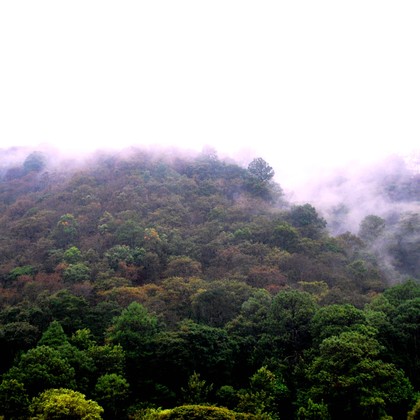
Cloud forest, montane rainforest, pine-oak forest and humid foothill forest, also forest edges, clearings with fruit trees and shade coffee; mostly between about 1000 and 3000 m, in northern Central America locally lower. After the breeding season many birds move down to lower forest, sometimes below 500 m. It lives in pairs or small groups in the middle and upper tree layers and eats fruit, insects, and eggs and nestlings of other birds. It nests in a tree cavity, often an old woodpecker hole.
Where the bird is most at home, classified by the vegetation units of Mexico and Central America.




Range and movements
In Mexico from San Luis Potosí and Hidalgo through Veracruz, Puebla and Oaxaca to Chiapas, with an isolated population in the Sierra de los Tuxtlas, and on the Pacific side in Guerrero and Oaxaca. Further in the mountains and foothills of Guatemala, Belize (Maya Mountains), El Salvador, Honduras, Nicaragua, Costa Rica and Panama, east to Darién. Outside the guide area only in extreme north-western Colombia.
- Resident
- dark = core range, pale = thinly spread
How and when to look
Common at Monteverde and San Gerardo de Dota in Costa Rica, at Boquete and Volcán in Panama and at El Triunfo in Chiapas. It often visits fruiting trees and feeders at lodges.
Conservation status
Least Concern. It disappears where montane forest is cleared but also occurs in secondary forest, forest edges and shade coffee.
Scientific name
Aulacorhynchus prasinus | (Gould, 1833)
Gould described the species in 1833 as Pteroglossus prasinus; because it was later moved to another genus, the author and year stand in brackets. The genus Aulacorhynchus was introduced in 1835 by Gould. Aulacorhynchus is Greek, from aulax, aulakos 'furrow' and rhunkhos 'bill', after the grooved bill. prasinus is Latin for 'leek-green', after the grass-green plumage. The specimen the first description was based on came from Valle Real, Mexico.