All species › Passerines › New World warblers › Golden-cheeked Warbler
Position in the tree Birds Aves › Birds with a flexible palate Neognathae › All other modern birds Neoaves › Landbirds Telluraves › Falcons, parrots and passerines Australaves › Falcons and passerines Eufalconimorphae › Parrots and passerines Psittacopasserae
Golden-cheeked Warbler | Setophaga chrysoparia
Geelwangzanger | Chipe mejilla dorada
The Golden-cheeked Warbler is a black-and-white warbler with a bright yellow face that breeds only in juniper-oak woodland in central Texas. The entire world population winters in the guide area, in the pine-oak forest of the highlands from Chiapas to Nicaragua.

Voice
The song is a buzzy, slightly hoarse series, roughly bzzz lay-zee day-zee; rarely heard in the guide area. The call is a dry tsik.
Recording: Nathan Wahler — CC BY-NC-SA 4.0 · converted to mono · xeno-canto
Identification
12–13 cm. Face bright yellow with a black line through the eye that continues to the nape. The male has a black crown, back, throat and breast, two broad white wing bars, a white belly and black streaks on the flanks. The female and young birds have an olive-green back with fine black streaks, a yellow or white throat with black mottling and a less sharp eye-line. The vent is white in every plumage.
Confusion species
Black-throated Green Warbler Setophaga virens has an olive-green cheek patch instead of a black eye-line, an olive-green crown and back and a yellow wash at the vent. Hermit Warbler Setophaga occidentalis has an all-yellow head without an eye-line and a grey back. Townsend's Warbler Setophaga townsendi has a dark cheek patch and a yellow breast.
Habitat
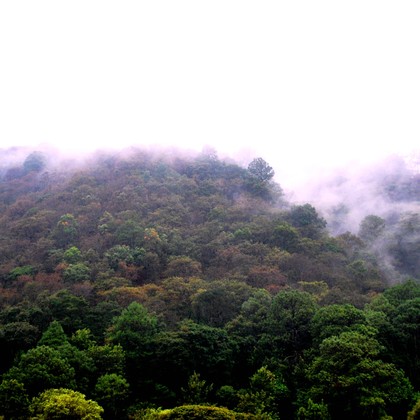
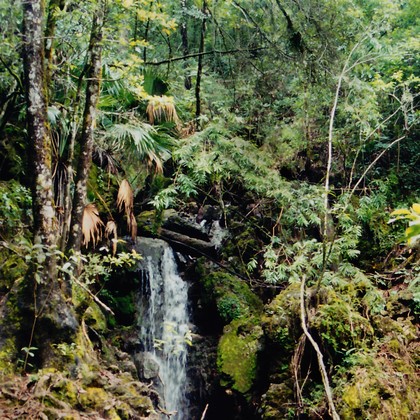
In winter pine-oak and oak forest in the highlands, mainly from about 1000 to 2600 m, also humid oak forest at the edge of cloud forest. It searches mainly in the crowns of oaks for insects and travels with mixed flocks of other warblers and vireos.
Where the bird is most at home, classified by the vegetation units of Mexico and Central America.
Range and movements
Breeds only on the Edwards Plateau and adjacent areas in central Texas. Migrates through the Sierra Madre Oriental of eastern Mexico in spring and in July and August. Winters in the highlands of Chiapas, Guatemala, El Salvador, Honduras and Nicaragua; rare in Costa Rica.
- Winter visitor (c. Oct–Mar)
- dark = core range, pale = thinly spread
How and when to look
In winter it can sometimes be found in mixed flocks in the pine-oak forest of the highlands of Honduras and Guatemala. The black eye-line through the yellow face separates it from the much more numerous Black-throated Green Warbler in the same flocks.
Conservation status
Endangered (EN). The breeding area in Texas is small and shrinking through development and clearance of juniper-oak woodland; on the wintering grounds pine-oak forest is being lost to logging and conversion to farmland.
Scientific name
Setophaga chrysoparia | (Sclater & Salvin, 1860)
Sclater & Salvin described the species in 1860 as Dendroeca chrysoparia; because it was later moved to another genus, the author and year stand in brackets. The genus Setophaga was introduced in 1827 by Swainson. Setophaga is Greek, from sēs, sētos 'moth' and -phagos '-eating': 'moth-eater'. chrysoparia is Greek, from khrusos 'gold' and pareia 'cheek', after the golden-yellow cheeks. The specimen the first description was based on came from Verapaz, Guatemala.