All species › Passerines › New World warblers › Hermit Warbler
Position in the tree Birds Aves › Birds with a flexible palate Neognathae › All other modern birds Neoaves › Landbirds Telluraves › Falcons, parrots and passerines Australaves › Falcons and passerines Eufalconimorphae › Parrots and passerines Psittacopasserae
Hermit Warbler | Setophaga occidentalis
Heremietzanger | Chipe cabeza amarilla
The Hermit Warbler is a grey-and-white warbler with an all-yellow head and, in the male, a black throat. It breeds in coniferous forest on the west coast of the United States and winters in the guide area in the pine-oak and coniferous forest of the mountains, from western Mexico to Nicaragua.

Voice
The song is a high, buzzy series, roughly seedle seedle seedle zeet, ending on a higher or lower note; in the guide area heard mainly in spring. The call is a flat tip.
Recording: Paul Marvin — CC BY-NC-SA 4.0 · converted to mono · xeno-canto
Identification
12–14 cm. Head entirely bright yellow, in the female and young birds with an olive-green or grey wash on the crown and behind the cheek. Back grey with fine dark streaks, two white wing bars. The male has a black throat; in the female the throat is yellow or white with at most a few black spots. Breast and belly white, the flanks unstreaked or only faintly streaked.
Confusion species
Townsend's Warbler Setophaga townsendi has a dark cheek patch, a yellow breast and black streaks on the flanks; hybrids between the two species, with intermediate head and breast patterns, occur. Black-throated Green Warbler Setophaga virens has an olive-green cheek patch, an olive-green back and a yellow wash at the vent. Golden-cheeked Warbler Setophaga chrysoparia has a black line through the eye.
Habitat
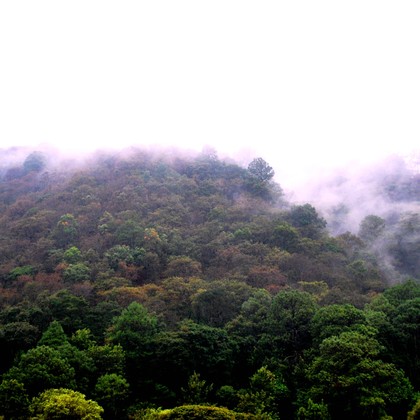
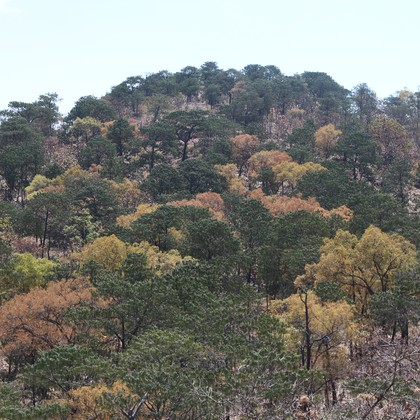
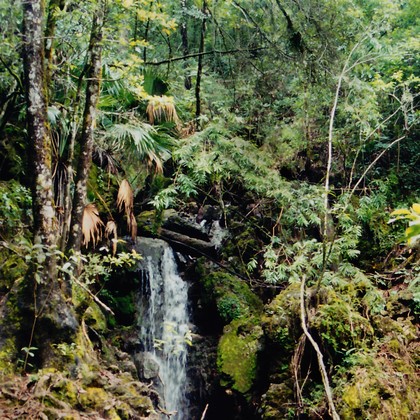
In winter pine-oak forest, coniferous forest and the higher parts of cloud forest, mainly from about 1500 to 3500 m. It searches for insects high in the crowns of pines and firs and travels with mixed flocks.
Where the bird is most at home, classified by the vegetation units of Mexico and Central America.

Range and movements
Breeds in coniferous forest from Washington to central California. Winters in the mountains of western and central Mexico, from Sinaloa and Durango, south through Chiapas to Guatemala, El Salvador, Honduras and Nicaragua; rare in Costa Rica. A small part of the population winters along the coast of California. On migration also in north-western Mexico.
- Winter visitor (c. Oct–Mar)
- dark = core range, pale = thinly spread
How and when to look
In winter found in mixed flocks in the coniferous forest of the mountains, for example in the highlands of Chiapas and Guatemala; the yellow head is usually the first thing seen in the crowns of the pines.
Conservation status
Not threatened (LC). Fairly common; the breeding population appears roughly stable.
Scientific name
Setophaga occidentalis | (Townsend, 1837)
Townsend described the species in 1837 as Sylvia occidentalis; because it was later moved to another genus, the author and year stand in brackets. The genus Setophaga was introduced in 1827 by Swainson. Setophaga is Greek, from sēs, sētos 'moth' and -phagos '-eating': 'moth-eater'. occidentalis is Latin for 'western', after its breeding range in western North America. The specimen the first description was based on came from Fort Vancouver, Washington.