All species › Cuckoos › Cuckoos › Grey-capped Cuckoo
Position in the tree Birds Aves › Birds with a flexible palate Neognathae › All other modern birds Neoaves › Doves, turacos and allies Columbaves › Bustards, turacos and cuckoos Otidimorphae
Grey-capped Cuckoo | Coccyzus lansbergi
Grijskopkoekoek | Cuclillo cabecigrís
Grey-capped Cuckoo is a cuckoo of north-western South America and in the guide area a vagrant, not a native species. The species is partly migratory, along routes that are poorly known. Only a few records are known from the guide area, in Panama.
Voice
A fast series of six to eight hollow, falling cu notes, often with a short pause before the last.
Recording: Tuomas Seimola — CC BY-NC-SA 4.0 · converted to mono · xeno-canto
Identification
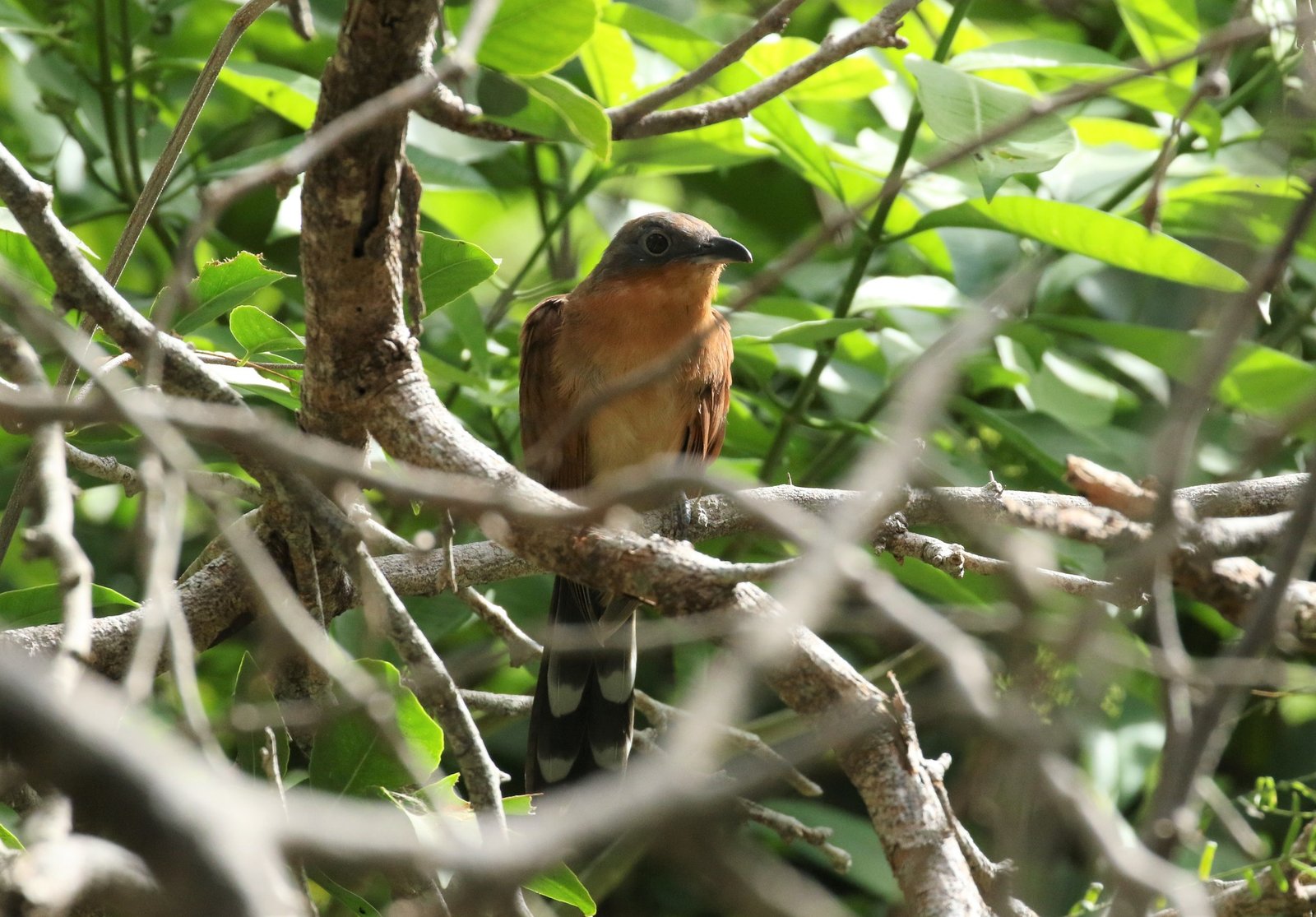
25–28 cm, about half of it tail. The crown and face down to below the eye are slate-grey, sharply set off against the rufous-brown upperparts and wings. The underparts are warm rusty buff. The bill is fairly stout, slightly decurved and black, sometimes with a pale spot at the base of the lower mandible. Around the eye is a narrow ring of yellowish to greyish-white bare skin. From below the tail is black with white tips.
Confusion species
Mangrove Cuckoo Coccyzus minor has grey-brown upperparts, a black mask and a yellow lower mandible. Little Cuckoo Coccycua minuta is smaller and entirely rufous, without a grey cap. Common Squirrel Cuckoo Piaya cayana is much larger, with a grey belly and a pale yellow bill.
Habitat
Dry and semi-deciduous forest, gallery forest and shrubby savanna, mainly in the lowlands.
Where the bird is most at home, classified by the vegetation units of Mexico and Central America.



Range and movements
In the guide area only a few records in Panama, mainly in the east of the country; in July 2018 a bird was seen at Juan Hombrón in Coclé. Breeds in western Ecuador and north-western Peru, and further in parts of Colombia and Venezuela.
How and when to look
A cuckoo with a grey cap, rufous-brown back and rusty underparts is worth investigating in Panama, especially in dry forest and scrub in the northern summer. A photograph or sound recording is almost indispensable for an accepted record.
Conservation status
Not threatened globally. In the guide area a vagrant with no regular presence.
Scientific name
Coccyzus lansbergi | Bonaparte, 1850
Bonaparte described the species in 1850 and placed it straight away in the genus where it still stands. The genus Coccyzus was introduced in 1816 by Vieillot. Coccyzus is Greek, from kokkuzō 'to cry cuckoo', after the cuckoo's call. lansbergi honours the Dutch diplomat and naturalist Reinhart Frans van Lansberge (d. 1873), consul in Colombia and later governor of Surinam. The specimen the first description was based on came from Bogotá, Colombia.