All species › Cuckoos › Cuckoos › Pearly-breasted Cuckoo
Position in the tree Birds Aves › Birds with a flexible palate Neognathae › All other modern birds Neoaves › Doves, turacos and allies Columbaves › Bustards, turacos and cuckoos Otidimorphae
Pearly-breasted Cuckoo | Coccyzus euleri
Witbuikkoekoek | Cuclillo ventriblanco
Pearly-breasted Cuckoo is a South American cuckoo and in the guide area a vagrant, not a native species. It closely resembles Yellow-billed Cuckoo, with which it was long confused. Only a few records are known from the guide area, in eastern Panama.
Voice
A series of five to fifteen, sometimes more, loud, frog-like kuoup notes; also a rattle resembling that of Yellow-billed Cuckoo.
Recording: Dante Buzzetti — CC BY-NC-SA 4.0 · shortened to the first 60 s, mono · xeno-canto
Identification
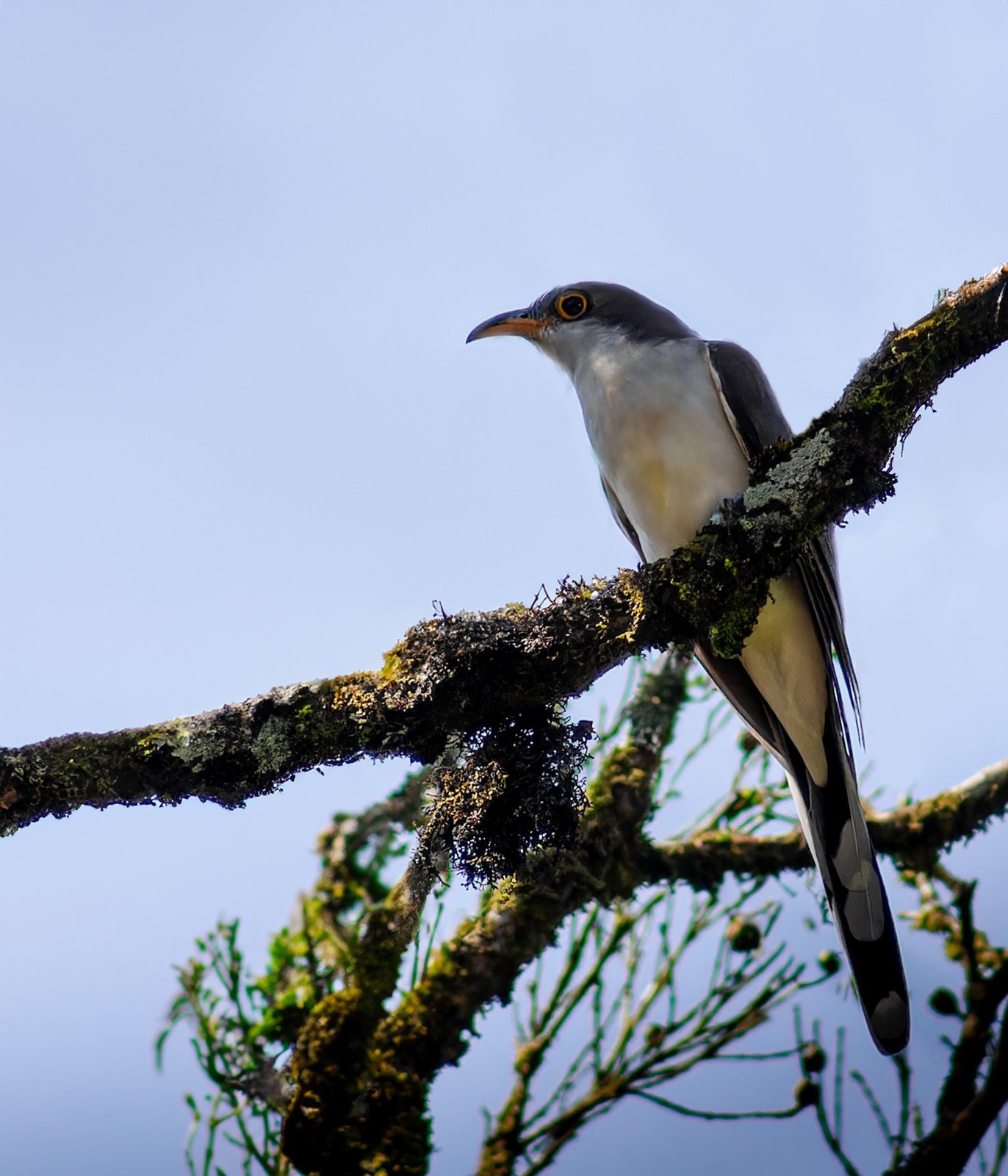
25–28 cm, slender and long-tailed, slightly smaller than Yellow-billed Cuckoo. Grey-brown above, the head slightly greyer, with dark grey ear coverts; pearly grey to white below. The bill is slightly decurved, with a black upper mandible and a yellow lower mandible. The primaries are brown, with no or almost no rufous patch. From below the tail is black with large white tips.
Confusion species
Yellow-billed Cuckoo Coccyzus americanus is almost identical but shows a clear rufous patch in the primaries, especially in flight. Black-billed Cuckoo Coccyzus erythropthalmus has an all-black bill and narrow white tail tips. Mangrove Cuckoo Coccyzus minor has a black mask and buff underparts.
Habitat
Forest edges, secondary forest and gallery forest in the lowlands.
Where the bird is most at home, classified by the vegetation units of Mexico and Central America.



Range and movements
In the guide area only a few records in eastern Panama, including in July 2014 in the Bayano area, where a bird was carrying nest material. Lives in South America, mainly east of the Andes, from Venezuela and the Guianas to Brazil, Bolivia, Paraguay and north-eastern Argentina.
How and when to look
A cuckoo that looks like a Yellow-billed Cuckoo but shows no rufous in the wing deserves a second look in eastern Panama; the call, a series of frog-like notes, helps with identification. A sound recording or a photograph of the wing is almost indispensable for an accepted record.
Conservation status
Not threatened globally. In the guide area a vagrant with no regular presence.
Scientific name
Coccyzus euleri | Cabanis, 1873
Cabanis described the species in 1873 and placed it straight away in the genus where it still stands. The genus Coccyzus was introduced in 1816 by Vieillot. Coccyzus is Greek, from kokkuzō 'to cry cuckoo', after the cuckoo's call. euleri honours the Swiss consul and ornithologist Carl Euler (1834–1901), who lived and worked in Brazil. The specimen the first description was based on came from Cantagalo, Rio de Janeiro, Brazil.