All species › Birds of prey › Kites, Old World vultures, eagles and hawks › Grey Hawk
Position in the tree Birds Aves › Birds with a flexible palate Neognathae › All other modern birds Neoaves › Landbirds Telluraves › Raptors, owls, kingfishers and woodpeckers Afroaves › Hawks and owls Hieraves
Grey Hawk | Buteo plagiatus
Grijze buizerd | Gavilán gris
The Grey Hawk is a compact, pale grey buzzard with finely grey-and-white barred underparts, a dark eye and a black tail with broad white bands. It hunts from a perch at a forest edge or along a river, mainly for lizards, and gives itself away with a whistled call. In the guide area it is a resident from northern Mexico to northwestern Costa Rica.

Voice
A clear, whistled, descending hoo-weeeoo, often in series; also a drawn-out, high scream kreeee.
Recording: Richard E. Webster — CC BY-NC-SA 4.0 · converted to mono · xeno-canto
Identification
41–46 cm, with fairly short, broad wings and a medium-length tail. Adults have a plain pale grey head and pale grey upperparts, and underparts with fine grey and white bars. The eye is dark, cere and legs are yellow. The tail is black with two or three white bands, the middle one the broadest, and a white rump. In flight the underwings are whitish with fine grey bars and dark tips. Young birds are brown above, with a pale head with a dark eye-stripe and moustachial stripe, white underparts with bold dark spots and barred thighs, and a brown tail with many narrow dark bands. Male and female are alike; the female is larger.
Confusion species
The Grey-lined Hawk Buteo nitidus is very similar to the Grey Hawk, but has fine grey-and-white bars on the back and only occurs from central Costa Rica southward. The Roadside Hawk Rupornis magnirostris has a pale eye, a brownish-grey breast, rufous bars on the belly and often rufous in the primaries. Young Broad-winged Hawks Buteo platypterus resemble young Grey Hawks, but have a less striking head pattern and no white rump.
Habitat
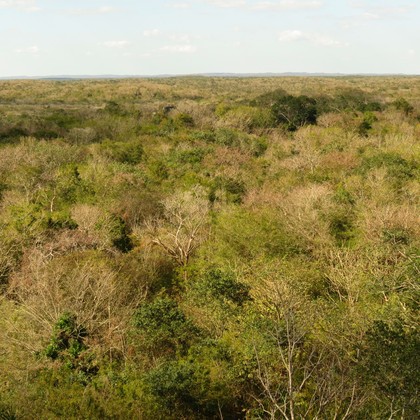
Riparian and gallery forest, dry and seasonal deciduous forest, forest edges and open woodland, mesquite and cottonwoods along rivers in the north, and pastures and plantations with tall trees, from the lowlands into the foothills. It often perches on a bare branch at a forest edge.
Where the bird is most at home, classified by the vegetation units of Mexico and Central America.






Range and movements
Resident from northwestern (Sonora) and northeastern Mexico (Nuevo León and Tamaulipas) south on both slopes through the lowlands, including the Yucatán Peninsula, and on through Belize, Guatemala, El Salvador, Honduras and Nicaragua to northwestern Costa Rica (Guanacaste). Scarce on the central plateau of Mexico. Outside the guide area it breeds in southern Arizona, New Mexico and Texas; some of those birds winter in Mexico.
- Resident
- dark = core range, pale = thinly spread
How and when to look
It often perches in full view on a bare branch at a forest edge or on a post and gives itself away with its whistled call. Common on the Yucatán Peninsula, along the Pacific coast of Mexico, such as around San Blas in Nayarit, and in Guanacaste.
Conservation status
Not threatened. Locally benefits from semi-open country.
Scientific name
Buteo plagiatus | (Schlegel, 1862) (GBIF: Buteo nitidus)
Schlegel described the species in 1862 as Asturina plagiata; because it was later moved to another genus, the author and year stand in brackets. The genus Buteo was introduced in 1799 by De Lacépède. Buteo is the Latin word for a buzzard. plagiatus is Latin; Schlegel's (1862) intended meaning is uncertain, but probably 'striped, barred' (from plaga 'stripe'), after the finely grey-and-white barred underparts. The specimen the first description was based on came from Veracruz, Mexico.