All species › Birds of prey › Kites, Old World vultures, eagles and hawks › Semiplumbeous Hawk
Position in the tree Birds Aves › Birds with a flexible palate Neognathae › All other modern birds Neoaves › Landbirds Telluraves › Raptors, owls, kingfishers and woodpeckers Afroaves › Hawks and owls Hieraves
Semiplumbeous Hawk | Leucopternis semiplumbeus
Kleine bonte buizerd | Gavilán semiplomizo
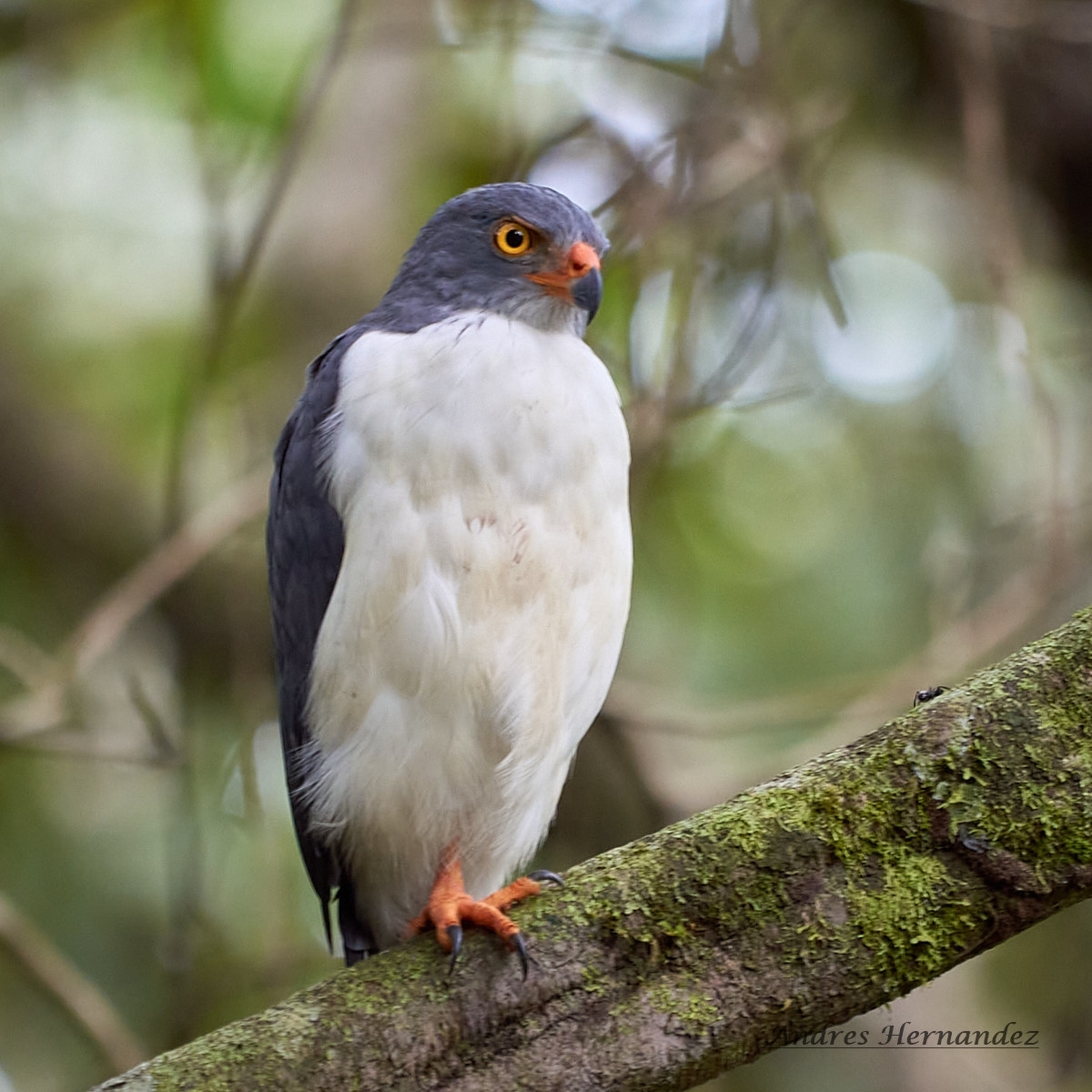
The Semiplumbeous Hawk is a small, stocky forest buzzard with dark slate-grey upperparts, white underparts, an orange cere and legs and a short black tail with a single narrow white band. It sits still for long periods in the canopy of humid lowland forest and catches lizards, frogs, snakes and small birds there. In the guide area it is a resident of the Caribbean lowlands from Honduras to Panama.
Voice
A high, plaintive, whistled kweeeeer, often repeated at length from the forest.
Recording: Patrick ODonnell — CC BY-NC-SA 4.0 · converted to mono · xeno-canto
Identification
31–37 cm, with short, rounded wings and a short tail. Head, nape and upperparts are dark slate grey, throat and underparts pure white. The eye is yellow-orange; cere and legs are bright orange. The tail is black with a single narrow white band halfway and a narrow white tip. In flight the underwings are white with dark tips. Young birds have fine dark streaks on the head and breast and white-barred wing coverts. Male and female are alike.
Confusion species
The White Hawk Pseudastur albicollis is much larger and has a white head and white upperparts. The Plumbeous Hawk Cryptoleucopteryx plumbea is slate grey below as well. The Bicolored Hawk Astur bicolor has grey underparts, rufous thighs and a long tail with several bands.
Habitat
The interior and edges of humid lowland forest and lower foothill forest, including the rainforest of Darién and old secondary forest bordering large forest. It perches at mid-level in the canopy and rarely soars over the forest.
Where the bird is most at home, classified by the vegetation units of Mexico and Central America.




Range and movements
Resident in humid lowland forest on the Caribbean side of eastern Honduras, Nicaragua and Costa Rica, and in Panama on both sides, east to Darién. Outside the guide area in western Colombia and northwestern Ecuador.
- Resident
- dark = core range, pale = thinly spread
How and when to look
It often sits still for a long time on a branch at mid-level in the forest or at a forest edge and is usually first noticed by its call. The Caribbean lowlands of Costa Rica and the forests of Soberanía and Darién in Panama are places where the species is regularly seen.
Conservation status
Not threatened. Dependent on humid lowland forest and therefore sensitive to deforestation.
Scientific name
Leucopternis semiplumbeus | Lawrence, 1861
Lawrence described the species in 1861 and placed it straight away in the genus where it still stands. The genus Leucopternis was introduced in 1847 by Kaup. Leucopternis is Greek, from leukos 'white' and pternis, a kind of hawk mentioned by Aristotle. semiplumbeus is Latin, from semi- 'half' and plumbeus 'lead-coloured', after the slate-grey upperparts above white underparts. The specimen the first description was based on came from Caribbean slope of Panama, along the railway across the isthmus.