All species › Waders, gulls and terns › Skimmers, noddies, terns and gulls › Grey-headed Gull
Position in the tree Birds Aves › Birds with a flexible palate Neognathae › All other modern birds Neoaves › Birds of the elements Elementaves › Cranes and waders Gruimorphae
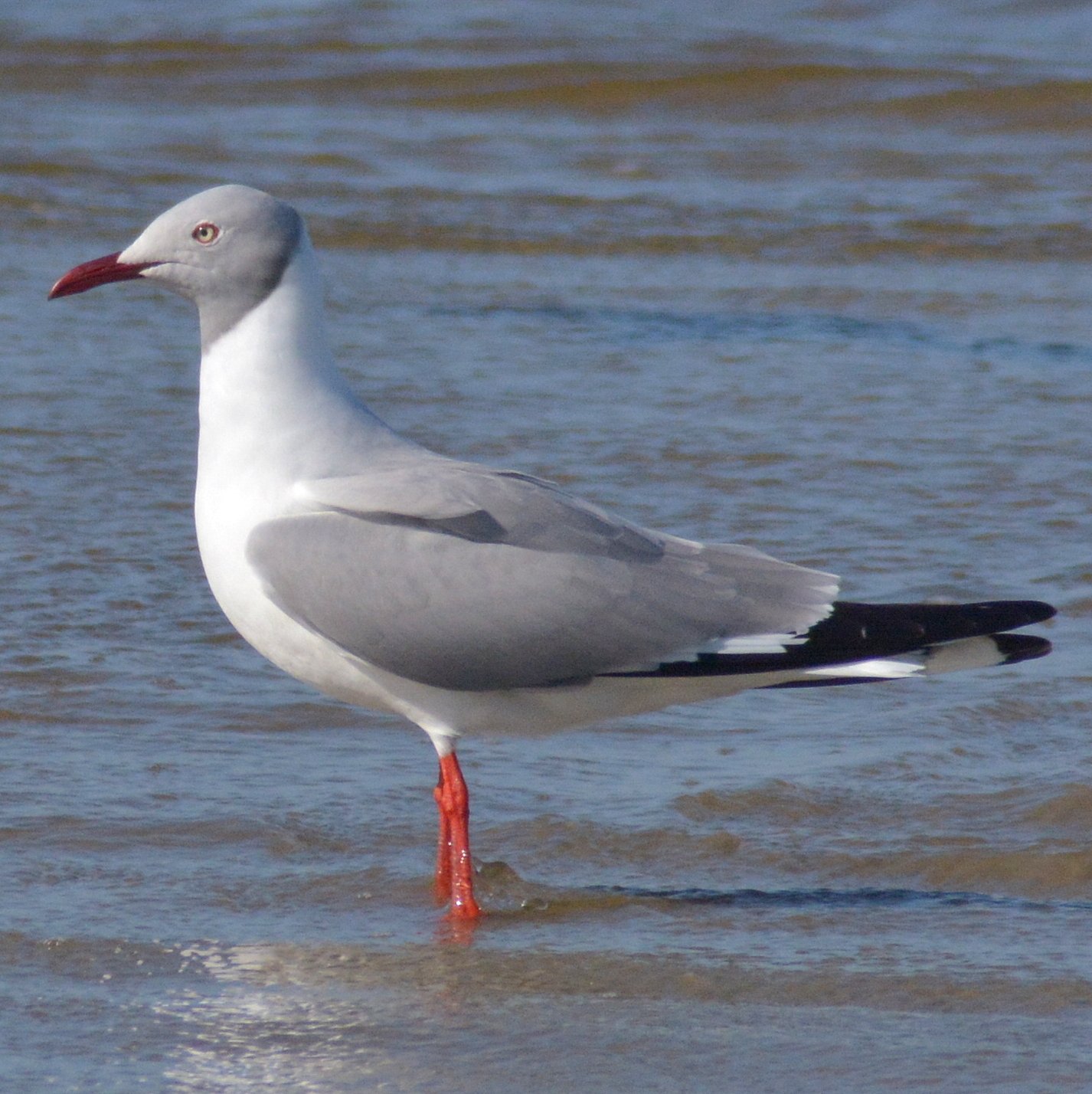
Grey-headed Gull | Chroicocephalus cirrocephalus
Grijskopmeeuw | Gaviota cabecigrís
The Grey-headed Gull is a medium-sized gull of South America and sub-Saharan Africa, and a vagrant in the guide area, not a native species. In South America it breeds along the coast of Ecuador and Peru and on lakes and rivers in the east of the continent. The few records here come from the Pacific coast in the south of the guide area.
Voice
A drawn-out, grating kaaarr and a hoarse kwerrk; in flocks a constant cackling.
Recording: Fabrício Grigolin — CC BY-NC-SA 4.0 · shortened to the first 60 s, mono · xeno-canto
Identification
40–42 cm, a medium-sized gull with a fairly long red bill and red legs. In breeding plumage adults have a pale grey hood with a darker rear border, a pale iris with a red eye-ring, a mid-grey mantle and a black outer wing with two large white mirrors and a white wedge on the leading edge; the underwing is conspicuously dark grey. In non-breeding plumage the hood fades to a grey wash or a dark spot behind the eye. Immatures have a brown bar across the wing coverts, a black terminal tail band, an orange bill with a dark tip and a dark eye.
Confusion species
Bonaparte's Gull Chroicocephalus philadelphia is much smaller, with a fine black bill, a dark eye and a pale underwing. Laughing Gull Leucophaeus atricilla and Franklin's Gull Leucophaeus pipixcan are darker grey, with a black hood in breeding plumage and no white wedge or mirrors in the outer wing.
Habitat
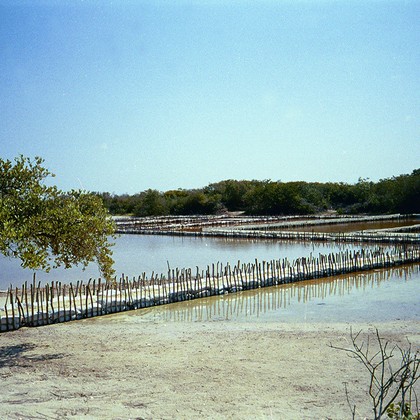
Coastal lagoons, estuaries, beaches and harbours, and in inland South America also lakes and rivers. It feeds while walking and swimming and takes fish, small crustaceans and refuse.
Where the bird is most at home, classified by the vegetation units of Mexico and Central America.



Range and movements
A small number of records in the guide area, on the Pacific coast of Panama and Costa Rica. Outside the guide area the species breeds along the coast of Ecuador and Peru, in eastern South America from Brazil to Argentina, and across much of sub-Saharan Africa and on Madagascar.
- Resident
- Summer visitor (c. Apr–Sep)
- dark = core range, pale = thinly spread
How and when to look
Flocks of gulls and terns on the Pacific coast of Panama, such as in the Bay of Panama, offer the best chance. The grey hood, the pale eye and the dark underwing with white mirrors set it apart from the regular gulls here.
Conservation status
Not threatened globally. The population is large and widespread. In the guide area a vagrant with no regular presence.
Scientific name
Chroicocephalus cirrocephalus | (Vieillot, 1818)
Vieillot described the species in 1818 as Larus cirrocephalus; because it was later moved to another genus, the author and year stand in brackets. The genus Chroicocephalus was introduced in 1836 by Eyton. Chroicocephalus combines the Ancient Greek khrōikos 'coloured' with -kephalos '-headed'. cirrocephalus comes from Modern Latin cirrus, 'cloud' (Latin cirrus, 'curl'), and Greek -kephalos, '-headed': 'cloud-headed', for the grey head. The name is based on Azara's 'Gabiota cenicienta' (ashy gull). The specimen the first description was based on came from Brazil.