All species › Grebes › Grebes › Least Grebe
Position in the tree Birds Aves › Birds with a flexible palate Neognathae › All other modern birds Neoaves › Flamingos and grebes Mirandornithes
Least Grebe | Tachybaptus dominicus
Amerikaanse dodaars | Zambullidor menor
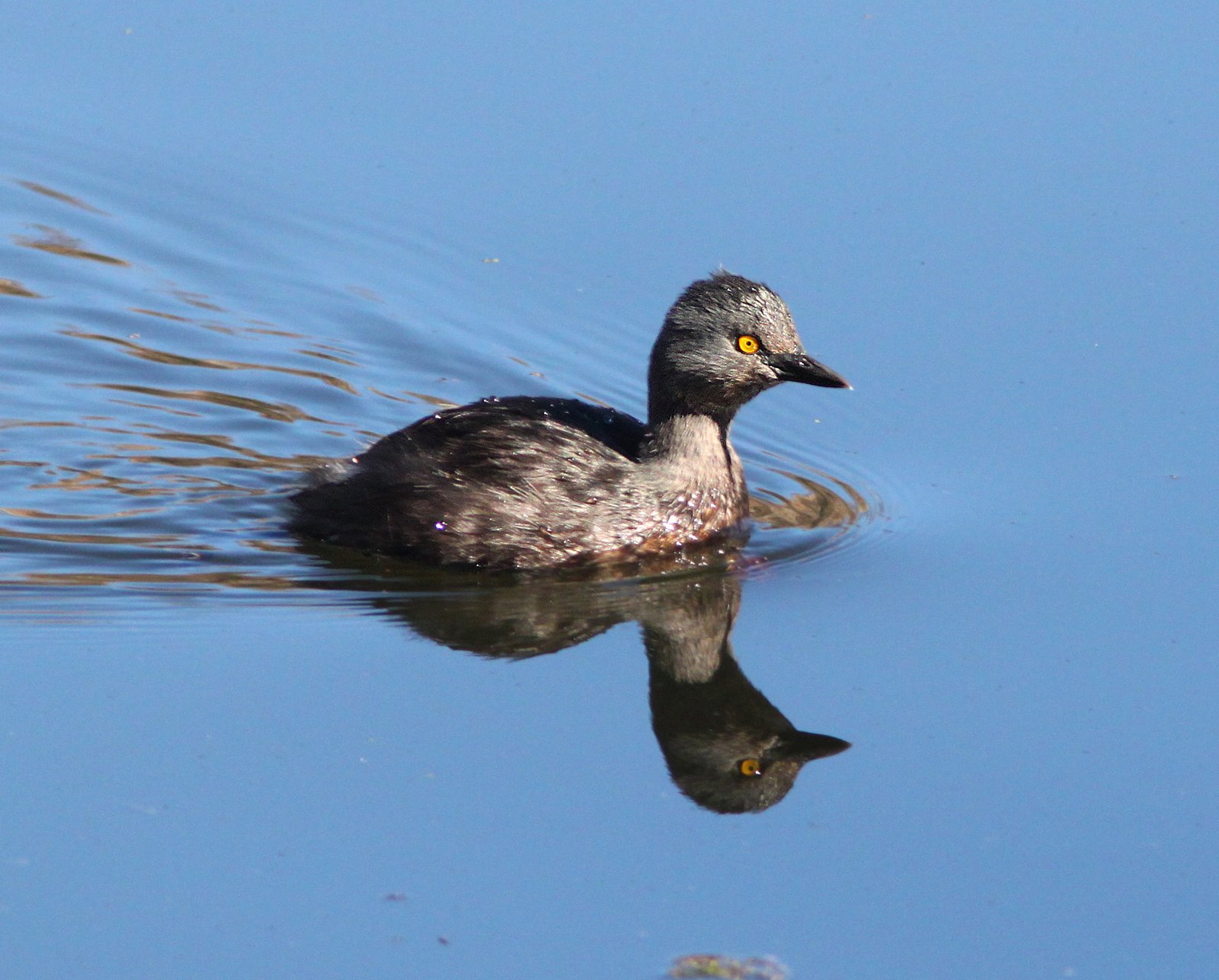
The Least Grebe is the smallest grebe in the guide area: a dark, rounded waterbird with a bright yellow eye. It occurs from north-western Mexico to Panama, on almost every small, vegetated pond in the lowlands. When disturbed it would rather dive than fly.
Voice
A rapid, rattling trill, often given by both birds of a pair as a duet; also a short, shrill peek or beenk. The courtship call has been compared to the whinnying of a horse.
Recording: Manuel Grosselet — CC BY-NC-SA 4.0 · converted to mono · xeno-canto
Identification
21–27 cm, small and rounded, with a thin, pointed, dark bill and a golden-yellow to orange-yellow eye. In breeding plumage almost uniformly dark grey-brown, with a blackish crown and throat and a greyer head; breast and flanks are browner. Outside the breeding season paler, with a white throat and a pale bill base. Juveniles have dark and pale stripes on the head. In flight, which is seldom seen, a white wing patch. Sits low in the water, with no visible tail and the white rear end sometimes fluffed up. Southern Baja California has a subspecies of its own, T. d. bangsi; elsewhere in the guide area T. d. brachypterus.
Confusion species
Pied-billed Grebe Podilymbus podiceps is larger and browner, with a thick, pale bill and a dark eye. Eared Grebe Podiceps nigricollis is larger, with a red eye and, in winter plumage, a white throat and cheek patch. The female Masked Duck Nomonyx dominicus also swims low and dives, but is a duck, with a broad bill, a stiff tail and two dark stripes across the face.
Habitat
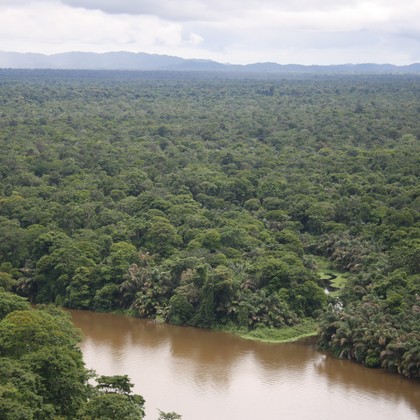
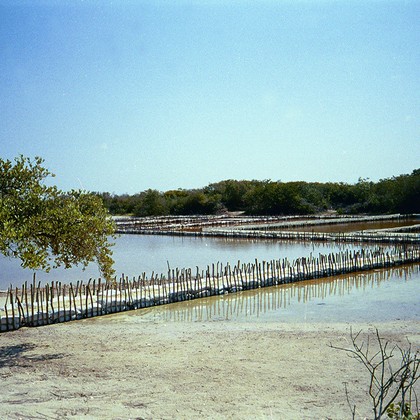
Small, shallow freshwater pools and ponds with plenty of floating plants and fringing vegetation, cattail marshes, ditches and canals, rice fields, cattle ponds and temporary rain pools; locally also brackish pools behind mangroves. Mainly in the lowlands, but in Mexico locally up to about 2500 m. It eats small fish, insects and their larvae and other invertebrates, caught by diving. The nest is a floating heap of plant material anchored to vegetation; it breeds almost all year round wherever there is water.
Where the bird is most at home, classified by the vegetation units of Mexico and Central America.



Range and movements
Resident over almost all of Mexico, from southern Baja California and Sonora along the Pacific side and from Tamaulipas along the Gulf coast to the Yucatán Peninsula; scarcer and more local in the dry interior of the north, and almost absent from northern Baja California. Also in Guatemala, Belize, Honduras, El Salvador, Nicaragua, Costa Rica and Panama. Outside the guide area in southern Texas, the Greater Antilles and South America to northern Argentina.
- Resident
- dark = core range, pale = thinly spread
How and when to look
Small, densely vegetated ponds with some open water are the best bet, as are cattle ponds and roadside pools. Examples are the lagoons of the Yucatán Peninsula and Palo Verde in Costa Rica. The rattling duet often gives a pair away before the birds are seen.
Conservation status
Not threatened; common and widespread in the guide area. Habitat is lost locally through the draining of small wetlands, but the species is also quick to occupy new water, such as farm ponds and reservoirs.
Scientific name
Tachybaptus dominicus | (Linnaeus, 1766)
Linnaeus described the species in 1766 as Colymbus dominicus; because it was later moved to another genus, the author and year stand in brackets. The genus Tachybaptus was introduced in 1853 by Reichenbach. Tachybaptus is Greek, from takhus 'fast' and baptō 'to sink under, dive'. dominicus means 'of Santo Domingo', the old name for Hispaniola. The specimen the first description was based on came from Hispaniola (Santo Domingo).