All species › Flamingos › Flamingos › American Flamingo
Position in the tree Birds Aves › Birds with a flexible palate Neognathae › All other modern birds Neoaves › Flamingos and grebes Mirandornithes
American Flamingo | Phoenicopterus ruber
Rode flamingo | Flamenco del Caribe
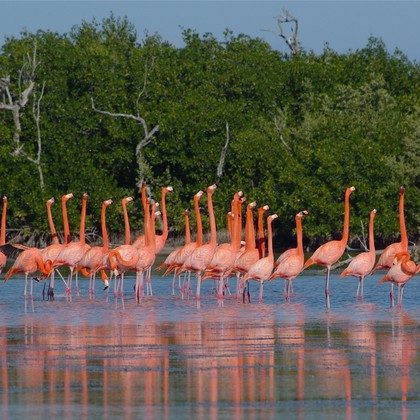
The American Flamingo is the only flamingo of the guide area and the most richly coloured of all flamingos: pink to orange-red over head, neck and body. In the guide area it lives almost only along the coast of the Yucatán Peninsula, where it breeds in a few large colonies and feeds in flocks in the lagoons all year.

Voice
Goose-like: a nasal, honking ka-ha, mainly in flight; feeding flocks keep up a low, continuous gabbling, which swells to a loud din at a colony.
Recording: FREDERIC Lionel — CC BY-NC-SA 4.0 · shortened to the first 60 s, mono · xeno-canto
Identification
120–145 cm, with a very long neck and very long legs. Adults are pink to coral red, brightest on the head, neck and breast; the wing coverts are deep red, the flight feathers black and visible only in flight or when the wings are spread. The bill is bent in the middle, with a pale base, a pink to orange middle section and a black tip; the legs are pink. Juveniles are greyish-brown with a pink wash, a grey bill with a black tip and grey legs, and colour up only after several years. It flies with neck and legs outstretched, in long lines or loose Vs.
Confusion species
Its shape makes it unmistakable in the guide area. Roseate Spoonbill Platalea ajaja is much smaller, with a shorter, white neck and a flat spatulate bill. Birds turning up far from the Yucatán coast may be escapes from collections and belong to other species: Chilean Flamingo Phoenicopterus chilensis is paler, with grey legs with red joints and a bill that is more than half black.
Habitat
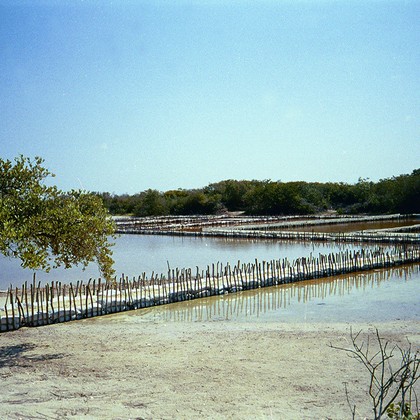
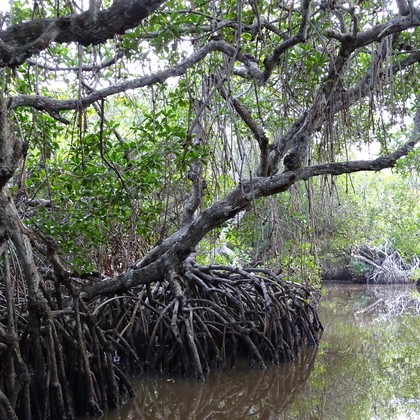
Shallow saltpans, saline and brackish coastal lagoons and estuaries, tidal flats and shallow bays behind mangroves. It feeds while walking with its head upside down in the water, filtering small crustaceans, molluscs, insect larvae and algae from water and mud. It breeds in dense colonies on bare mudbanks, where each pair builds a flattened mud cone with a single egg.
Where the bird is most at home, classified by the vegetation units of Mexico and Central America.

Range and movements
Coast of the state of Yucatán, with the main breeding colony in Ría Lagartos and recently also a breeding site in Ría Celestún; outside the breeding season large flocks feed mainly in Ría Celestún, on the border with Campeche. Further along the coast of Campeche and northern Quintana Roo, including around Holbox and Laguna Yalahau. Elsewhere along the Gulf coast of Mexico, in Belize and in the rest of Central America a rare visitor; birds inland in Mexico are usually escapes. Outside the guide area in the Caribbean (mainly Cuba, the Bahamas and Bonaire), along the coasts of Colombia and Venezuela, on the Galápagos and in small numbers in Florida.
- Resident
- Summer visitor (c. Apr–Sep)
- Winter visitor (c. Oct–Mar)
- Passage (Mar–Apr, Oct–Nov)
- dark = core range, pale = thinly spread
How and when to look
In Ría Celestún flocks can be seen all year, with the largest numbers in winter; boat trips leave from the village of Celestún. At Ría Lagartos and Las Coloradas they feed in the saltpans. The breeding colony itself is closed to visitors.
Conservation status
Not threatened; the world population is increasing. The Yucatán population has grown strongly since the mid-twentieth century thanks to the protection of the breeding areas in the Ría Lagartos and Ría Celestún biosphere reserves. Disturbance of the colony, salt extraction, coastal development and hurricanes remain threats.
Scientific name
Phoenicopterus ruber | Linnaeus, 1758
Linnaeus described the species in 1758 and placed it straight away in the genus where it still stands. He introduced the genus Phoenicopterus in that same work. Phoenicopterus is Greek, from phoinix 'crimson' and pteron 'feather', thus 'red-feathered'. ruber is Latin for 'red', after this species' deep rose-red plumage. The specimen the first description was based on came from the West Indies.