All species › Waterfowl › Ducks, swans and geese › Lesser Scaup
Position in the tree Birds Aves › Birds with a flexible palate Neognathae › Fowl Galloanserae
Lesser Scaup | Aythya affinis
Kleine topper | Porrón bola
The Lesser Scaup is the diving duck that winters furthest south and the most numerous one in the guide area: from the lakes of northern Mexico to the lagoons and reservoirs of Panama. Large, dense flocks often sit on open water, far from the shore.
Voice
Usually silent in winter. The female has a harsh, purring karr-karr, especially when taking off; the displaying male a soft, whistled whee-oo.
Recording: Stanislas Wroza — CC BY-NC-SA 4.0 · converted to mono · xeno-canto
Identification
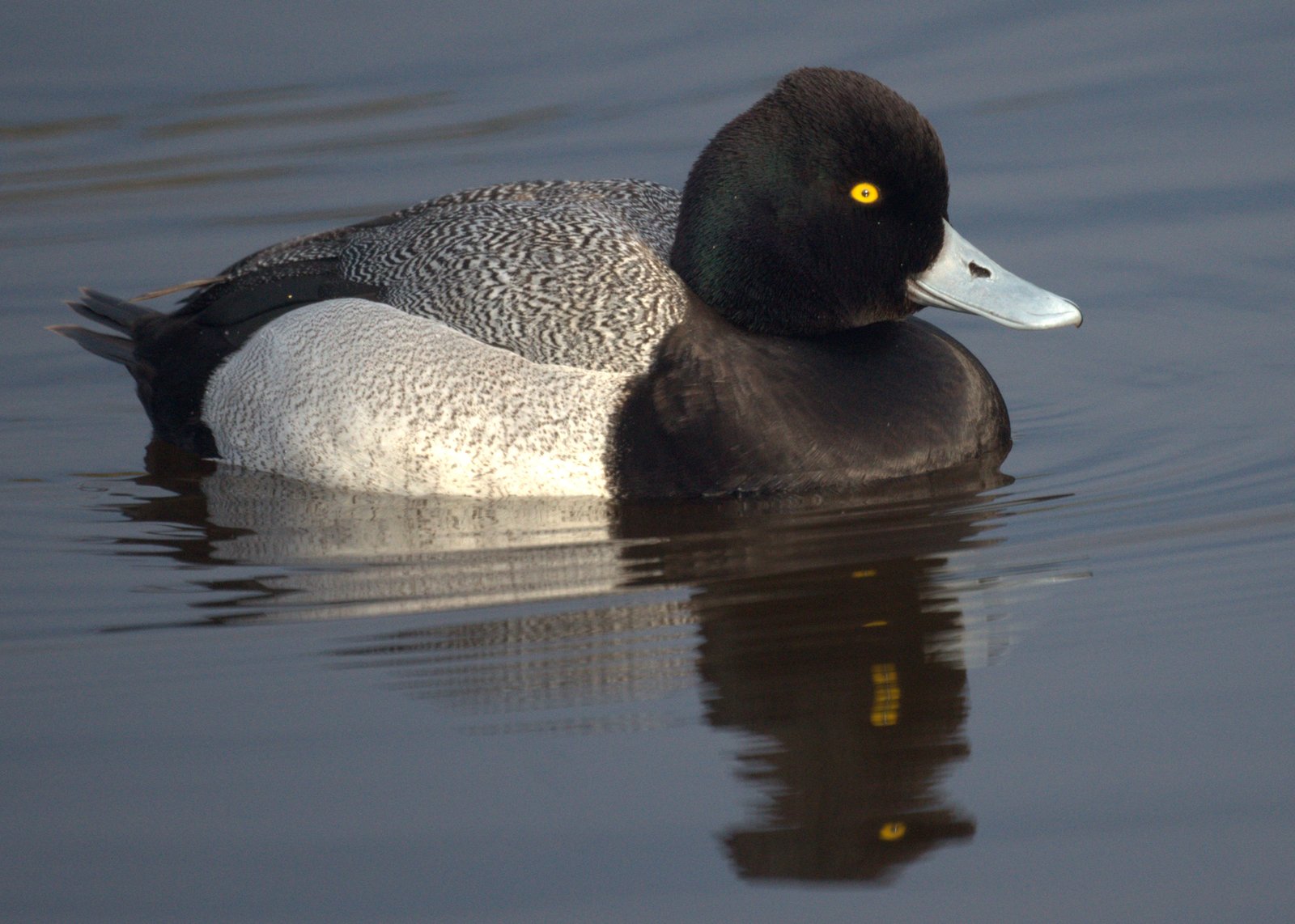
38–48 cm, a medium-sized diving duck with a head that forms a small peak at the back of the crown. The male has a black head with a mainly purple gloss, a black breast and stern, a grey, finely vermiculated back and whitish flanks, often with a grey wash. The eye is yellow, the bill blue-grey with a small black nail at the tip. The female is brown, with a sharply defined white patch around the base of the bill and a yellow eye. In flight a white stripe across the secondaries that becomes grey on the primaries.
Confusion species
Greater Scaup Aythya marila, scarce in the guide area, is larger and has a rounder head with more green gloss, a broader bill with a larger black nail and a paler back; in flight the white wing stripe extends far onto the primaries. Head shape is the most reliable feature, but it depends on posture. Ring-necked Duck Aythya collaris has a black back, a white ring on the bill and, in the male, a white wedge in front of the grey flanks; the female has a dark eye and no sharp white patch at the bill.
Habitat
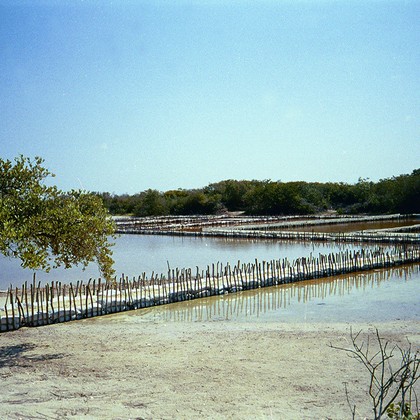
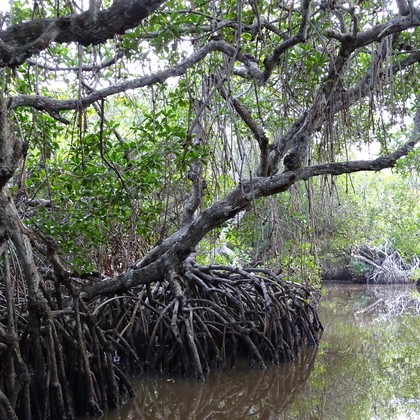
Lakes, reservoirs and crater lakes, also in the mountains, and shallow coastal lagoons, bays, harbours and brackish waters behind mangroves. It dives for molluscs, crustaceans, insect larvae and water plants. By day it often rests in flocks on open water.
Where the bird is most at home, classified by the vegetation units of Mexico and Central America.


Range and movements
Winters throughout Mexico, from Baja California, Sonora, Chihuahua and Tamaulipas to Chiapas and the Yucatán Peninsula, both on the coast and on lakes on the plateau. In Central America common to fairly common in Guatemala, Belize, El Salvador, Honduras, Nicaragua and Costa Rica, and locally in Panama. Some continue to north-western South America. Breeds in Alaska, Canada and the northern United States.
- Winter visitor (c. Oct–Mar)
- dark = core range, pale = thinly spread
How and when to look
Large lakes and reservoirs with open water, such as the crater lakes and highland lakes of Guatemala, Nicaragua and the Mexican plateau; the flocks sometimes hold Ring-necked Ducks and the odd Greater Scaup.
Conservation status
Not threatened globally. The North American population has declined clearly since the 1980s; possible causes are poorer condition of the birds through changes in their food and loss of breeding habitat in the boreal north. In the guide area a common winter visitor.
Scientific name
Aythya affinis | (Eyton, 1838)
Eyton described the species in 1838 as Fuligula affinis; because it was later moved to another genus, the author and year stand in brackets. The genus Aythya was introduced in 1822 by Boie. Aythya is from Greek aithuia, an unidentified diving seabird mentioned by Aristotle and Hesychius. affinis is Latin for 'related to', after the close resemblance to the greater scaup. The specimen the first description was based on came from North America.