All species › Waterfowl › Ducks, swans and geese › Redhead
Position in the tree Birds Aves › Birds with a flexible palate Neognathae › Fowl Galloanserae
Redhead | Aythya americana
Amerikaanse tafeleend | Pato cabeza roja
The Redhead is a sturdy diving duck of the prairie marshes of North America. A large part of the world population winters in the Laguna Madre, the shallow lagoon behind the barrier islands of Texas and Tamaulipas, where the birds feed in dense flocks on seagrass. Elsewhere in the guide area the species is much scarcer.

Voice
Largely silent in winter. The displaying male has a cat-like, upslurred meeow; the female a low, harsh krrr.
Recording: Stanislas Wroza — CC BY-NC-SA 4.0 · converted to mono · xeno-canto
Identification
40–56 cm, with a rounded head, a steep forehead and a fairly short bill. The male has a uniform reddish-brown head and neck, a black breast and stern and a grey, finely vermiculated back and flanks. The eye is yellow. The bill is blue-grey with a narrow white band and a black tip. The female is a uniform warm brown, with a paler area around the base of the bill, a faint pale eye-ring and the same, but duller, bill pattern. In flight a broad grey wing bar across the secondaries. Males in eclipse resemble females but keep the yellow eye.
Confusion species
Canvasback Aythya valisineria is larger and paler, with a white back and flanks, a long, wedge-shaped profile and a long black bill that runs in one line into the forehead; the female has a sandy head and a grey back. Ring-necked Duck Aythya collaris is smaller, with a peaked head, a black back and, in the female, an obvious eye-ring. The female Lesser Scaup Aythya affinis has a sharp white patch at the base of the bill and a yellow eye.
Habitat
Shallow coastal lagoons with seagrass, brackish and saline lagoons and bays; inland large lakes, reservoirs and saline lakes on the plateau. It feeds mainly on submerged plants, in the Laguna Madre above all on the rhizomes of seagrass. In winter it lives in flocks, sometimes of many thousands of birds.
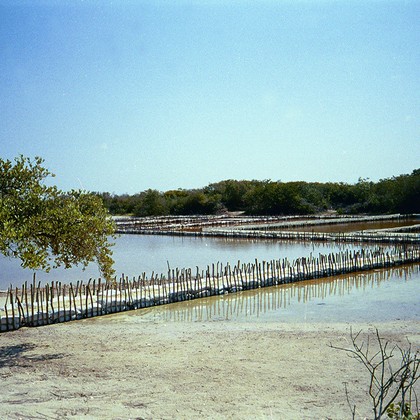
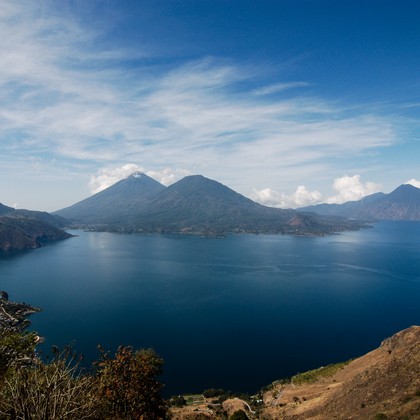
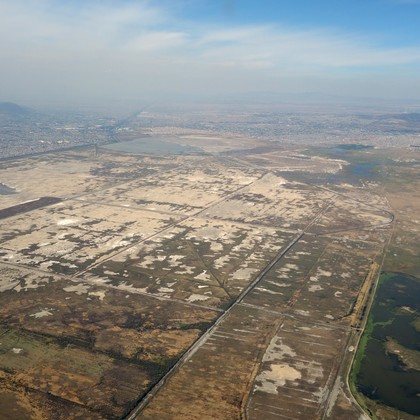
Where the bird is most at home, classified by the vegetation units of Mexico and Central America.

Range and movements
Winters mainly along the coast of Tamaulipas, in the Laguna Madre and in lagoons further south along the Gulf coast to Veracruz. Further in smaller numbers on lakes and reservoirs in Baja California, Sonora, Chihuahua, Durango and on the central plateau to Jalisco, Michoacán and Guanajuato, and locally along the Gulf coast to Tabasco and the Yucatán Peninsula. A few birds remain through the summer in northern Mexico. Rare in Central America, with a few records in Guatemala and Belize, among other places. Breeds in western and central North America.
- Winter visitor (c. Oct–Mar)
- dark = core range, pale = thinly spread
How and when to look
The lagoons of the Laguna Madre in Tamaulipas in the winter months, where large, dense rafts of red-headed ducks lie on the open water; elsewhere in Mexico often among other diving ducks on lakes on the plateau.
Conservation status
Not threatened globally. The North American population has increased in recent decades. Because a large share of the birds winters on a single lagoon system, the species is sensitive to the decline of the seagrass beds through pollution, dredging and changes in salinity.
Scientific name
Aythya americana | (Eyton, 1838)
Eyton described the species in 1838 as Fuligula americana; because it was later moved to another genus, the author and year stand in brackets. The genus Aythya was introduced in 1822 by Boie. Aythya is from Greek aithuia, an unidentified diving seabird mentioned by Aristotle and Hesychius. americana means 'American', after its North American breeding range. The specimen the first description was based on came from North America (not specified).