All species › Gamebirds › New World quail › Long-tailed Wood Partridge
Position in the tree Birds Aves › Birds with a flexible palate Neognathae › Fowl Galloanserae
Long-tailed Wood Partridge | Dendrortyx macroura
Mexicaanse bospatrijs | Codorniz coluda neovolcánica
The Long-tailed Wood Partridge is a large, long-tailed quail of the montane forests of central and southern Mexico. With its black head with white stripes it is the most boldly marked of the three wood partridges. The species lives hidden in dense undergrowth and is noticed mainly by its loud duets at dusk and dawn.

Voice
A complex, loud and rhythmic song, usually as a duet between male and female, carrying far through the forest at dusk and dawn. When alarmed, a repetition of short, low, squeaky notes.
Recording: Manuel Grosselet — CC BY-NC-SA 4.0 · converted to mono · xeno-canto
Identification
29–42 cm; a large quail with a long tail, a short crest tipped buff, and a red bill and red legs. Most of the head is black, with a white stripe above and a white stripe below the eye. The upper back is chestnut edged grey, the lower back a mixture of olive-brown, black and tawny. The breast is blue-grey streaked chestnut. The female has a slightly shorter tail and is on average lighter than the male. Six subspecies are recognised, differing mainly in the tone of the breast and upperparts.
Confusion species
Bearded Wood Partridge Dendrortyx barbatus of the Sierra Madre Oriental lacks the black-and-white head and has a blue-grey throat and head with a buff crown and a cinnamon breast. Ocellated Quail Cyrtonyx ocellatus and Montezuma Quail Cyrtonyx montezumae have a black-and-white patterned head, but are much smaller, round and short-tailed. Singing Quail Dactylortyx thoracicus is smaller and has a cinnamon or grey throat without white stripes.
Habitat
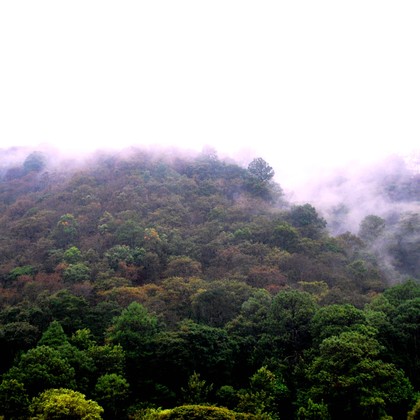
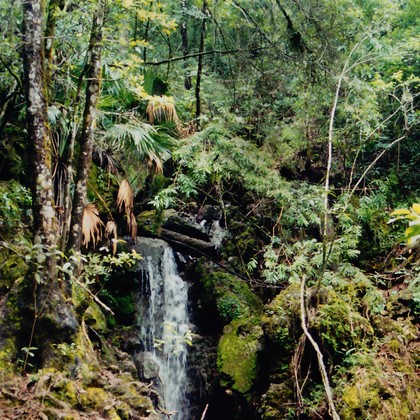
Humid pine-oak forest, pine forest, sacred fir forest (Abies religiosa) and evergreen montane forest with dense undergrowth, between about 1200 and 3300 m. It lives in pairs or small groups on the forest floor and keeps to dense vegetation. It eats seeds, fruit, buds and invertebrates.
Where the bird is most at home, classified by the vegetation units of Mexico and Central America.

Range and movements
Only in Mexico, in four separate areas: the Trans-Mexican Volcanic Belt from Jalisco and Michoacán to the Valley of Mexico, Morelos, Puebla and western Veracruz, the Sierra Madre del Sur in Guerrero, and the mountains of Oaxaca. The species does not occur outside the guide area.
- Resident
- dark = core range, pale = thinly spread
How and when to look
The duets are best heard at sunrise and sunset in the montane forests around the volcanoes in the state of México and Morelos, and in the mountains of Guerrero and Oaxaca. Seeing one is difficult; the chances are best on quiet forest trails early in the morning.
Conservation status
Not threatened. Locally fairly common, but vulnerable to hunting and the loss of forest with dense undergrowth; some isolated subspecies have a small range.
Scientific name
Dendrortyx macroura | (Jardine & Selby, 1828)
Jardine & Selby described the species in 1828 as Ortyx macroura; because it was later moved to another genus, the author and year stand in brackets. The genus Dendrortyx was introduced in 1844 by Gould. Dendrortyx is Greek, from dendron 'tree' and ortux 'quail': 'tree quail', after its forest life. macroura is Greek, from makros 'long' and oura 'tail', after the long tail. The specimen the first description was based on came from Mexico.