All species › Gamebirds › New World quail › Buffy-crowned Wood Partridge
Position in the tree Birds Aves › Birds with a flexible palate Neognathae › Fowl Galloanserae
Buffy-crowned Wood Partridge | Dendrortyx leucophrys
Witkeelbospatrijs | Codorniz coluda centroamericana
The Buffy-crowned Wood Partridge is the wood partridge of the mountains of Central America, from Chiapas to Costa Rica. It is a large, long-tailed quail of the forest floor that lives in groups and makes itself heard mainly at dusk and dawn with loud, hoarse whistled series. The three wood partridges (Dendrortyx) occur only in the guide area.
Voice
A rapid series of loud, hoarse whistles, rendered as kee-orr-KWA, often preceded by softer notes and sung by several birds together. Heard mainly in the early morning and at dusk.
Recording: MiriamEaglemon — CC BY-NC-SA 4.0 · converted to mono · xeno-canto
Identification
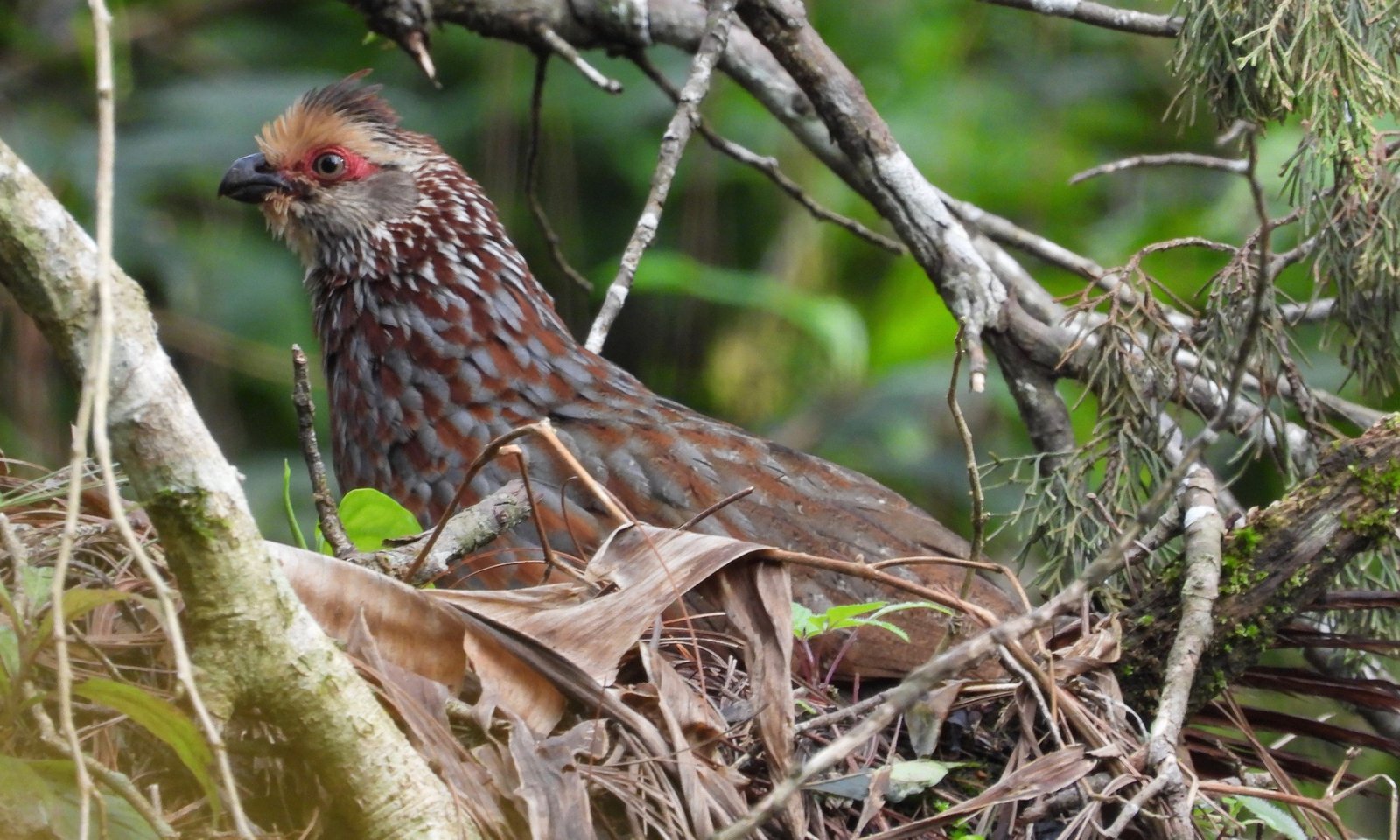
28–35 cm; a large, slender quail with a long, often slightly cocked tail and a short, rounded crest. In the nominate form (D. l. leucophrys, Chiapas to Nicaragua) the forehead, supercilium, chin and throat are white and the bare skin around the eye is red. The crown, crest and hindneck are chestnut, the back, wings and tail a mixture of chestnut and grey, and the breast and belly blue-grey streaked chestnut. The subspecies D. l. hypospodius in Costa Rica is larger and greyer, with very dark, narrow breast streaks. Male and female are almost alike.
Confusion species
Wood quails such as Spotted Wood Quail Odontophorus guttatus are smaller and more compact, with a short tail, and lack the white throat and the grey, streaked underparts. Singing Quail Dactylortyx thoracicus is much smaller and shorter-tailed. Tinamous, such as Great Tinamou Tinamus major, have an almost invisible tail, a thin bill and no crest.
Habitat
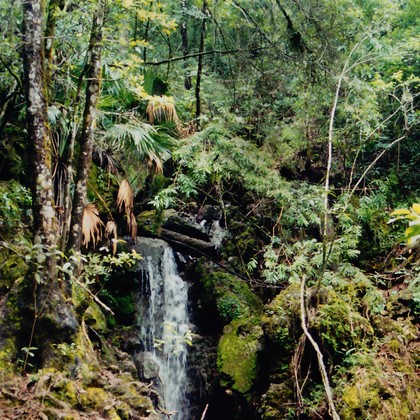
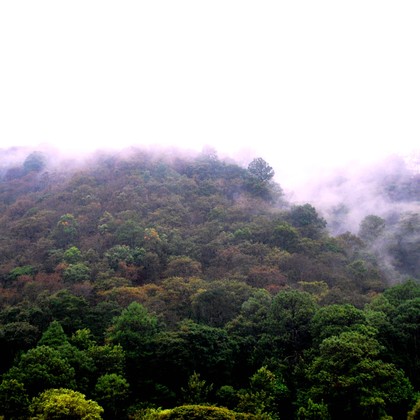
Humid to semi-humid montane forest: oak and pine-oak forest, evergreen montane forest and cloud forest, also secondary forest, logged forest and shade coffee plantations. It lives in groups on the ground and escapes danger by running into cover; it flies only when it has to. It eats seeds, fruit, buds and invertebrates.
Where the bird is most at home, classified by the vegetation units of Mexico and Central America.



Range and movements
In the mountains of Chiapas, Guatemala, El Salvador, Honduras and Nicaragua, and after a gap in the highlands of Costa Rica. The species does not occur outside the guide area.
- Resident
- dark = core range, pale = thinly spread
How and when to look
The loud whistled series carry far at dusk, for example in the montane forests of the Guatemalan highlands and in the Cordillera Central and the Talamanca range in Costa Rica. Early in the morning groups sometimes cross quiet forest trails and country lanes.
Conservation status
Not threatened. It tolerates some disturbance and also occurs in secondary forest and coffee plantations, but it is hunted and locally suffers from forest loss.
Scientific name
Dendrortyx leucophrys | (Gould, 1844)
Gould described the species in 1844 as Ortyx leucophrys; because it was later moved to another genus, the author and year stand in brackets. The genus Dendrortyx was introduced in 1844 by Gould. Dendrortyx is Greek, from dendron 'tree' and ortux 'quail': 'tree quail', after its forest life. leucophrys is Greek, from leukos 'white' and ophrus 'eyebrow', after the pale eyebrow stripe. The specimen the first description was based on came from Cobán, Guatemala.