All species › Parrots › African and New World parrots › Mealy Amazon
Position in the tree Birds Aves › Birds with a flexible palate Neognathae › All other modern birds Neoaves › Landbirds Telluraves › Falcons, parrots and passerines Australaves › Falcons and passerines Eufalconimorphae › Parrots and passerines Psittacopasserae
Mealy Amazon | Amazona farinosa
Grote amazone | Loro corona azul
The Mealy Amazon is the largest amazon of the guide area: a heavily built, mostly green parrot with a broad white eye-ring and a back that looks dusted with flour. It lives in humid lowland forest from southern Mexico to Panama and beyond in South America. Birds from Mexico to western Panama are treated by some authors as a separate species.

Voice
Very loud and varied: a deep chok-chok or kluk-kluk, rolling and grating cries and a whistled chewee; groups carry far, especially in flight to and from the roost.
Recording: Juan Freile — CC BY-NC-SA 4.0 · converted to mono · xeno-canto
Identification
38–41 cm. Green, with a greyish, powdery bloom on the back and mantle; the tail is fairly long with a broad yellow-green terminal band. Around the eye a broad, bare white ring. The crown is blue or blue-grey in the north of the guide area (A. f. guatemalae), mostly green with little blue from Nicaragua to western Panama (A. f. virenticeps) and green, sometimes with a small yellow spot, in eastern Panama (A. f. inornata). In flight a red wing speculum and dark blue tips to the flight feathers. The bill is dark with a pale base. The sexes are alike.
Confusion species
Red-lored Amazon Amazona autumnalis is smaller, with a red forehead and yellow cheeks. Yellow-crowned Amazon Amazona ochrocephala, in the guide area only in Panama, is smaller, has yellow on the forehead and crown and a narrower eye-ring. White-crowned Parrot Pionus senilis and Blue-headed Parrot Pionus menstruus are smaller, with red undertail coverts.
Habitat
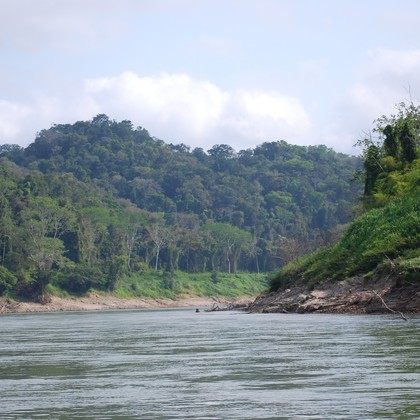
Tall humid lowland and foothill forest, also forest edges, old secondary forest and shaded cacao and coffee plantations with tall trees; mostly below 1000 m, locally higher. It eats fruit, seeds and nuts in the canopy. It nests in a cavity high in a large tree.
Where the bird is most at home, classified by the vegetation units of Mexico and Central America.





Range and movements
From southern Mexico (southern Veracruz, Oaxaca, Tabasco, Chiapas and southern Campeche and Quintana Roo) through Belize, the Petén and the Caribbean lowlands of Guatemala and Honduras to Nicaragua, Costa Rica and Panama; mainly on the Caribbean side, in Costa Rica and Panama also on the Pacific side (Osa, Darién). Outside the guide area in northern and central South America, south to Bolivia and eastern Brazil.
- Resident
- dark = core range, pale = thinly spread
How and when to look
Pairs and groups fly high over the forest shortly after sunrise and can then be recognised by their loud calls and slow, shallow wingbeats; good places are the Selva Lacandona, Tikal, the Caribbean lowlands of Costa Rica and the Canal area in Panama.
Conservation status
Least Concern. In Mexico and northern Central America it has declined sharply through clearance of lowland forest and nest poaching; the northern form, treated by some authors as a separate species, has become locally scarce there.
Scientific name
Amazona farinosa | (Boddaert, 1783)
Boddaert described the species in 1783 as Psittacus farinosus; because it was later moved to another genus, the author and year stand in brackets. The genus Amazona was introduced in 1830 by Lesson. Amazona comes from 'Amazone', the French name Buffon gave to various tropical American parrots because they came from the Amazon region. farinosa is Latin for 'mealy, floury', after the greyish, powdery bloom over the green plumage. The specimen the first description was based on came from Cayenne, French Guiana.