All species › Swifts › Hummingbirds › Mexican Sheartail
Position in the tree Birds Aves › Birds with a flexible palate Neognathae › All other modern birds Neoaves › Birds of the elements Elementaves › Nightjars and swifts Strisores
Mexican Sheartail | Doricha eliza
Mexicaanse schaarstaartkolibrie | Colibrí tijereta mexicano
The Mexican Sheartail is a small hummingbird found only in Mexico, in two widely separated areas: the north coast of the Yucatán Peninsula and central Veracruz. The male has a purple throat and a deeply forked tail. Owing to the loss of coastal scrub and dry forest the species is listed as Near Threatened.

Voice
A dry, high chip or tsik, and in chases a short twitter.
Recording: Esau Toaki Villarreal — CC BY-NC-SA 4.0 · converted to mono · xeno-canto
Identification
8–9 cm, with a fairly long, slightly decurved black bill. The male is green above, with a glittering rose-purple throat, white breast and belly, green flanks and a deeply forked dark tail, shorter than in Slender Sheartail. The female has a dark eyestripe with a pale supercilium, whitish underparts with buff flanks and a rounded tail with a rufous base, a black band and white tips.
Confusion species
Ruby-throated Hummingbird Archilochus colubris, common in Yucatán and Veracruz in winter, has a straight bill; the male has a red throat and a shorter tail. Canivet's Emerald Cynanthus canivetii has a red base to the bill and the male is all green; the female has a white stripe behind the eye and grey underparts. Buff-bellied Hummingbird Amazilia yucatanensis is larger, with a red bill and a rufous tail.
Habitat
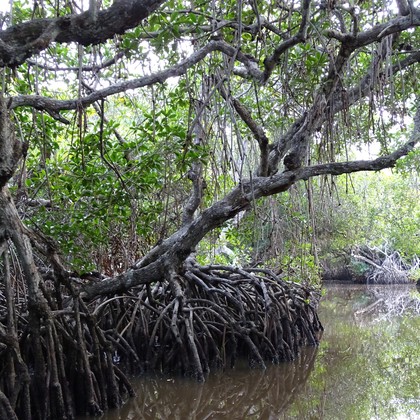
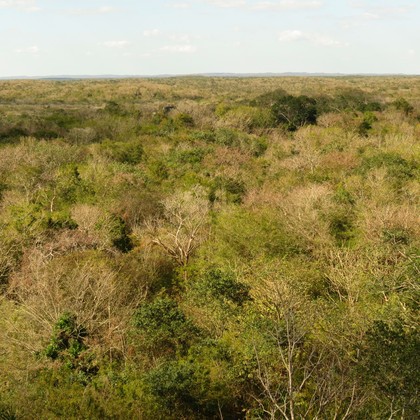
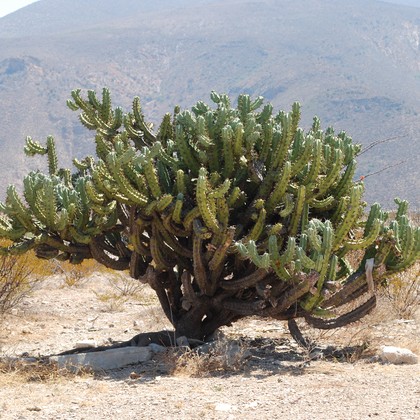
In Yucatán low coastal scrub and dune vegetation behind the beach, mangrove edges and dry scrub, also gardens in coastal villages. In Veracruz tropical dry forest, scrub and gardens in the lowlands and low hills. It feeds low at flowers of shrubs and herbs.
Where the bird is most at home, classified by the vegetation units of Mexico and Central America.


Range and movements
Endemic to the guide area and to Mexico. One population along the north coast of the Yucatán Peninsula, from northern Campeche to the northeast of Yucatán state, and a second population in central Veracruz, in the lowlands and low hills between Xalapa and the Gulf coast.
- Resident
- dark = core range, pale = thinly spread
How and when to look
In Yucatán in the coastal scrub along the road between Progreso and Telchac and at Sisal, Celestún and Río Lagartos; in Veracruz in the dry scrub east of Xalapa.
Conservation status
Near Threatened. The range is small and fragmented. Development of the Yucatán coast and conversion of dry forest and scrub to farmland in Veracruz reduce its habitat.
Scientific name
Doricha eliza | (Lesson & Delattre, 1839)
Lesson & Delattre described the species in 1839 as Trochilus eliza; because it was later moved to another genus, the author and year stand in brackets. The genus Doricha was introduced in 1854 by Reichenbach. Doricha is named after Doricha (fl. 700 BC), a famous Greek courtesan or hetaira. eliza honours Éliza Lefèvre (fl. 1840), wife of the French zoologist Amédée Lefèvre. The specimen the first description was based on came from between Veracruz and Xalapa, Veracruz, Mexico.