All species › Swifts › Hummingbirds › Ruby-throated Hummingbird
Position in the tree Birds Aves › Birds with a flexible palate Neognathae › All other modern birds Neoaves › Birds of the elements Elementaves › Nightjars and swifts Strisores
Ruby-throated Hummingbird | Archilochus colubris
Robijnkeelkolibrie | Colibrí garganta rubí
The Ruby-throated Hummingbird is the only hummingbird that breeds in eastern North America. Almost the entire world population winters in Mexico and Central America, where in the northern winter it is one of the most numerous hummingbirds of the dry lowlands. Some birds cross the Gulf of Mexico in a single non-stop flight.

Voice
A dry, short tchew or tchip, and in chases a rapid, twittering squeaking. The wings give a soft hum in flight, slightly higher in the male.
Recording: Anne McCormack — CC BY-NC-SA 4.0 · shortened to the first 60 s, mono · xeno-canto
Identification
8–9 cm, with a straight, medium-length black bill. The male is glossy green above, with a metallic ruby-red throat that looks black in poor light, a black face and chin, a white breast below the throat and greyish-green flanks; the tail is forked and dark. The female has a white throat and underparts, pale greyish-buff flanks and a rounded tail with white tips to the outer feathers. Young males have a streaked throat, often with a few red feathers.
Confusion species
Female and young Black-chinned Hummingbird Archilochus alexandri are almost identical; that species has a slightly longer bill, broader and more rounded inner primaries, a duller crown and pumps its tail more. Male Black-chinned has a black throat with a purple lower edge. Females of Selasphorus species, such as Rufous Hummingbird Selasphorus rufus, show rufous on the flanks and at the base of the tail.
Habitat
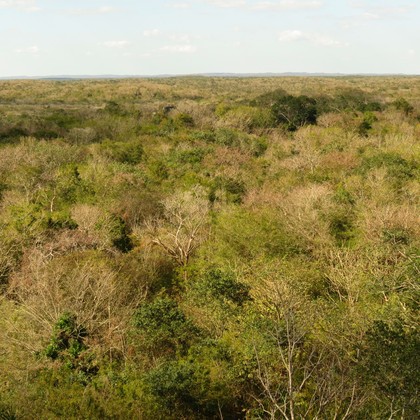
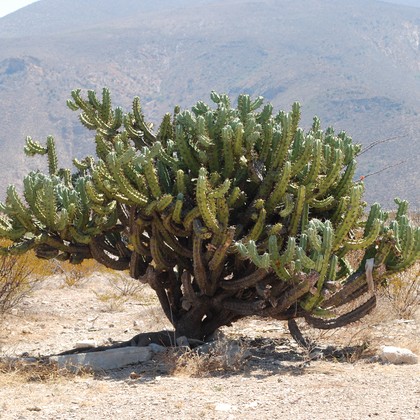
In winter mainly dry and semi-deciduous forest, thorn scrub, forest edges, gallery forest, citrus and coffee plantations and gardens with flowering trees and shrubs, from sea level to about 1500 m. It defends flower-rich spots and also takes small insects and spiders.
Where the bird is most at home, classified by the vegetation units of Mexico and Central America.





Range and movements
Winters from southern Mexico, mainly on the Pacific side and on the Yucatán Peninsula, through Guatemala, Belize, El Salvador, Honduras and Nicaragua to Costa Rica; scarce in western Panama. On migration numerous along the Gulf coast of Tamaulipas and Veracruz. Does not breed in the guide area; the breeding range lies in the eastern United States and southern Canada.
- Winter visitor (c. Oct–Mar)
- dark = core range, pale = thinly spread
How and when to look
In the northern winter at flowering trees and shrubs along forest edges and in gardens in the dry Pacific lowlands and on Yucatán. In September and October and again in March and April large numbers move along the coast of the Gulf of Mexico.
Conservation status
Least Concern. The world population is large and appears to be increasing. The species depends on flower-rich dry forest and scrub in its wintering area.
Scientific name
Archilochus colubris | (Linnaeus, 1758)
Linnaeus described the species in 1758 as Trochilus Colubris; because it was later moved to another genus, the author and year stand in brackets. The genus Archilochus was introduced in 1854 by Reichenbach. Archilochus honours the Greek poet Archilochus of Paros (7th century BC); Reichenbach named many hummingbird genera after classical figures. colubris is a Latinised form of colibri, the French and Spanish name for a hummingbird. The specimen the first description was based on came from South Carolina, United States.