All species › Cuckoos › Cuckoos › Mexican Squirrel Cuckoo
Position in the tree Birds Aves › Birds with a flexible palate Neognathae › All other modern birds Neoaves › Doves, turacos and allies Columbaves › Bustards, turacos and cuckoos Otidimorphae
Mexican Squirrel Cuckoo | Piaya mexicana
Kaneelkoekoek | Cuclillo canelo mexicano
The Mexican Squirrel Cuckoo is the squirrel cuckoo of the dry Pacific slope of Mexico, recently recognised as a separate species. It lives only in Mexico, from Sonora to the Isthmus of Tehuantepec, and does not occur outside the guide area. It is paler and brighter than the Common Squirrel Cuckoo of the Gulf slope and Central America, and has a different tail pattern.

Voice
Similar to Common Squirrel Cuckoo: a loud keep-wheeoo, a series of clear whistles and a dry, rattling chik-chik-chik. The song seems to average slightly higher and faster, with sharper notes, but the differences have not yet been studied well.
Recording: Efraín Octavio Aguilar Pérez — CC BY-NC 4.0 · converted to mono · iNaturalist
Identification
45–50 cm, more than two thirds of it tail; the tail averages longer than in Common Squirrel Cuckoo. The head, upperparts and wings are bright rufous to cinnamon, the throat pale ochre. The lower breast is grey and the belly and undertail coverts pale grey. Below, the tail feathers are rufous, with a broad black band before the tip and a broad white tip. The bill is greenish-yellow, the eye red with a greenish-grey bare eye-ring. The sexes are alike.
Confusion species
Common Squirrel Cuckoo Piaya cayana of the Gulf slope and southern Mexico is darker rufous, with a dark grey to blackish belly, an all-black undertail with white tips and a greenish-yellow eye-ring; the two species meet around the Isthmus of Tehuantepec. Greater Roadrunner Geococcyx californianus and Lesser Roadrunner Geococcyx velox are streaked and live mainly on the ground.
Habitat
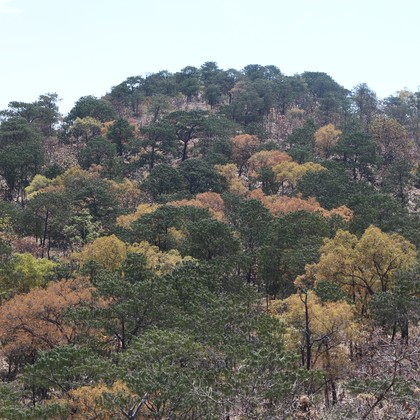
Dry and semi-dry deciduous forest, thorn forest, gallery forest along rivers and forest edges, also the lower edges of oak forest, from sea level to about 2000 m. It forages like Common Squirrel Cuckoo, running and leaping through the branches after large caterpillars and other insects. It incubates its own eggs, in a nest of leaves and twigs.
Where the bird is most at home, classified by the vegetation units of Mexico and Central America.




Range and movements
Endemic to Mexico. On the Pacific slope from southern Sonora and south-western Chihuahua through Sinaloa, Durango, Nayarit, Jalisco, Colima, Michoacán and Guerrero to Oaxaca, west of the Isthmus of Tehuantepec, and inland in the Balsas basin in Morelos, Puebla and the State of México, with outliers to Zacatecas and Aguascalientes.
- Resident
- dark = core range, pale = thinly spread
How and when to look
In dry forest and gallery forest along rivers on the Pacific coast, for example around San Blas in Nayarit, in Colima and Jalisco, and in the dry valleys of Morelos. The long rufous tail is obvious at once in flight; the call often gives it away first.
Conservation status
Not threatened. Fairly common in the dry forest of western Mexico, but dependent on a habitat that is heavily fragmented by farming and cattle ranching.
Scientific name
Piaya mexicana | (Swainson, 1827) (GBIF: Piaya cayana)
Swainson described the species in 1827 as Cuculus Mexicanus; because it was later moved to another genus, the author and year stand in brackets. The genus Piaya was introduced in 1830 by Lesson. Piaya comes from Piaye, 'devil (bird)', the Creole name in Cayenne for the Squirrel Cuckoo, regarded as a bird of ill omen. mexicana means 'of Mexico', where the species was described from. The specimen the first description was based on came from Temascaltepec, Mexico.