All species › Cuckoos › Cuckoos › Common Squirrel Cuckoo
Position in the tree Birds Aves › Birds with a flexible palate Neognathae › All other modern birds Neoaves › Doves, turacos and allies Columbaves › Bustards, turacos and cuckoos Otidimorphae
Common Squirrel Cuckoo | Piaya cayana
Eekhoornkoekoek | Cuclillo canela
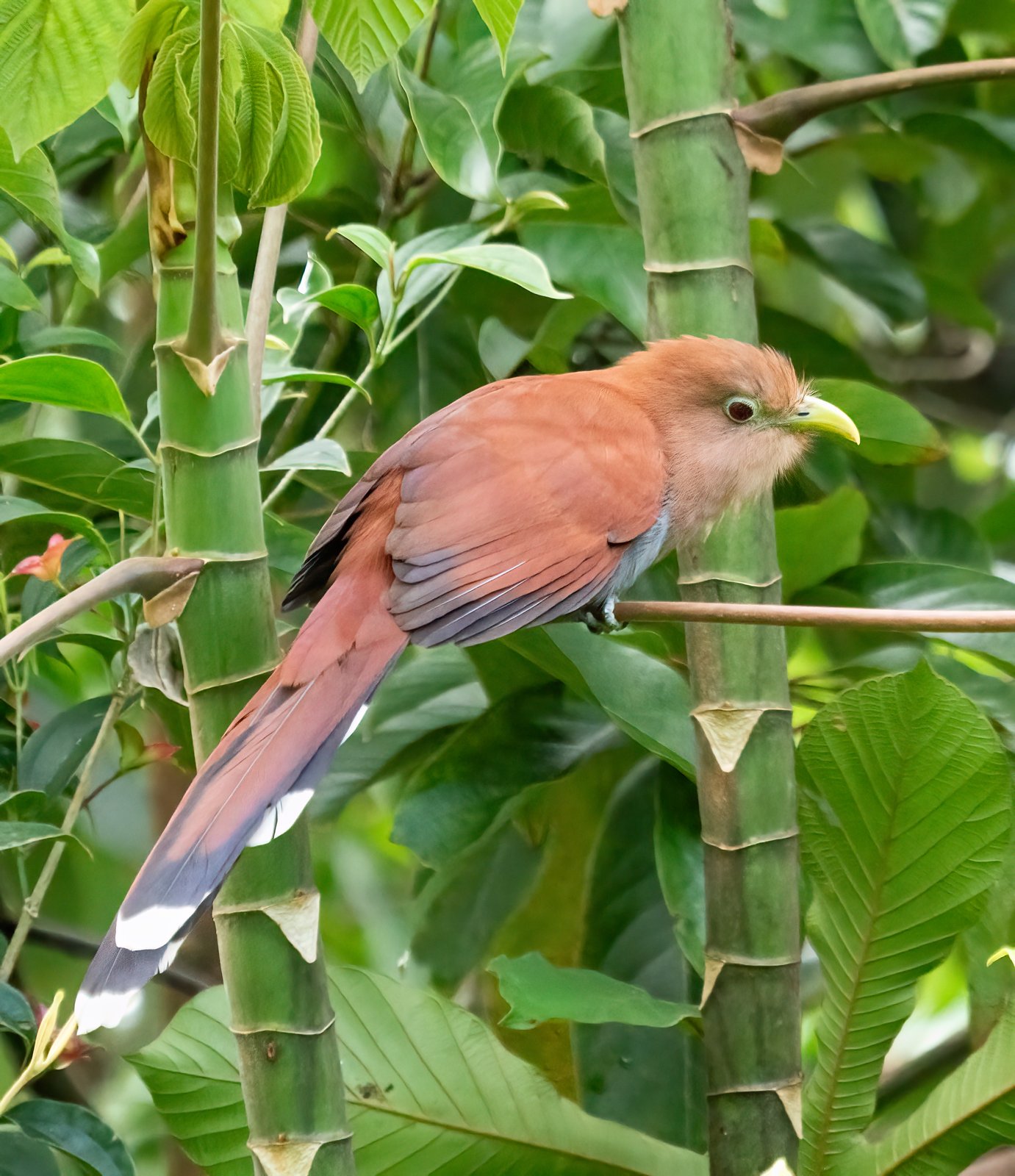
The Common Squirrel Cuckoo is a large, rufous cuckoo with a very long tail, which runs and leaps through the canopy like a squirrel. It is one of the most frequently seen cuckoos in the guide area, from the Caribbean slope of Mexico to Panama. Since the split of the Mexican Squirrel Cuckoo of western Mexico, the species includes the birds of the Gulf slope and all of Central America.
Voice
A loud, sharp keep-wheeoo or kjeek-kaaa, often in flight or on landing. The song is a long series of clear, even whistles, wheep wheep wheep wheep; also a dry, rattling chik-chik-chik.
Recording: Jacob Wijpkema — CC BY-NC-SA 4.0 · converted to mono · xeno-canto
Identification
43–48 cm, about two thirds of it tail. The head, upperparts and wings are bright rufous to cinnamon, the throat and upper breast paler ochre-brown. The lower breast is grey, merging into a dark grey to blackish belly and undertail coverts. The long, graduated tail is rufous above; below it is black, with broad white tips to the feathers, giving a ladder pattern. The bill is greenish-yellow, the eye red with a greenish-yellow bare eye-ring. The sexes are alike. Over most of the guide area the subspecies is P. c. thermophila; in eastern Panama P. c. nigricrissa, with an even darker belly.
Confusion species
Mexican Squirrel Cuckoo Piaya mexicana of the Pacific slope of Mexico is paler and brighter rufous, with a pale throat, a pale grey belly and an undertail that is rufous with a black band and a white tip; its eye-ring is greenish-grey. Little Cuckoo Coccycua minuta of eastern Panama is much smaller, with a shorter tail and a red eye-ring. Pheasant Cuckoo Dromococcyx phasianellus is brown and spotted, with a crest and a fan-like tail.
Habitat
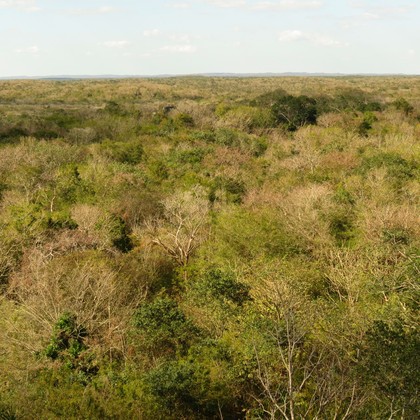
Humid and semi-humid lowland forest, foothill forest and seasonal forest, especially forest edges, clearings, gallery forest and secondary forest; also shade coffee, cacao and gardens with large trees, from sea level to about 2000 m. It runs and leaps along branches and lianas, taking mainly large caterpillars, including hairy ones, as well as cicadas, grasshoppers, spiders and occasionally small lizards. It glides from tree to tree with its tail spread. It incubates its own eggs, in a nest of leaves and twigs in dense vegetation.
Where the bird is most at home, classified by the vegetation units of Mexico and Central America.





Range and movements
In Mexico on the Gulf slope from southern Tamaulipas and San Luis Potosí through Veracruz, Puebla, Oaxaca and Tabasco to the Yucatán Peninsula and Chiapas, and south of the Isthmus of Tehuantepec also on the Pacific slope. Further south throughout Guatemala, Belize, Honduras, El Salvador, Nicaragua, Costa Rica and Panama, on both slopes. Outside the guide area in South America south to northern Argentina and Uruguay.
- Resident
- dark = core range, pale = thinly spread
How and when to look
Anywhere in forest edges and wooded gardens; often in mixed flocks of other birds moving through the canopy. The long tail and the rufous colour are obvious at once in flight. The loud keep-wheeoo often gives it away.
Conservation status
Not threatened. Common and widespread; the species copes well with fragmented forest, forest edges and agroforestry.
Scientific name
Piaya cayana | (Linnaeus, 1766)
Linnaeus described the species in 1766 as Cuculus cayanus; because it was later moved to another genus, the author and year stand in brackets. The genus Piaya was introduced in 1830 by Lesson. Piaya comes from Piaye, 'devil (bird)', the Creole name in Cayenne for the Squirrel Cuckoo, regarded as a bird of ill omen. cayana refers to Cayenne in French Guiana, where the type specimen came from. The specimen the first description was based on came from Cayenne, French Guiana.