All species › Trogons › Trogons › Mountain Trogon
Position in the tree Birds Aves › Birds with a flexible palate Neognathae › All other modern birds Neoaves › Landbirds Telluraves › Raptors, owls, kingfishers and woodpeckers Afroaves › Mousebirds, rollers and woodpeckers Coraciimorphae › Trogons and cavity nesters Cavitaves
Mountain Trogon | Trogon mexicanus
Mexicaanse trogon | Trogón mexicano
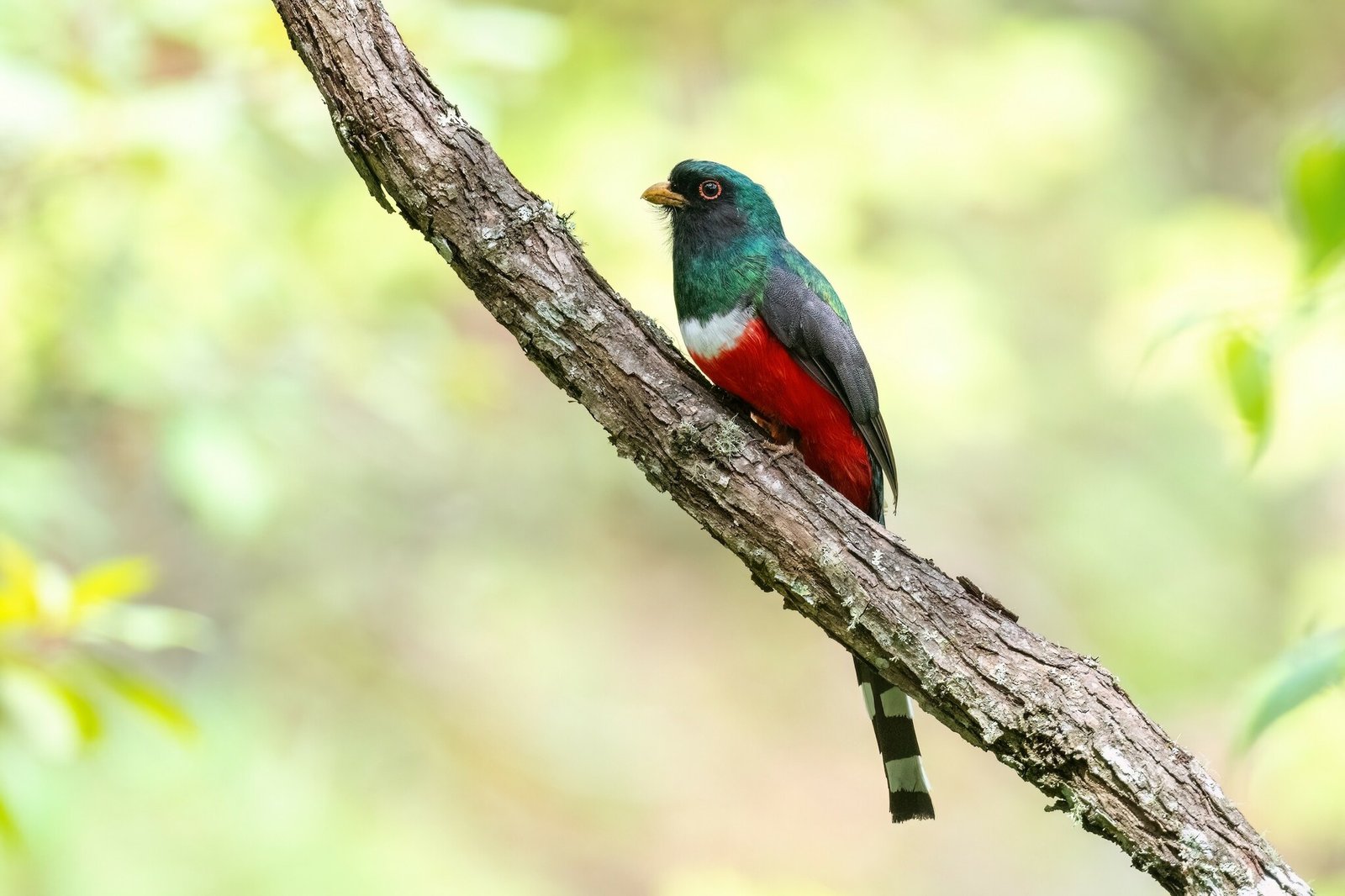
The Mountain Trogon is a red-bellied trogon of pine-oak woodland and cloud forest in the mountains, from north-western Mexico to Honduras. It occurs up to above 3000 m and does not live outside the guide area. The male can be recognised by the almost black underside of the tail with three broad white bands.
Voice
A series of two to six hoarse, nasal kow notes, often slowly repeated; lower and rougher than in Collared Trogon. Also a rattling cackle.
Recording: Barry Edmonston — CC BY-NC-SA 4.0 · shortened to the first 60 s, mono · xeno-canto
Identification
30–33 cm. The male is green on the head, breast and back, with a black face and throat, a red eye-ring, a yellow bill, a white band between the green breast and the red belly and a dark green upperside of the tail without a coppery sheen. The underside of the tail is almost black with three broad white bands, formed by the white tips of the outer tail feathers. The female is brown on the head, breast and back, with a white patch behind the eye, a white breast band, a red belly and an undertail with broad white tips.
Confusion species
Coppery-tailed Trogon Trogon ambiguus has a coppery sheen on the tail and a finely vermiculated grey-and-white undertail and usually lives lower. Collared Trogon Trogon collaris is smaller, has a finely barred black-and-white undertail and lives in more humid, lower forest. Eared Quetzal Euptilotis neoxenus (Sierra Madre Occidental) is larger and has no white breast band and no yellow bill. Resplendent Quetzal Pharomachrus mocinno has no white breast band and the male has very long upper tail coverts.
Habitat
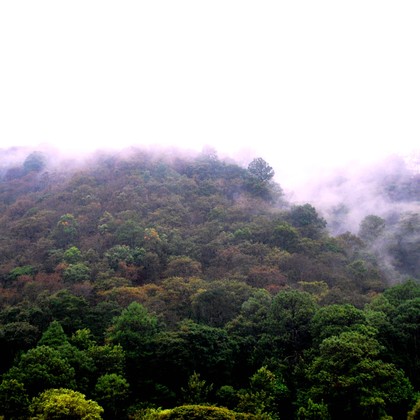
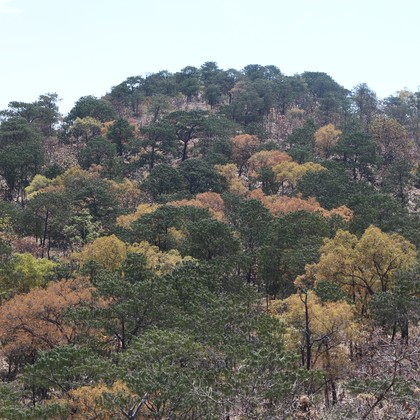
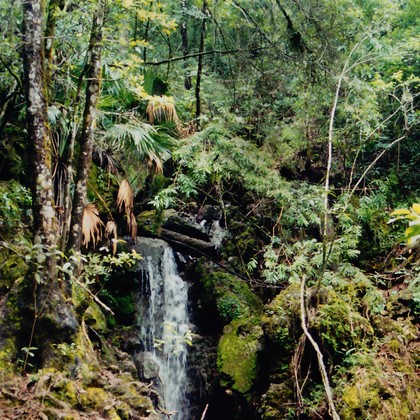
Pine-oak woodland, oak woodland, cloud forest and high-elevation conifer forest, mostly between 1500 and 3500 m. It perches still in the middle tree layer and eats fruit and insects. It nests in a tree cavity or in rotting wood. In winter it sometimes moves somewhat lower down the mountains.
Where the bird is most at home, classified by the vegetation units of Mexico and Central America.

Range and movements
Mountains of Mexico: the Sierra Madre Occidental from eastern Sonora and Chihuahua, the Sierra Madre Oriental from Nuevo León and Tamaulipas, the Trans-Mexican Volcanic Belt, the Sierra Madre del Sur in Guerrero and Oaxaca and the highlands of Chiapas; further in the highlands of Guatemala and Honduras. It does not occur outside the guide area.
- Resident
- dark = core range, pale = thinly spread
How and when to look
Common in the forests of Cerro San Felipe near Oaxaca City, along the road from Mazatlán to Durango in Sinaloa (Barranca Rancho Liebre) and in the highlands around Lake Atitlán in Guatemala. It is often heard first.
Conservation status
Not threatened. It disappears locally through logging in montane forests but is common in much of its range.
Scientific name
Trogon mexicanus | Swainson, 1827
Swainson described the species in 1827 and placed it straight away in the genus where it still stands. The genus Trogon was introduced in 1760 by Brisson. Trogon is Greek, from trōgōn 'gnawing, fruit-eating'. mexicanus is New Latin for 'from Mexico', after its country of origin. The specimen the first description was based on came from Temascaltepec, Mexico.