All species › Trogons › Trogons › Collared Trogon
Position in the tree Birds Aves › Birds with a flexible palate Neognathae › All other modern birds Neoaves › Landbirds Telluraves › Raptors, owls, kingfishers and woodpeckers Afroaves › Mousebirds, rollers and woodpeckers Coraciimorphae › Trogons and cavity nesters Cavitaves
Collared Trogon | Trogon collaris
Gekraagde trogon | Trogón de collar
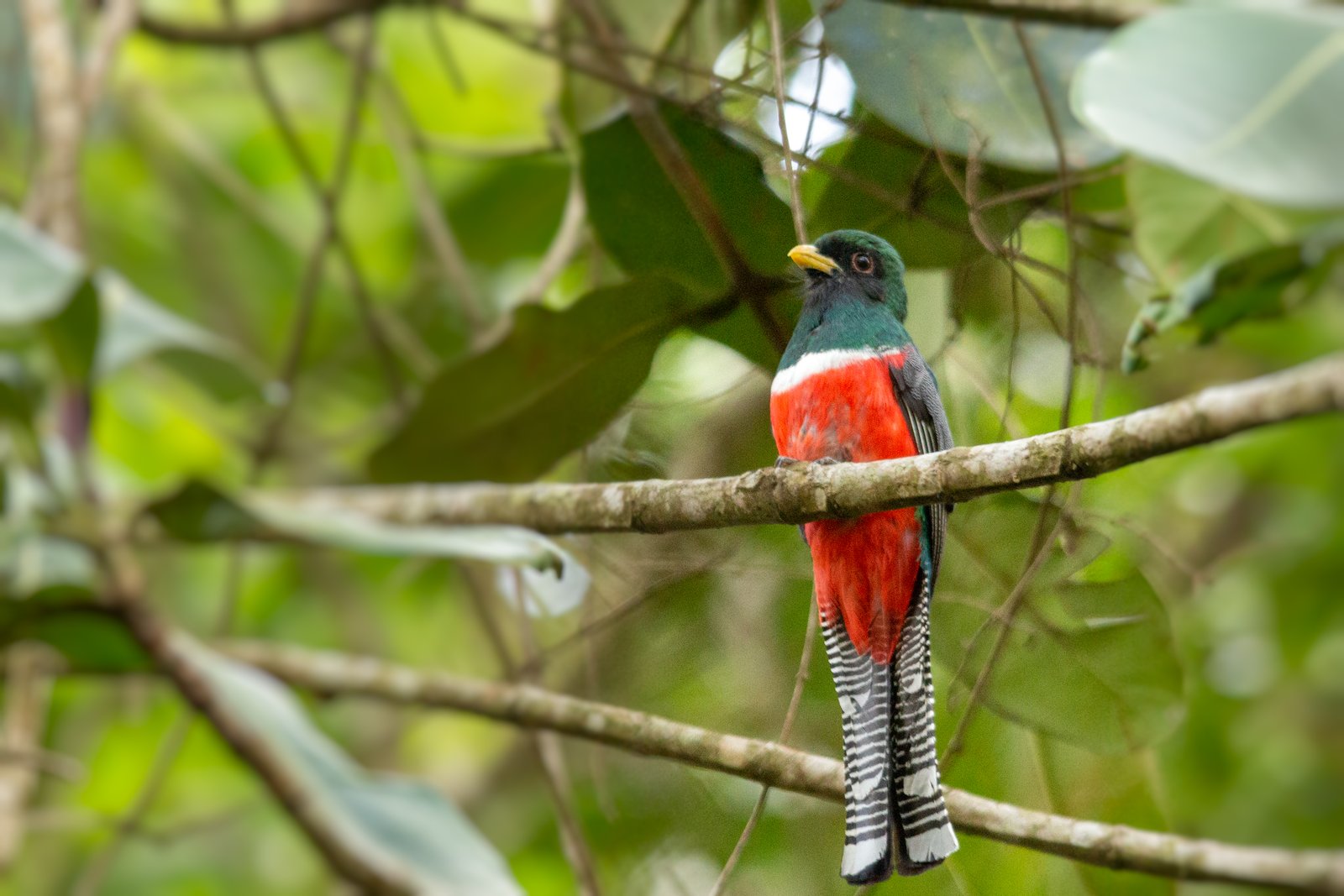
The Collared Trogon is a red-bellied trogon of humid forest, mainly in the hills and mountains, from eastern Mexico to Panama and far into South America. It is the most widespread red-bellied trogon of the guide area. In the mountains of Costa Rica and western Panama live birds with an orange rather than red belly, formerly treated as a separate species, the Orange-bellied Trogon.
Voice
A slow series of two to four clear, somewhat plaintive whistles, kyow kyow, often falling slightly in pitch. Also a soft rattling cackle.
Recording: Glauko Corrêa da Silva — CC BY-NC-SA 4.0 · shortened to the first 60 s, mono · xeno-canto
Identification
25–28 cm. The male is metallic green on the head, breast and back, with a black face and throat, a yellow bill and a white band between the green breast and the red belly. The underside of the tail is finely barred black and white with three broad white bands. The female is brown on the head, breast and back, with a white breast band, a pinkish-red belly, a white mark in front of and behind the eye and a greyish, finely marked undertail with black and white tips. In the mountains of Costa Rica and western Panama part of the birds have an orange to orange-yellow belly.
Confusion species
Coppery-tailed Trogon Trogon ambiguus and Elegant Trogon Trogon elegans have a coppery sheen on the tail, an orange-red eye-ring and a finely vermiculated grey-and-white undertail, and live in drier forest. Mountain Trogon Trogon mexicanus is larger, has an almost black undertail with three broad white bands and lives higher. Baird's Trogon Trogon bairdii and Slaty-tailed Trogon Trogon massena have no white breast band. Female Graceful Black-throated Trogon Trogon tenellus is also brown, but has a yellow belly.
Habitat
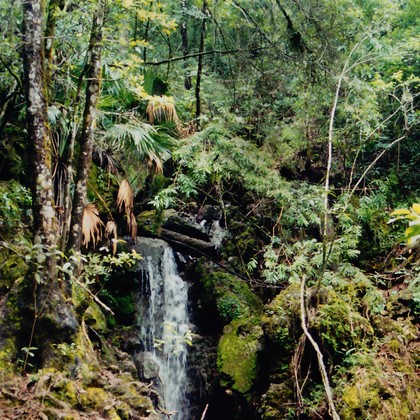
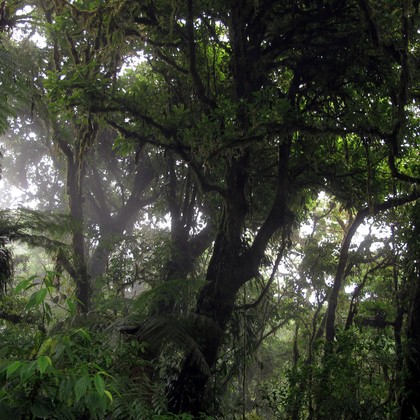
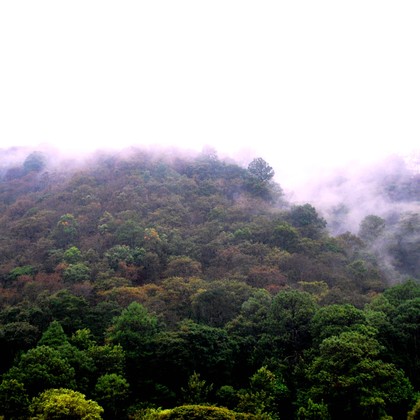
Humid forest, from lowland rainforest to cloud forest and montane rainforest, mostly between 600 and 2500 m; in Belize and the southern Yucatán Peninsula also in the lowlands. Also tall secondary forest, forest edges and shade coffee. It perches still in the middle and lower tree layers and eats insects and fruit. It nests in rotting wood or a termite nest.
Where the bird is most at home, classified by the vegetation units of Mexico and Central America.




Range and movements
Gulf slope of eastern Mexico from San Luis Potosí, Querétaro and Hidalgo through Puebla, Veracruz and Oaxaca to Chiapas and Tabasco, the Pacific slope of Guerrero and Oaxaca, the southern Yucatán Peninsula, and on through Belize, Guatemala, El Salvador (only in the mountains), Honduras, Nicaragua and Costa Rica to Panama. Outside the guide area in South America to Bolivia and Brazil, and on Trinidad and Tobago.
- Resident
- dark = core range, pale = thinly spread
How and when to look
Common in the montane forests of Monteverde and the Savegre valley in Costa Rica and in the cloud forest of El Triunfo in Chiapas. The orange-bellied birds are mainly seen in the Cordillera de Talamanca and in western Panama.
Conservation status
Not threatened. Widespread and locally common; it tolerates some disturbance and also occurs in secondary forest and shade coffee.
Scientific name
Trogon collaris | Vieillot, 1817
Vieillot described the species in 1817 and placed it straight away in the genus where it still stands. The genus Trogon was introduced in 1760 by Brisson. Trogon is Greek, from trōgōn 'gnawing, fruit-eating'. collaris is Latin for 'collared', after the white band between breast and belly. The specimen the first description was based on came from Cayenne, French Guiana.