All species › Waterfowl › Ducks, swans and geese › Muscovy Duck
Position in the tree Birds Aves › Birds with a flexible palate Neognathae › Fowl Galloanserae
Muscovy Duck | Cairina moschata
Muskuseend | Pato real
The Muscovy Duck is the large black wood duck of the tropical lowlands, from Mexico into South America. The wild bird is shy and lives along wooded rivers, lagoons and marshes. In addition, the domesticated form is a common farmyard duck throughout the guide area, and tame and feral birds are often seen near villages, in towns and in parks.

Voice
Usually silent. The male gives a soft hiss, the female a soft, hoarse quack.
Recording: Manuel Grosselet — CC BY-NC-SA 4.0 · converted to mono · xeno-canto
Identification
66–84 cm; the male is much larger than the female. The wild bird is black with a green and purple gloss and has large white wing coverts, which may show as a white patch at rest and form a large white panel on the forewing in flight. The male has bare black and red caruncles around the eye and at the base of the bill and a short, bristly crest; the female is smaller and duller and lacks caruncles. Juveniles have little or no white in the wing. Tame and feral birds are often partly or wholly white and have much red on the face.
Confusion species
Black-bellied Whistling Duck Dendrocygna autumnalis also has a large white wing panel, but is smaller and rufous-brown, with a red bill and long pink legs. At a distance a flying Muscovy Duck may recall a cormorant such as Neotropic Cormorant Nannopterum brasilianum; that species has no white in the wing, a thinner neck and a longer tail.
Habitat
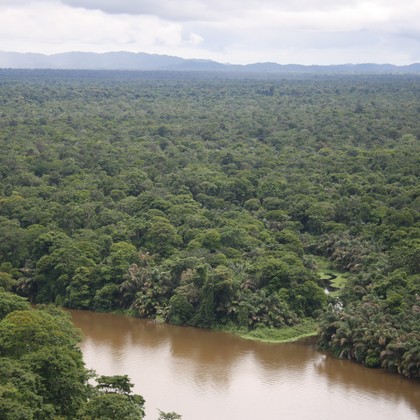
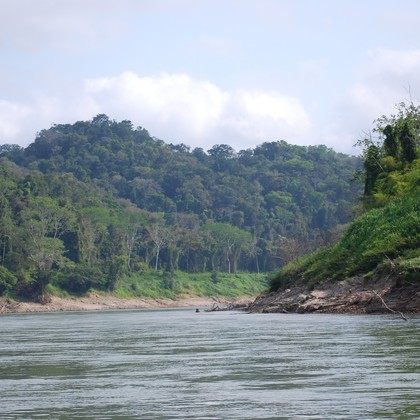
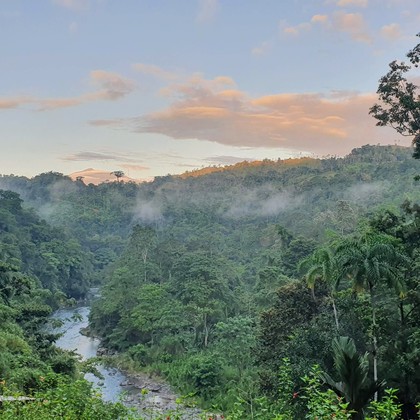
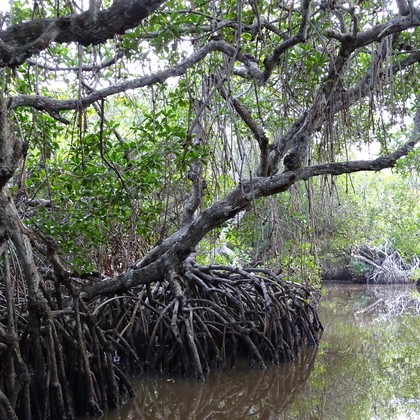
Swamp forest, gallery forest along slow rivers, lagoons, mangroves and freshwater marshes with large trees, mainly in the lowlands below about 1000 m. It roosts and nests in trees; the nest is in a tree cavity and the species also uses nest boxes. It eats aquatic plants, seeds, insects, small fish and other small animals.
Where the bird is most at home, classified by the vegetation units of Mexico and Central America.


Range and movements
Native to the lowlands of Mexico, on the Pacific side from Sinaloa and on the Gulf coast from Tamaulipas and the Río Bravo valley southwards, through the Yucatán Peninsula, Belize, Guatemala, El Salvador, Honduras, Nicaragua and Costa Rica to Panama. Outside the guide area in South America to northern Argentina. Tame and feral birds also occur outside the natural range, including on the plateau.
- Resident
- dark = core range, pale = thinly spread
How and when to look
Wild Muscovy Ducks are best seen early in the morning, when they fly from their roost trees along wooded rivers and lagoons, for instance in the Pantanos de Centla in Tabasco, along the rivers of the Petén and at Caño Negro and Palo Verde in Costa Rica. Birds that allow a close approach near villages are usually tame or feral.
Conservation status
Not threatened globally. In the guide area the wild bird has declined strongly through hunting and the loss of swamp forest and has disappeared from many districts. Nest-box projects in Mexico have helped the population locally. Interbreeding with tame birds erodes the wild character of the populations in some places.
Scientific name
Cairina moschata | (Linnaeus, 1758)
Linnaeus described the species in 1758 as Anas moschata; because it was later moved to another genus, the author and year stand in brackets. The genus Cairina was introduced in 1822 by Fleming. Cairina derives from old names such as 'Cairo duck', given in the mistaken belief that the bird came from Egypt; it actually comes from tropical America. moschata is New Latin for 'of Muscovy' (Russia) or, on another reading, 'musky'; the duck in fact comes from tropical America. The specimen the first description was based on came from Brazil (later designated; originally 'India').