All species › Waterfowl › Ducks, swans and geese › Wood Duck
Position in the tree Birds Aves › Birds with a flexible palate Neognathae › Fowl Galloanserae
Wood Duck | Aix sponsa
Carolina-eend | Pato arcoíris
The Wood Duck is a North American perching duck that winters in small numbers in northern Mexico. Further south it is seen occasionally; birds turning up outside winter or in city parks may come from captivity.
Voice
The female gives a loud, rising oo-eek, oo-eek when flushed; the male gives a thin, high, rising whistle.
Recording: Don Profota — CC BY-NC-SA 4.0 · converted to mono · xeno-canto
Identification
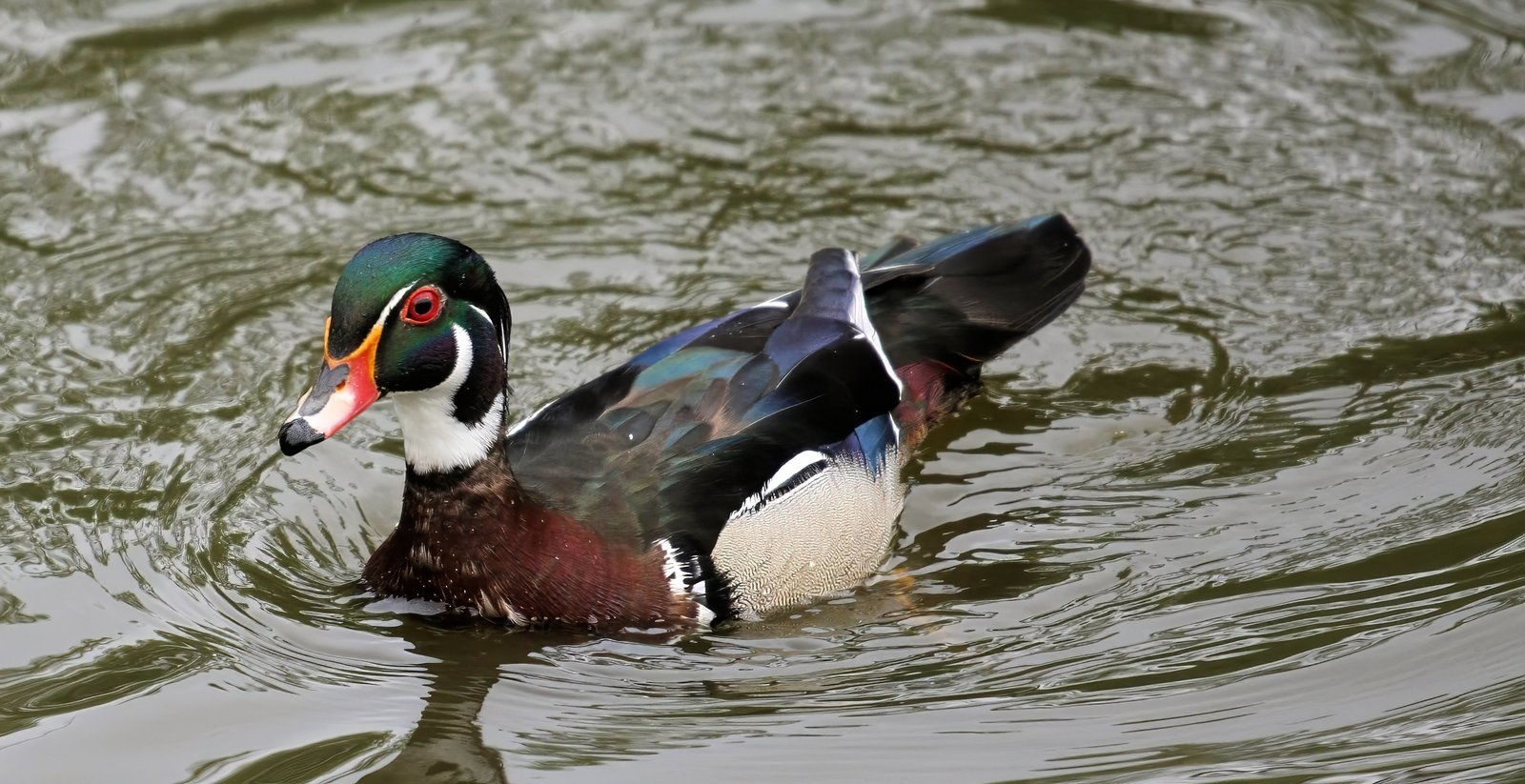
47–54 cm, with a large head, a short bill and a long, broad tail. The male has a glossy green and purple head with a crest hanging backwards, narrow white lines along the crest and cheek, a white throat with two spurs onto the cheek and neck, a red eye and a red-and-white bill; the breast is chestnut with white spots, bordered at the rear by a white and a black vertical bar, and the flanks are buff. The female is greyish-brown with a grey head, a short crest and a white, teardrop-shaped patch around the eye; the breast and flanks are finely spotted pale. In eclipse plumage the male resembles the female but keeps the red bill and the white throat pattern. In flight the long, dark tail and the raised head stand out.
Confusion species
Mandarin Duck Aix galericulata, which occurs as an escape, has orange 'sails' on the back and orange whiskers in the male; the female has a narrow white eye-ring with a white line behind it instead of a teardrop eye patch. Female Hooded Merganser Lophodytes cucullatus has a narrow, pointed bill and a rufous crest without a white eye patch.
Habitat
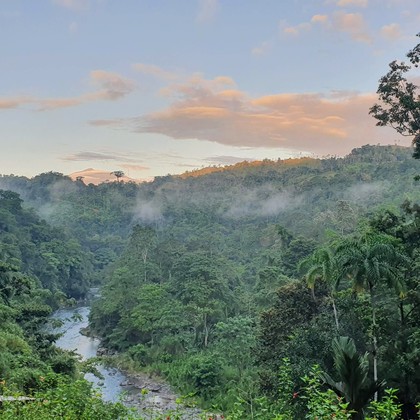
Rivers with wooded banks, lakes, reservoirs and ponds with trees along the edge, and swamp forest; it seeks cover under overhanging branches. Also on ponds in parks. It eats seeds, acorns, aquatic plants and invertebrates.
Where the bird is most at home, classified by the vegetation units of Mexico and Central America.




Range and movements
Scarce winter visitor to northern Mexico, mainly in Chihuahua, Coahuila, Nuevo León, Tamaulipas and Durango, with scattered records south to Jalisco, Michoacán, central Mexico and Veracruz. Only a few records in Belize and Costa Rica. Breeds in eastern North America and along the west coast from Canada to California; northern birds move to the southern United States in winter.
- Winter visitor (c. Oct–Mar)
- dark = core range, pale = thinly spread
How and when to look
Along sheltered, wooded riverbanks and ponds in northern Mexico, where the birds often sit under overhanging branches and are only noticed when they fly off; the female's call then gives them away.
Conservation status
Not threatened globally. The North American population recovered in the twentieth century from a steep decline caused by hunting and forest loss, helped by hunting regulations and nest boxes. In the guide area a scarce winter visitor.
Scientific name
Aix sponsa | (Linnaeus, 1758)
Linnaeus described the species in 1758 as Anas Sponsa; because it was later moved to another genus, the author and year stand in brackets. The genus Aix was introduced in 1828 by Boie. Aix is the Ancient Greek word for a diving bird mentioned by Aristotle that can no longer be identified. sponsa is Latin for 'bride', after the drake's splendid, wedding-dress-like plumage. The specimen the first description was based on came from Carolina, United States.