All species › Waders, gulls and terns › Sandpipers and allies › Red Knot
Position in the tree Birds Aves › Birds with a flexible palate Neognathae › All other modern birds Neoaves › Birds of the elements Elementaves › Cranes and waders Gruimorphae
Red Knot | Calidris canutus
Kanoet | Correlimos gordo
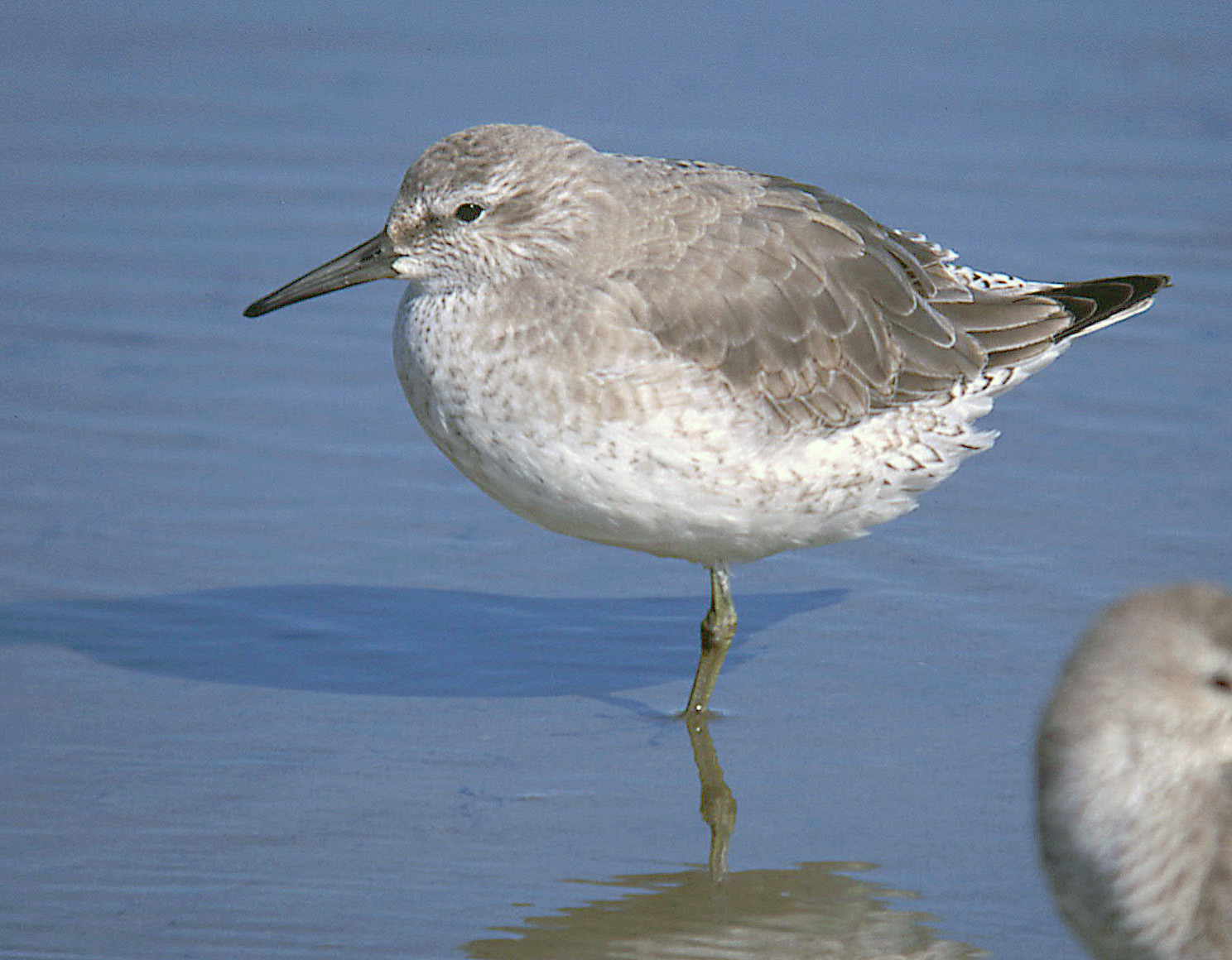
The Red Knot is a medium-sized, stocky sandpiper that breeds in the far north and is one of the longest-distance migrants in the world. In the guide area it is a local passage migrant and winter visitor on large tidal flats and in lagoons; the subspecies roselaari, which breeds in Alaska and eastern Siberia, winters in northwestern Mexico, and birds of the subspecies rufa occur along the Gulf coast.
Voice
A soft, low knut or wut-wut, from which the species takes its Dutch and English name; flocks also give a muted twittering.
Recording: Arend Wassink — CC BY-NC-SA 4.0 · converted to mono · xeno-canto
Identification
23–26 cm, larger and heavier than most sandpipers, with a short neck, short greenish-grey legs and a straight black bill about as long as the head. In non-breeding plumage plain pale grey above, with fine dark shaft streaks, a white supercilium and a white belly with grey-speckled breast and flanks. Juveniles have a fine scaly pattern on the upperparts from dark and pale feather edges and a faint buff wash on the breast. In breeding plumage, sometimes already visible in spring, the face and underparts are rusty red. In flight a narrow white wing bar and a pale grey, finely barred rump.
Confusion species
Short-billed Dowitcher Limnodromus griseus and Long-billed Dowitcher Limnodromus scolopaceus have a much longer bill. Sanderling Calidris alba is smaller and whiter, with a black bend of the wing. Black-bellied Plover Pluvialis squatarola has a shorter, thicker bill, larger eyes and the typical stop-and-peck feeding of plovers.
Habitat
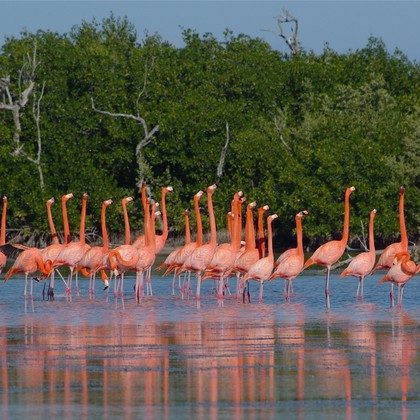
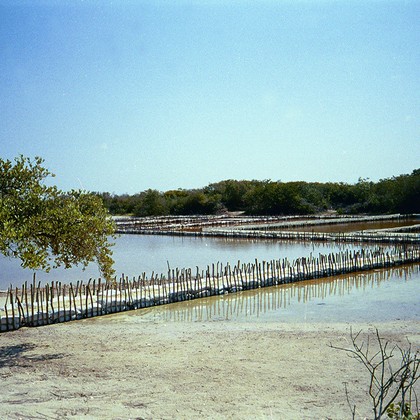
Tidal flats, mudbanks and sandbars, the shallow margins of lagoons and salt pans, sometimes wide sandy beaches. It feeds in compact flocks, walking with the head down and rapidly probing for small bivalves, small crustaceans and worms.
Where the bird is most at home, classified by the vegetation units of Mexico and Central America.

Range and movements
Passage migrant and winter visitor, mainly along the Pacific coast of Baja California, with the lagoons of Guerrero Negro and Ojo de Liebre and Bahía de San Quintín, and along the Gulf of California in Sonora and Sinaloa; in smaller numbers along the Gulf coast from Tamaulipas to the Yucatán Peninsula. Scarce and irregular in Central America, with most records along the Pacific coast and in the Bay of Panama. Outside the guide area the species breeds on the high Arctic tundra around the North Pole and winters along the coasts of all continents; American birds mainly in the southeastern United States, northern Brazil and Tierra del Fuego.
- Winter visitor (c. Oct–Mar)
- dark = core range, pale = thinly spread
How and when to look
Large tidal flats and lagoons in Baja California, Sonora and Sinaloa, in winter and on migration. The birds often mix with other waders; the compact build, straight bill and short legs set them apart.
Conservation status
Near Threatened. The world population is declining. The subspecies rufa has declined sharply, partly through overfishing of horseshoe crabs, whose eggs are an important food source during spring migration. The subspecies roselaari, which winters in northwestern Mexico, is small in number and depends on a handful of lagoons, where disturbance and coastal development play a part.
Scientific name
Calidris canutus | (Linnaeus, 1758)
Linnaeus described the species in 1758 as Tringa Canutus; because it was later moved to another genus, the author and year stand in brackets. The genus Calidris was introduced in 1804 by Merrem. Calidris goes back to Ancient Greek kalidris or skalidris, a name Aristotle used for an unidentified grey waterside bird. canutus is traditionally linked to King Cnut, from the tale of him commanding the tide and the knot's habit of feeding along the tideline, though there is no historical foundation for this. Another explanation is that the name imitates the bird's grunting call. The specimen the first description was based on came from Sweden.