All species › Waders, gulls and terns › Sandpipers and allies › Surfbird
Position in the tree Birds Aves › Birds with a flexible palate Neognathae › All other modern birds Neoaves › Birds of the elements Elementaves › Cranes and waders Gruimorphae
Surfbird | Calidris virgata
Brandingloper | Correlimos de rompientes
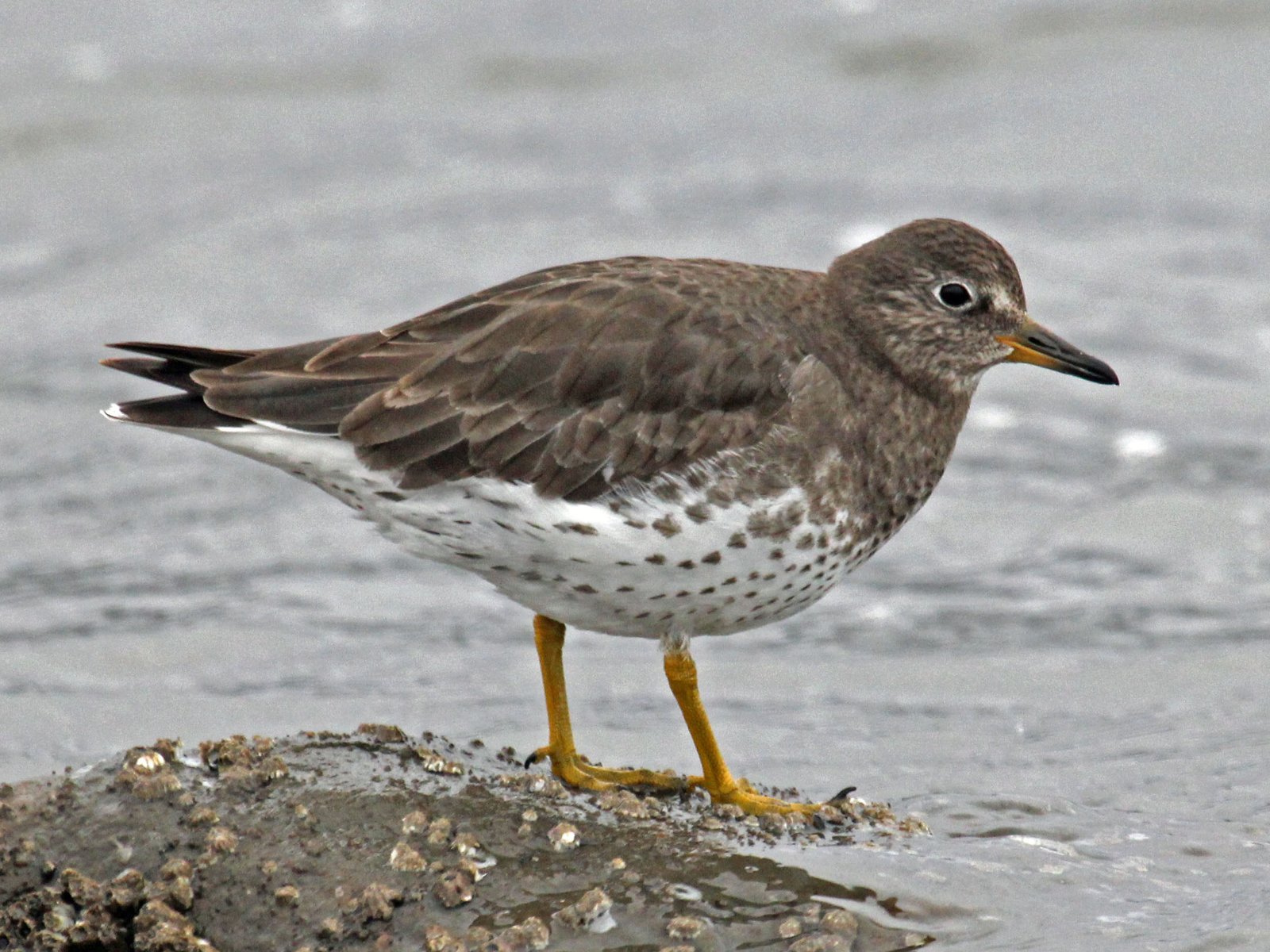
The Surfbird is a stocky, grey sandpiper of rocks in the surf, with a short, thick bill with a yellow base and short greenish-yellow legs. It breeds high in the mountains of Alaska and Yukon and winters along the rocky shores of the Pacific, from Alaska to southern South America. In the guide area it is a winter visitor and passage migrant along the Pacific coast, most numerous in Baja California.
Voice
Usually silent outside the breeding season; sometimes a soft, high kee or kip, and flocks give a soft twittering on take-off.
Recording: Davyd Betchkal — CC BY-NC-SA 4.0 · converted to mono · xeno-canto
Identification
24–26 cm, short-necked and heavy, with a short, straight, thick bill, black with a distinct yellow base, and short, sturdy, greenish-yellow legs. In non-breeding plumage grey-brown above and across the breast, with a white chin and a white belly with some spotting on the flanks. In breeding plumage the upperparts are spangled, with large rufous scapulars, and the head and underparts are white with black streaks and chevrons. Juveniles are paler, with fine pale fringes on the back and wing. In flight a white tail with a broad black terminal band and a narrow white wing bar.
Confusion species
Black Turnstone Arenaria melanocephala uses the same rocks but is darker, with dull red legs, and shows a white wedge on the back in flight. Ruddy Turnstone Arenaria interpres has bright orange legs and a pied head and breast pattern. Wandering Tattler Tringa incana is slimmer and uniformly grey, longer in leg and bill, and shows no white in flight. No other bird of rocky shores has such a short, thick bill with a yellow base.
Habitat
Surf-washed rock platforms, reefs, cobble beaches and rocky islets, as well as breakwaters, piers and harbour jetties; adjacent sand and mud only close to rocks. It eats mainly barnacles, small snails and small bivalves, which it prises off the rock with its blunt bill. At high tide flocks rest on higher rocks, often together with Black and Ruddy Turnstones.
Where the bird is most at home, classified by the vegetation units of Mexico and Central America.



Range and movements
Winter visitor and passage migrant along the Pacific coast of Baja California and in the Gulf of California, and further south along rocky stretches of the Pacific coast of Mexico. Scarce to rare along the Pacific coast of Central America, with records in Costa Rica and Panama among others; virtually absent from the Caribbean side. Outside the guide area the species breeds in the mountains of Alaska and Yukon and winters along the rocky Pacific coast from southeastern Alaska to the Strait of Magellan; most of the wintering population stays along the coasts of Peru and Chile.
- Winter visitor (c. Oct–Mar)
- dark = core range, pale = thinly spread
How and when to look
Breakwaters and rock platforms at low tide along the west coast of Baja California, often together with Black Turnstones. The yellow base of the short, thick bill and the greenish-yellow legs are the features to check; in flight the white tail with its black terminal band identifies the species.
Conservation status
Not threatened. The population is relatively small, and in spring a large part of the species gathers in a few bays in Alaska, where oil pollution could affect a large share of the birds. In the guide area the species also uses breakwaters and piers; disturbance of rocky roosts plays a part locally.
Scientific name
Calidris virgata | (Gmelin, 1789)
Gmelin described the species in 1789 as Tringa virgata; because it was later moved to another genus, the author and year stand in brackets. The genus Calidris was introduced in 1804 by Merrem. Calidris goes back to Ancient Greek kalidris or skalidris, a name Aristotle used for an unidentified grey waterside bird. virgata is Latin for 'streaked', after the streaked head and breast in breeding plumage. The specimen the first description was based on came from Prince William Sound, Alaska.