All species › Waders, gulls and terns › Sandpipers and allies › Ruff
Position in the tree Birds Aves › Birds with a flexible palate Neognathae › All other modern birds Neoaves › Birds of the elements Elementaves › Cranes and waders Gruimorphae
Ruff | Calidris pugnax
Kemphaan | Combatiente
The Ruff is a Eurasian wader and a vagrant in the guide area, not a native species. The birds that turn up here probably arrive via North America, where the species is a scarce but annual visitor. Only a few records are known.

Voice
Usually silent; in flight sometimes a soft kee-weet or a low grunt.
Recording: Stanislas Wroza — CC BY-NC-SA 4.0 · converted to mono · xeno-canto
Identification
22–32 cm; the male is clearly larger than the female. In the guide area almost only to be expected in non-breeding or juvenile plumage: a small head on a fairly long neck, a short, slightly drooping bill, a full breast and long legs, greenish to orange. The upperparts are scaly, with broad pale feather fringes; juveniles are warm buff on the neck and breast. In flight a narrow white wing bar and two oval white patches on either side of the rump.
Confusion species
Lesser Yellowlegs Tringa flavipes has a longer, straight bill, bright yellow legs and a square white rump. Stilt Sandpiper Calidris himantopus has a longer bill drooping at the tip and a white rump. Pectoral Sandpiper Calidris melanotos has a sharply demarcated streaked breast, and Buff-breasted Sandpiper Calidris subruficollis is smaller, with a short, straight bill and plain buff underparts.
Habitat
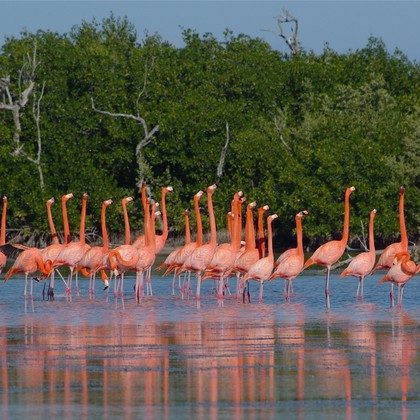
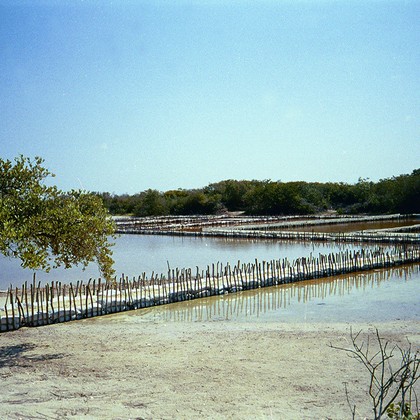
Wet grassland, rice fields, shallow margins of fresh and brackish lagoons, salt pans and mudflats; often among other waders.
Where the bird is most at home, classified by the vegetation units of Mexico and Central America.



Range and movements
A few records in Mexico and Central America, including Costa Rica and Panama. Breeds in northern Eurasia and winters mainly in Africa south of the Sahara and in southern Asia; in eastern North America a scarce passage migrant.
- Resident
- Summer visitor (c. Apr–Sep)
- Winter visitor (c. Oct–Mar)
- Passage (Mar–Apr, Oct–Nov)
- dark = core range, pale = thinly spread
How and when to look
Flocks of yellowlegs and Stilt Sandpipers on wet pasture and rice fields are the place to look for a Ruff; the small head, the full breast and the white patches beside the rump in flight are the best features.
Conservation status
Not threatened globally. In the guide area a vagrant with no regular presence; there is no evidence of a trend.
Scientific name
Calidris pugnax | (Linnaeus, 1758)
Linnaeus described the species in 1758 as Tringa Pugnax; because it was later moved to another genus, the author and year stand in brackets. The genus Calidris was introduced in 1804 by Merrem. Calidris goes back to Ancient Greek kalidris or skalidris, a name Aristotle used for an unidentified grey waterside bird. pugnax is Latin for 'combative', after the males' sparring at their display grounds. The specimen the first description was based on came from Sweden.