All species › Waders, gulls and terns › Sandpipers and allies › Red-necked Phalarope
Position in the tree Birds Aves › Birds with a flexible palate Neognathae › All other modern birds Neoaves › Birds of the elements Elementaves › Cranes and waders Gruimorphae
Red-necked Phalarope | Phalaropus lobatus
Grauwe franjepoot | Falaropo picofino
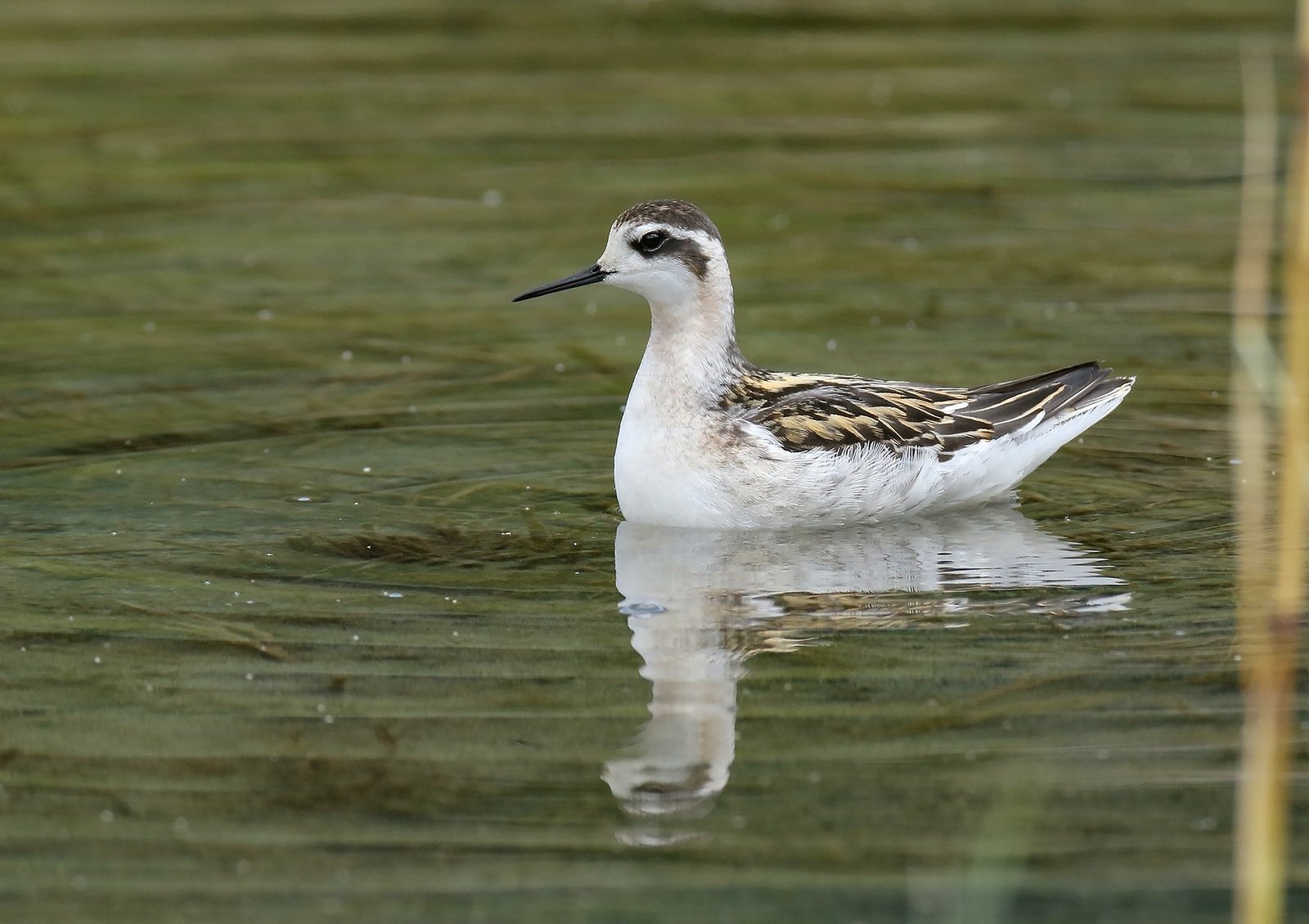
The Red-necked Phalarope is the smallest phalarope, a swimming wader that lives mainly at sea outside the breeding season. It migrates in large numbers along the Pacific coast of the guide area, and in the Gulf of California and off the west coast flocks of thousands may gather. The female is larger and more brightly coloured than the male, which incubates the eggs and cares for the young.
Voice
A short, sharp twit or kip, mainly in flight or from flocks on the water.
Recording: Stanislas Wroza — CC BY-NC-SA 4.0 · converted to mono · xeno-canto
Identification
18–20 cm, small and finely built, with a thin, needle-like black bill and lobed toes. In non-breeding plumage dark grey above with white stripes along the back, white below, with a white forehead, a dark crown and a black patch extending back from the eye. In flight a narrow white wing bar and a dark centre to the rump. The breeding female has a slate-grey head, a white throat, a rufous band along the side of the neck and buff back stripes; the male is duller. Juveniles are blackish with buff back stripes. It sits high on the water and often spins rapidly.
Confusion species
Red Phalarope Phalaropus fulicarius is somewhat larger, with a thicker bill and a paler, plain grey back without stripes. Wilson's Phalarope Phalaropus tricolor is larger and longer-billed, with no wing bar and no black eye patch, but a white rump, and often walks on mud. Sanderling Calidris alba also has a dark patch at the bend of the wing and a white wing bar, but does not swim and has a thicker bill.
Habitat
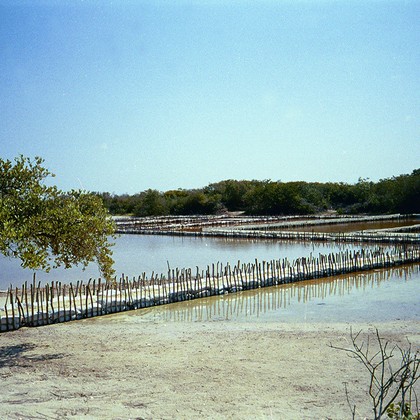
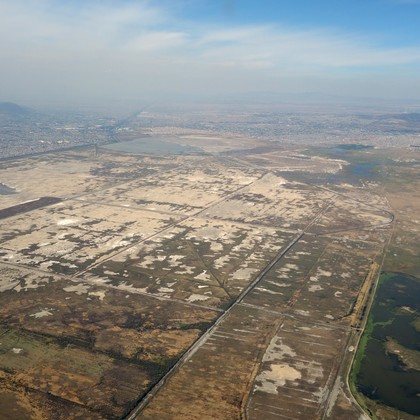
At sea over the continental shelf and along fronts and upwelling zones, also in bays and close inshore; on migration also on salt lakes, salt pans, lagoons and shrimp ponds inland and on the coast. It picks plankton and small invertebrates from the water surface, often spinning to draw prey upwards.
Where the bird is most at home, classified by the vegetation units of Mexico and Central America.


Range and movements
Passage migrant and winter visitor at sea along the whole Pacific coast, from Baja California and the Gulf of California to Panama, locally in large numbers. On migration also scattered over inland waters in northern Mexico. Rare on the Gulf of Mexico and Caribbean side. Outside the guide area the species breeds all around the North Pole, from Alaska and Canada to Greenland, Scandinavia and Siberia, and winters at sea, mainly off the west coast of South America, in the Arabian Sea and in Southeast Asia.
- Winter visitor (c. Oct–Mar)
- dark = core range, pale = thinly spread
How and when to look
Boat trips on the Gulf of California and along the Pacific coast often produce flocks during migration, sometimes among floating lines of foam and seaweed. Inland in northern Mexico single birds can be found on salt lakes and shrimp ponds in August and September, often together with Wilson's Phalaropes.
Conservation status
Not threatened. Numbers at important staging sites at sea have declined sharply in the past; the causes are not fully known. Oil pollution and changes in food supply at sea are possible threats.
Scientific name
Phalaropus lobatus | (Linnaeus, 1758)
Linnaeus described the species in 1758 as Tringa tobata; because it was later moved to another genus, the author and year stand in brackets. The genus Phalaropus was introduced in 1760 by Brisson. Phalaropus comes through French phalarope from Greek phalaris 'coot' and pous 'foot': like coots, phalaropes have lobed toes. lobatus is modern Latin for 'lobed', after the swimming lobes along the toes. The specimen the first description was based on came from Hudson Bay.