All species › Kingfishers, bee-eaters and rollers › Kingfishers › Ringed Kingfisher
Position in the tree Birds Aves › Birds with a flexible palate Neognathae › All other modern birds Neoaves › Landbirds Telluraves › Raptors, owls, kingfishers and woodpeckers Afroaves › Mousebirds, rollers and woodpeckers Coraciimorphae › Trogons and cavity nesters Cavitaves › Hornbills, kingfishers and woodpeckers Picocoraciae › Kingfishers, bee-eaters and woodpeckers Picodynastornithes
Ringed Kingfisher | Megaceryle torquata
Amerikaanse reuzenijsvogel | Martín pescador grande
The Ringed Kingfisher is the largest kingfisher of the guide area and a common resident of rivers, lakes and lagoons in the lowlands from Mexico to Panama. It hunts from a high perch over the water and is often first noticed by its loud, harsh call in flight.

Voice
A loud, harsh klek or kek, often in flight, and a rattling series that is lower, louder and slower than that of the Belted Kingfisher.
Recording: Jacob Wijpkema — CC BY-NC-SA 4.0 · converted to mono · xeno-canto
Identification
40–41 cm, large and heavily built, with a shaggy crest and a very long, heavy bill, dark with a paler base. The head, back and wings are blue-grey, with a broad white collar and a white throat. In the male the breast and belly are entirely rufous and the undertail coverts white. The female has a blue-grey breast band, below it a narrow white band and then a rufous belly. In flight the underwing coverts are white (male) or rufous (female).
Confusion species
Belted Kingfisher Megaceryle alcyon, a winter visitor, is smaller and always has a white belly: the male only a blue-grey breast band, the female a rufous band below it. Amazon Kingfisher Chloroceryle amazona is smaller and dark green above.
Habitat
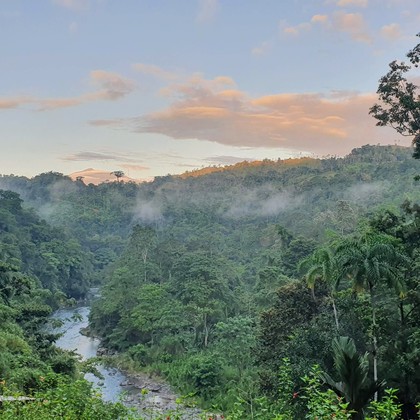
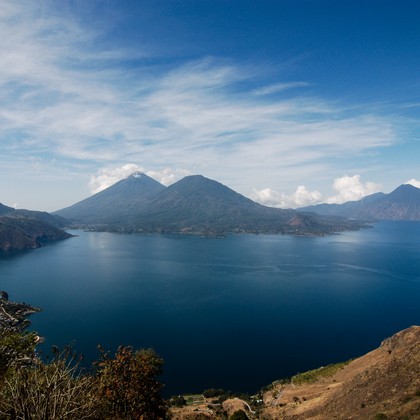
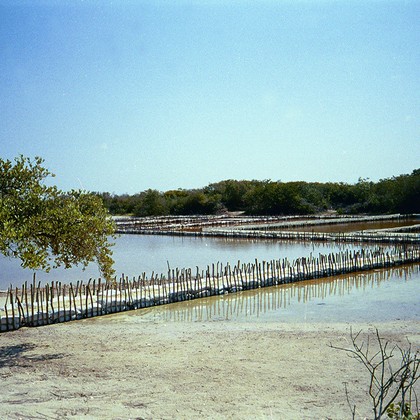
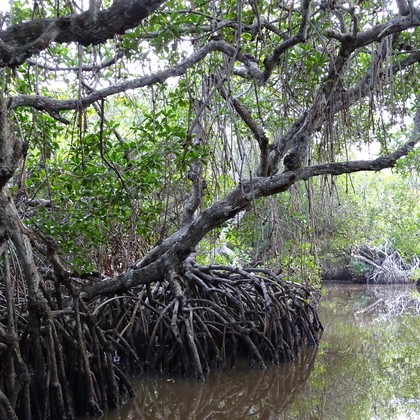
Larger rivers, lakes, reservoirs, lagoons, estuaries, mangroves and fish ponds, mainly in the lowlands and up to about 1500 m. It perches high over the water on dead branches, wires or posts and dives for fish, sometimes after a short hover; it often flies high and far over open water. It nests in a long tunnel in a steep earth bank, sometimes in small groups.
Where the bird is most at home, classified by the vegetation units of Mexico and Central America.


Range and movements
Lowlands on both slopes of the guide area: on the Gulf slope from Nuevo León and Tamaulipas, on the Pacific slope from Sinaloa, south through southern Mexico, the Yucatán Peninsula, Belize, Guatemala, El Salvador, Honduras, Nicaragua and Costa Rica to Panama. Outside the guide area in southern Texas, on a few islands of the Lesser Antilles and through almost all of South America to Tierra del Fuego.
- Resident
- dark = core range, pale = thinly spread
How and when to look
Along almost any large river and lagoon in the lowlands, for example on the Usumacinta River, on the Río Dulce in Guatemala, along the Tortuguero canal in Costa Rica and on Gatún Lake in Panama. A large kingfisher flying high over the water with a loud call is usually this species.
Conservation status
Not threatened. Common in the guide area and not particular about the type of water, as long as there are fish and steep banks to nest in.
Scientific name
Megaceryle torquata | (Linnaeus, 1766)
Linnaeus described the species in 1766 as Alcedo torquata; because it was later moved to another genus, the author and year stand in brackets. The genus Megaceryle was introduced in 1848 by Kaup. Megaceryle combines Greek megas 'great' with the genus name Ceryle, setting the large kingfishers apart from the smaller ones. torquata is Latin for 'collared', after the white collar. The specimen the first description was based on came from Martinique and Mexico.