All species › Passerines › New World sparrows › Savannah Sparrow
Position in the tree Birds Aves › Birds with a flexible palate Neognathae › All other modern birds Neoaves › Landbirds Telluraves › Falcons, parrots and passerines Australaves › Falcons and passerines Eufalconimorphae › Parrots and passerines Psittacopasserae
Savannah Sparrow | Passerculus sandwichensis
Savannahgors | Gorrión sabanero
The Savannah Sparrow is a small, streaked sparrow of open grassland, farmland and salt marsh, with a yellow spot above the eye. It is one of the most numerous winter visitors to open country in Mexico and northern Central America. Several resident forms also breed in the guide area, including large-billed birds of the salt marshes around the Gulf of California.

Voice
The song is a high, buzzy ditty: a few short ticks followed by two insect-like trills, like tsip tsip tsip tseeeee tsaaay; heard year-round from the resident birds. The call is a thin, high tseet.
Recording: Greg Irving — CC BY-NC-SA 4.0 · shortened to the first 60 s, mono · xeno-canto
Identification
11–15 cm. Small, with a short, notched tail and a fairly small, pointed bill. Head with a pale median crown-stripe, a supercilium that is yellow in front of the eye, a dark eye-stripe and a pale moustachial stripe with a dark malar stripe. Upperparts brown with dark streaks. Underparts white with narrow dark streaks on breast and flanks, often merging into a faint spot in the centre of the breast. Great variation between forms: birds of the salt marshes in the north-west are darker and more heavily streaked, while the forms around the Gulf of California are pale, show hardly any yellow and have a much heavier bill. The sexes are alike.
Confusion species
Vesper Sparrow Pooecetes gramineus is larger, has a white eye-ring and white outer tail feathers. Lincoln's Sparrow Melospiza lincolnii has a buff breast band with fine streaks, a grey supercilium and lives more in scrub. Song Sparrow Melospiza melodia is larger, with a longer, rounded tail, coarser streaks and no yellow. Grasshopper Sparrow Ammodramus savannarum has an unstreaked breast and a flat head with a large bill.
Habitat
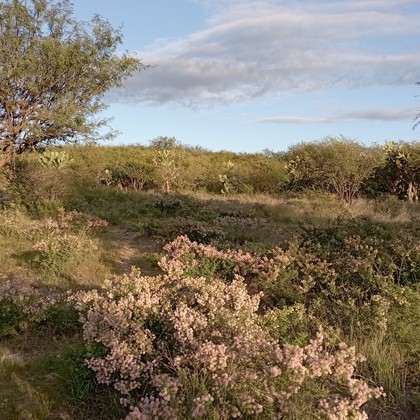
Open grassland, semi-desert grassland, fields, stubble, pasture and roadsides; in the north-west also salt marsh, on the central plateau wet grassland and mountain meadows. It lives in loose flocks, walks and runs through short grass and when disturbed flies up low, usually to a spot further on in the grass or to a fence.
Where the bird is most at home, classified by the vegetation units of Mexico and Central America.



Range and movements
Breeds across much of North America, from Alaska and Canada into northern Mexico. Winters from the United States south through all of Mexico to Guatemala, Belize and Honduras; scarce further south. Resident forms live in the salt marshes of Baja California and Sonora, along the coast of the Gulf of California, on the central plateau of Mexico and in the highlands of Guatemala.
- Resident
- Winter visitor (c. Oct–Mar)
- Passage (Mar–Apr, Oct–Nov)
- dark = core range, pale = thinly spread
How and when to look
In winter best found by walking along a grassy roadside or field edge; small sparrows that flush low and drop back into the grass are often Savannah Sparrows, and the yellow spot above the eye confirms the species.
Conservation status
Least Concern (LC). Very numerous, but in parts of North America it has declined through the loss of grassland. Some resident forms in the guide area have a small range and are vulnerable to the loss of salt marshes and wet grassland.
Scientific name
Passerculus sandwichensis | (Gmelin, 1789)
Gmelin described the species in 1789 as Emberiza sandwichensis; because it was later moved to another genus, the author and year stand in brackets. The genus Passerculus was introduced in 1838 by Bonaparte. Passerculus is Latin for 'little sparrow', a diminutive of passer 'sparrow'. sandwichensis refers to Sandwich Sound in Alaska (named after the Earl of Sandwich), where the first specimen was collected on Cook's third voyage; sources differ on exactly which place is meant. The specimen the first description was based on came from Unalaska, Alaska.