All species › Gamebirds › New World quail › Spot-bellied Bobwhite
Position in the tree Birds Aves › Birds with a flexible palate Neognathae › Fowl Galloanserae
Spot-bellied Bobwhite | Colinus leucopogon
Vlekbuikbobwhite | Colín gorjiblanco
The Spot-bellied Bobwhite is the bobwhite of the dry Pacific side of Central America, from south-eastern Guatemala to north-western Costa Rica. It is a small, compact quail with a short crest that walks in small groups through scrub, savanna and field edges. The species is sometimes treated as a subspecies group of Crested Bobwhite and does not occur outside the guide area.

Voice
Mainly in the breeding season the male gives a rising, somewhat hoarse whistled bob-wheet or bob-bob-wheet, often from a post or low bush. Groups keep in contact with soft calls and gather again after disturbance with a whistled koi-ee.
Recording: Oliver Komar — CC BY-SA 4.0 · converted to mono · xeno-canto
Identification
20–24 cm; round and short-tailed, with a short, pointed crest. The upperparts are brown, with small black spots on the nape and grey and black markings on the back and wings. The male has a white supercilium and a dark eye-stripe; depending on the subspecies the throat is white or brown. The underparts are pale to rufous-brown and densely covered with white spots, especially on the belly. Males vary strongly from north to south: birds in Guatemala and El Salvador have a white throat and head, those in Costa Rica a darker head and more fully spotted underparts. The female is duller, with a buff supercilium and a mottled throat.
Confusion species
Northern Bobwhite Colinus virginianus lives in the guide area mainly in Mexico and Guatemala and has scaled or streaked underparts without round white spots. Yucatan Bobwhite Colinus nigrogularis of the pine savannas on the Caribbean side of Honduras and Nicaragua has a black throat and black-and-white scaled underparts in the male. Crested Bobwhite Colinus cristatus lives further south, in Panama.
Habitat
Open savanna with shrubs and scattered trees, dry scrub, open dry forest, fallow land, pasture and field edges, from sea level to about 1500 m. It lives in pairs or small groups on the ground and eats seeds, shoots and insects. When threatened the group runs off or flushes with whirring wings and drops back in after a short distance.
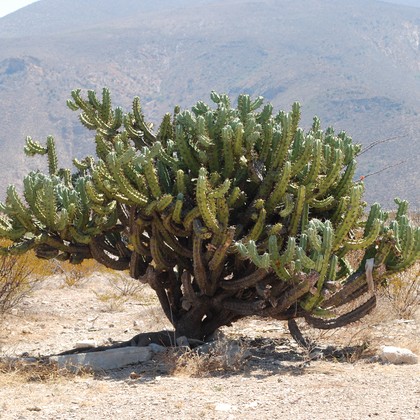
Where the bird is most at home, classified by the vegetation units of Mexico and Central America.



Range and movements
Pacific lowlands and dry interior valleys of south-eastern Guatemala, El Salvador, most of Honduras, Nicaragua and north-western Costa Rica, mainly Guanacaste. The species does not occur outside the guide area.
- Resident
- dark = core range, pale = thinly spread
How and when to look
In Guanacaste, for example at Palo Verde and Santa Rosa, and in the dry interior of Honduras and El Salvador, early in the morning when the males call. Groups often walk across dirt roads and trails.
Conservation status
Not threatened. Locally common in open farmland; the species partly benefits from deforestation but is under pressure from hunting.
Scientific name
Colinus leucopogon | (Lesson, 1842)
Lesson described the species in 1842 as Ortyx leucopogon; because it was later moved to another genus, the author and year stand in brackets. The genus Colinus was introduced in 1820 by Goldfuss. Colinus derives from the Nahuatl word zōlin, 'quail'. leucopogon is Greek, from leukos 'white' and pōgōn 'beard', after the white throat. The specimen the first description was based on came from La Unión, El Salvador.