All species › Gamebirds › New World quail › Yucatan Bobwhite
Position in the tree Birds Aves › Birds with a flexible palate Neognathae › Fowl Galloanserae
Yucatan Bobwhite | Colinus nigrogularis
Zwartkeelboomkwartel | Codorniz yucateca
The Yucatan Bobwhite is the bobwhite of the Yucatán Peninsula and of the pine savannas of Belize, Guatemala, Honduras and Nicaragua. The male stands out by its black throat framed in white and its boldly scaled underparts. The species does not occur outside the guide area.

Voice
The male gives a clear whistled bob-WHITE, very like that of Northern Bobwhite, mainly in the breeding season. Covey members keep in contact with soft calls.
Recording: Ross Gallardy — CC BY-NC-SA 4.0 · converted to mono · xeno-canto
Identification
19–22 cm; a small, round quail with a short tail and a short crest. The male has a black throat with a white border, a white forehead and supercilium, a black eyestripe and a black crown. The upperparts are rufous-brown with white speckles; the breast and belly are white with black feather edges, giving a striking scaled pattern, and the undertail coverts are cinnamon. The female has a buff throat and supercilium, a black-and-pale speckled hindneck and mantle, and a white breast and belly barred rufous and black. Four subspecies are recognised.
Confusion species
Northern Bobwhite Colinus virginianus lives further west and north and does not overlap; its black-throated forms lack the white border to the throat and have less boldly scaled underparts. Spot-bellied Bobwhite Colinus leucopogon in Honduras has a white or brown throat and white spots on a brown belly. Singing Quail Dactylortyx thoracicus lives in forest and has a plain cinnamon or grey throat without scaling.
Habitat
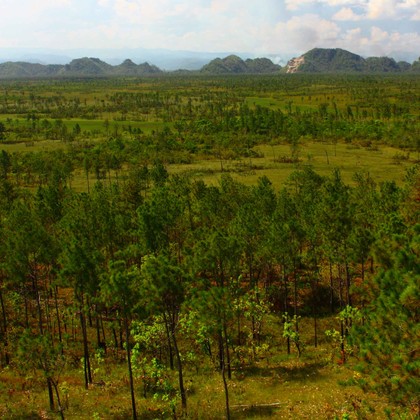
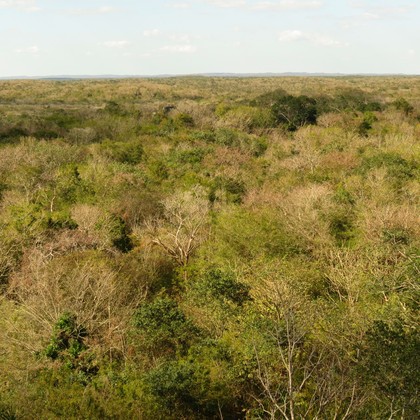
Forest clearings, pine savanna, rough grassland, weedy fields and margins, plantations and scrub in dry and semi-dry lowlands, locally also along coastal mangroves. It lives in coveys on the ground outside the breeding season. It eats seeds, shoots and insects.
Where the bird is most at home, classified by the vegetation units of Mexico and Central America.


Range and movements
On the Yucatán Peninsula (Yucatán, Campeche, Quintana Roo), in Belize, in northern Guatemala (Petén), and after a gap in the pine savannas of the Mosquitia in eastern Honduras and north-eastern Nicaragua. The species does not occur outside the guide area.
- Resident
- dark = core range, pale = thinly spread
How and when to look
On the Yucatán Peninsula coveys can be seen early in the morning along dirt roads through scrub and fields, for example around the archaeological sites of northern Yucatán. In Belize the species is locally common in the pine savannas of the interior.
Conservation status
Not threatened. The population is stable and the species locally benefits from open, human-influenced landscapes.
Scientific name
Colinus nigrogularis | (Gould, 1843)
Gould described the species in 1843 as Ortyx nigrogularis; because it was later moved to another genus, the author and year stand in brackets. The genus Colinus was introduced in 1820 by Goldfuss. Colinus derives from the Nahuatl word zōlin, 'quail'. nigrogularis is Latin, from niger 'black' and gula 'throat', after the male's black throat. The specimen the first description was based on came from Yucatán, Mexico.