All species › Waders, gulls and terns › Skimmers, noddies, terns and gulls › Swallow-tailed Gull
Position in the tree Birds Aves › Birds with a flexible palate Neognathae › All other modern birds Neoaves › Birds of the elements Elementaves › Cranes and waders Gruimorphae
Swallow-tailed Gull | Creagrus furcatus
Zwaluwstaartmeeuw | Gaviota tijereta
The Swallow-tailed Gull breeds almost exclusively on the Galápagos Islands and is a vagrant in the guide area, not a native species. It is the only gull in the world that hunts mainly at night at sea, for squid and small fish. Most records here come from the sea off the Pacific coast of the south of the guide area.
Voice
Usually silent away from colonies. At the breeding site a rasping, rattling scream and a clicking sound, which probably helps with orientation in the dark.
Recording: Eric DeFonso — CC BY-NC-SA 3.0 · converted to mono · xeno-canto
Identification
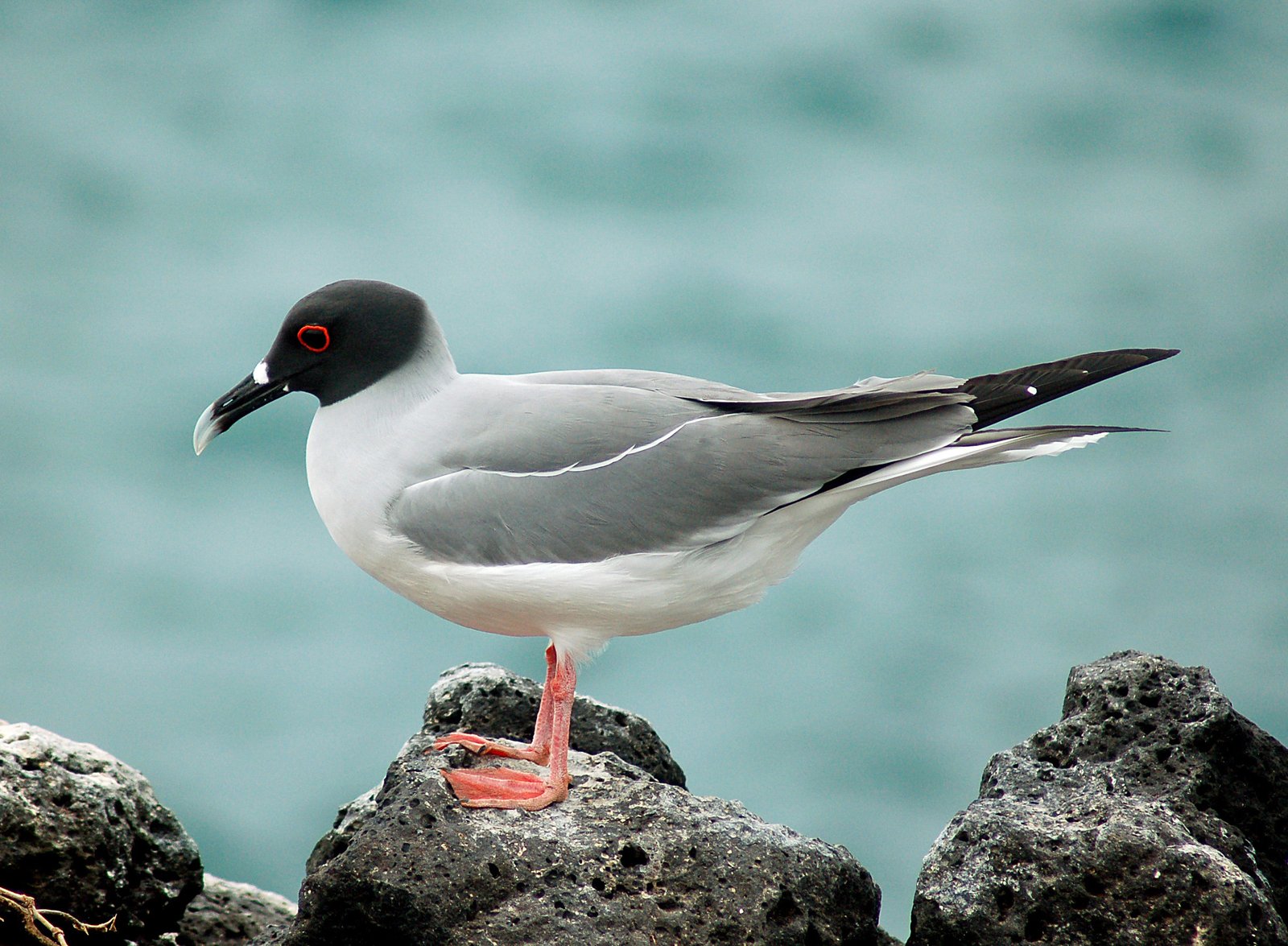
55–60 cm, a slender gull with long, pointed wings and a deeply forked white tail. Breeding adults have a dark slate-grey hood, a conspicuous red eye-ring around a large dark eye, a black bill with a pale tip and a white spot at the bill base; the legs are pink. Outside the breeding season the head is white with a dark patch around the eye. The upperwing is three-coloured: grey mantle and coverts, black outer primaries and a large white triangle on the rear of the wing. Juveniles are brown-scaled above and have a black terminal tail band.
Confusion species
Sabine's Gull Xema sabini has the same three-coloured wing pattern but is much smaller, with a small black bill with a yellow tip, no red eye-ring and a less deeply forked tail. Laughing Gull Leucophaeus atricilla and Franklin's Gull Leucophaeus pipixcan have a black hood, no white wing triangle and a square tail.
Habitat
Open ocean, often far offshore, and rocky islands. It hunts at night in flight and while swimming for prey that then rises to the surface, and rests by day at sea or on cliffs.
Where the bird is most at home, classified by the vegetation units of Mexico and Central America.



Range and movements
A small number of records in the guide area, most at sea off the Pacific coast of Costa Rica, including around Cocos Island, and in the Gulf of Panama, with single records off Guatemala and Mexico. Outside the guide area the species breeds on the Galápagos Islands and on Malpelo Island off Colombia, and outside the breeding season wanders to the cold seas off Ecuador and Peru.
How and when to look
Pelagic trips in the south of the guide area, and visits to Cocos Island, offer the best chance. The large red eye-ring and the deeply forked tail are the best features, even at a distance.
Conservation status
Not threatened globally. The world population is small and breeds almost entirely on protected islands. In the guide area a vagrant with no regular presence.
Scientific name
Creagrus furcatus | (Néboux, A-S, 1842)
Néboux, A-S described the species in 1842 as Larus furcatus; because it was later moved to another genus, the author and year stand in brackets. The genus Creagrus was introduced in 1854 by Bonaparte. Creagrus is Greek, from kreagra 'flesh-hook, fork', probably after the deeply forked tail. furcatus is Latin for 'forked', after the forked tail. The specimen the first description was based on came from the Galápagos Islands (originally given in error as Monterey Bay, California).